
How a Compact Industrial Heat Exchanger Saves Valuable Floor Space
When a process line is being fitted into an existing room, floor space is rarely just a real-estate question. It affects pipe routing, access to valves, electrical clearances, lifting paths, and the ability to maintain production while service work happens. A compact industrial heat exchanger can help reduce the equipment envelope, but the value comes from matching the exchanger to the full installation rather than simply choosing the smallest cabinet.
From an industrial procurement perspective, the unit should be compared on fit, duty, pressure drop, service access, and system connections. That approach is more useful than treating physical size as a standalone specification. A small footprint is valuable only if technicians can reach the connections, the piping remains practical, and the unit can meet the required thermal duty.
Why compactness changes a plant layout
A conventional exchanger arrangement can occupy more than its bare dimensions suggest. It needs pipe bends, valves, strainers, instruments, insulation clearance, and space for inspection or removal. A compact industrial heat exchanger may reduce the core hardware footprint by concentrating heat-transfer area into a smaller volume. In engineering literature, compact exchangers are commonly associated with high heat-transfer-area density; one technical source uses a general threshold above 700 m²/m³. The figure is a definition cue, not a sizing rule for every project.
In a crowded process area, this density can free room for equipment that cannot be made smaller: a pump skid, control panel, access aisle, or safety separation. It can also shorten some pipe runs. Still, a compact exchanger does not automatically make every installation compact. A poorly placed unit can require awkward piping or leave insufficient clearance for opening covers, disconnecting sensors, or replacing a gasketed assembly.
How a smaller exchanger supports better use of space
It reduces the core thermal footprint
Plate, plate-fin, microchannel, and other high-area-density formats can put substantial transfer surface within a relatively small envelope. For an industrial heat exchanger application, that can make it easier to fit a cooling or heating loop near the equipment it serves. The practical gain may be a cleaner layout rather than a dramatic reduction in room size.
It can simplify skid integration
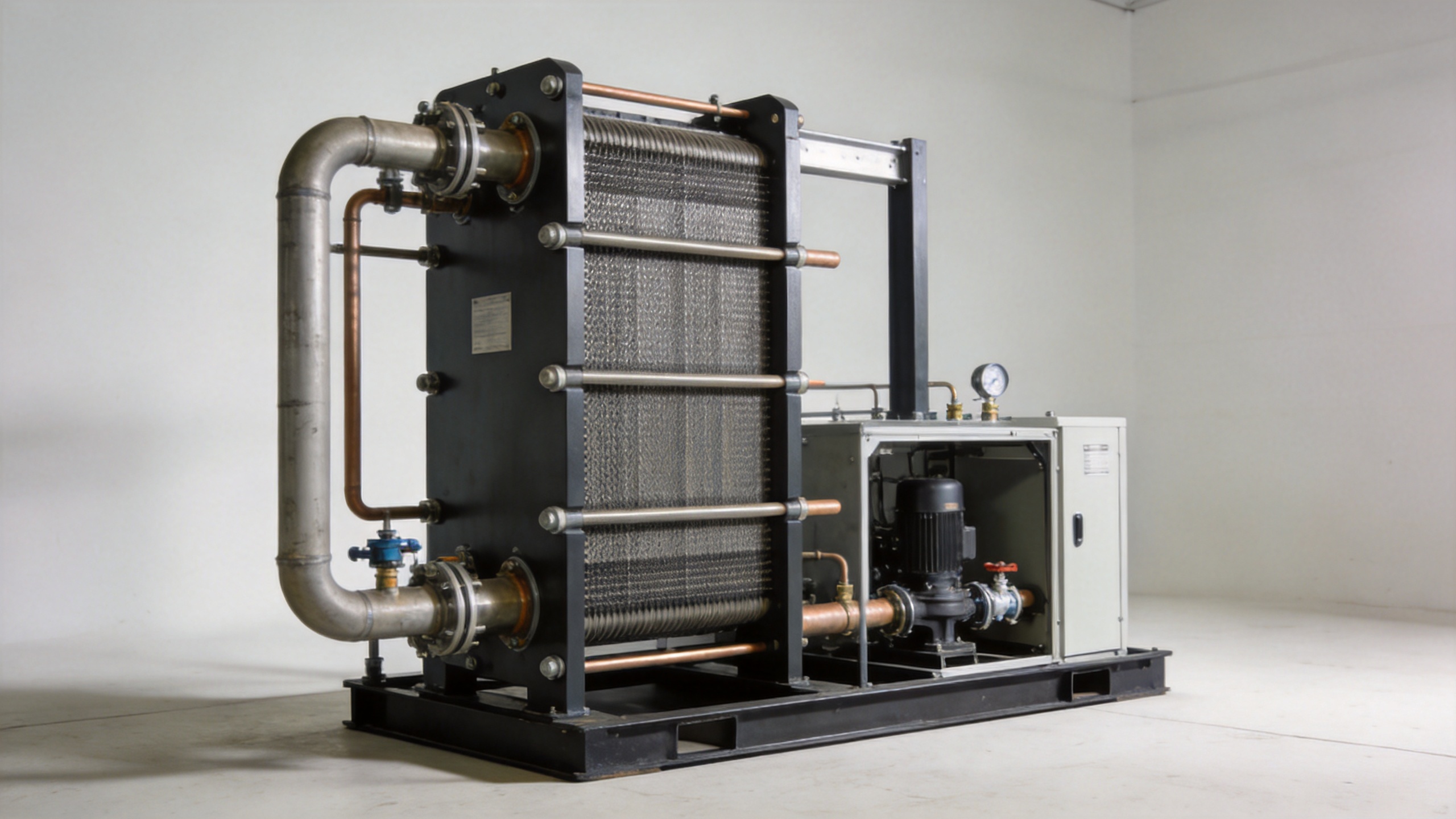
A compact exchanger can be incorporated with pumps, sensors, control valves, and filtration on one skid when the project calls for it. Consolidation may reduce scattered equipment and make connection planning clearer. Before choosing this approach, confirm the available service side, lifting route, drain point, electrical entry, and the locations of supply and return connections.
It may make retrofits less disruptive
Existing facilities often present fixed columns, narrow doorways, legacy pipe elevations, and incomplete drawings. In that setting, a compact arrangement can offer more routing options than a larger shell-and-tube arrangement. That is not a blanket conclusion: weights, connection orientation, isolation needs, and cleaning method must still be checked against the site.
Space saved is not the only selection criterion
The first question should be what heat load has to move at normal, minimum, and peak conditions. Then define fluid type, inlet and outlet temperatures, allowable pressure drop, flow range, contamination risk, and control behavior. An exchanger that fits the floor plan but imposes excessive pump demand or cannot tolerate the process fluid will create a different constraint elsewhere in the system.
Fouling is a useful example. Deposits add thermal resistance and can increase hydraulic resistance over time. For a dense exchanger with narrow passages or high area density, filtration, water quality, fluid cleanliness, and a realistic cleaning method deserve attention early. The appropriate choice depends on the actual medium and operating history; this article does not assume a particular construction is suitable for every fluid.
A practical footprint-and-access checklist
Use the following questions to compare each candidate with the full installation:
- What thermal duty and temperature approach are required across the operating range?
- Which fluid properties, solids, corrosion concerns, and cleanliness limits affect material and passage selection?
- What pressure drop can the circulation pump and control arrangement accommodate?
- How much clearance is required for inspection, cleaning, plate-pack access, or removal?
- Where will isolation valves, strainers, vents, drains, instruments, and insulation sit?
- Can the exchanger pass through doors and reach its final position without blocking future service?
- How will its piping, controls, and alarms interact with the wider thermal-management loop?
With these answers, the floor-space claim becomes measurable in layout drawings. It is often better to reserve a slightly larger service zone around the exchanger than to create an arrangement that is difficult to inspect after commissioning.
Where an industrial heat exchanger layout can gain the most
Compact thermal equipment can be relevant in semiconductor support systems, new-energy test environments, laboratory-scale processes, chemical and pharmaceutical utilities, and other installations where thermal control must coexist with limited floor area. The details vary by duty. Dynamic loads, target temperature range, fluid selection, control response, and connection standards should be verified for the individual application.
For example, a cooling loop next to process equipment may benefit from a compact exchanger if its piping run, service clearance, and pump requirements are considered together. In a plant with dirty utility water or frequent cleaning needs, a more accessible configuration may be preferable even if the bare footprint is larger. The right comparison is therefore not compact versus conventional in the abstract; it is the total installed arrangement and its maintenance plan.
Turn a small footprint into a workable installation
This equipment class saves valuable floor space when its high-area-density design is translated into a serviceable, well-routed system. Ask suppliers to review the heat duty, fluid data, pressure-drop allowance, mounting orientation, connection layout, and maintenance procedure against the available drawing. If the project involves precision temperature control, the exchanger should also be evaluated alongside the pump, controls, piping, and process connections rather than in isolation.
That preparation keeps the decision grounded: a compact exchanger can create useful layout flexibility, while the final value depends on confirmed operating conditions and an installation plan that leaves room to operate and maintain the system.
 Hot News