
How an EV Battery Test Chiller Keeps Cells Within Range
In a battery lab, temperature is not background scenery. It is part of the test condition. An ev battery test chiller gives engineers a controlled liquid loop so that heat released during charge, discharge, pulse, or ageing work does not quietly change the condition being measured. The aim is not to make every cell behave the same way; it is to hold the planned boundary conditions steady enough that a difference in the data can be investigated.
That distinction matters when a programme compares cells, fixtures, charge rates, or states of charge. A chamber setpoint alone may not describe the temperature at the cell surface or inside a representative thermal path. Heat generation changes with current, resistance, state of charge, and elapsed time. A well-integrated ev battery test chiller removes or supplies heat through a fixture, plate, cold plate, or secondary circuit while the test system records what the cells actually experience.
Why temperature control changes the meaning of a battery test
Cell temperature affects electrochemical behaviour, resistance, and ageing response. If a high-rate segment raises cell temperature while the lab report only records room temperature, the result can be difficult to compare with another run. An ev battery test chiller helps establish a repeatable thermal boundary, but it does not replace sensor placement or a defined test method.
This is particularly important during demanding duty cycles. Heat load is rarely flat: it can rise during a pulse, relax during a rest period, and shift as the cell ages. If thermal control reacts too slowly, the test may meet an average temperature target while missing a short-lived excursion at the fixture or cell. The useful question is therefore not simply “what cooling capacity is installed?” It is “what temperature, at which measurement point, under which load profile, must the loop hold?”
Regulatory and development work make this practical. UNECE Regulation No. 100 includes thermal shock and cycling requirements for rechargeable energy storage systems, with defined hot and cold exposures and transition requirements. The applicable revision and programme must be confirmed; the broader lesson is clear: reproducible temperature transitions need deliberate control, logging, and verification.
What an EV battery test chiller controls
An ev battery test chiller usually controls the temperature of a circulating heat-transfer fluid rather than the cell directly. The loop commonly includes a reservoir or internal circuit, pump, heat exchanger, sensors, control logic, hoses, and a test fixture. The fixture and connection determine how effectively that controlled fluid temperature becomes a controlled cell condition.
- Supply temperature: the fluid condition entering the fixture.
- Return temperature: a useful indicator of heat picked up or released by the test article.
- Flow and pressure: variables that influence heat transfer and fixture consistency.
- Ramp response: how the loop follows a planned change without excessive overshoot or delay.
- Measurement locations: fluid, fixture, surface, and any validated cell-temperature proxy should be distinguished in the data record.
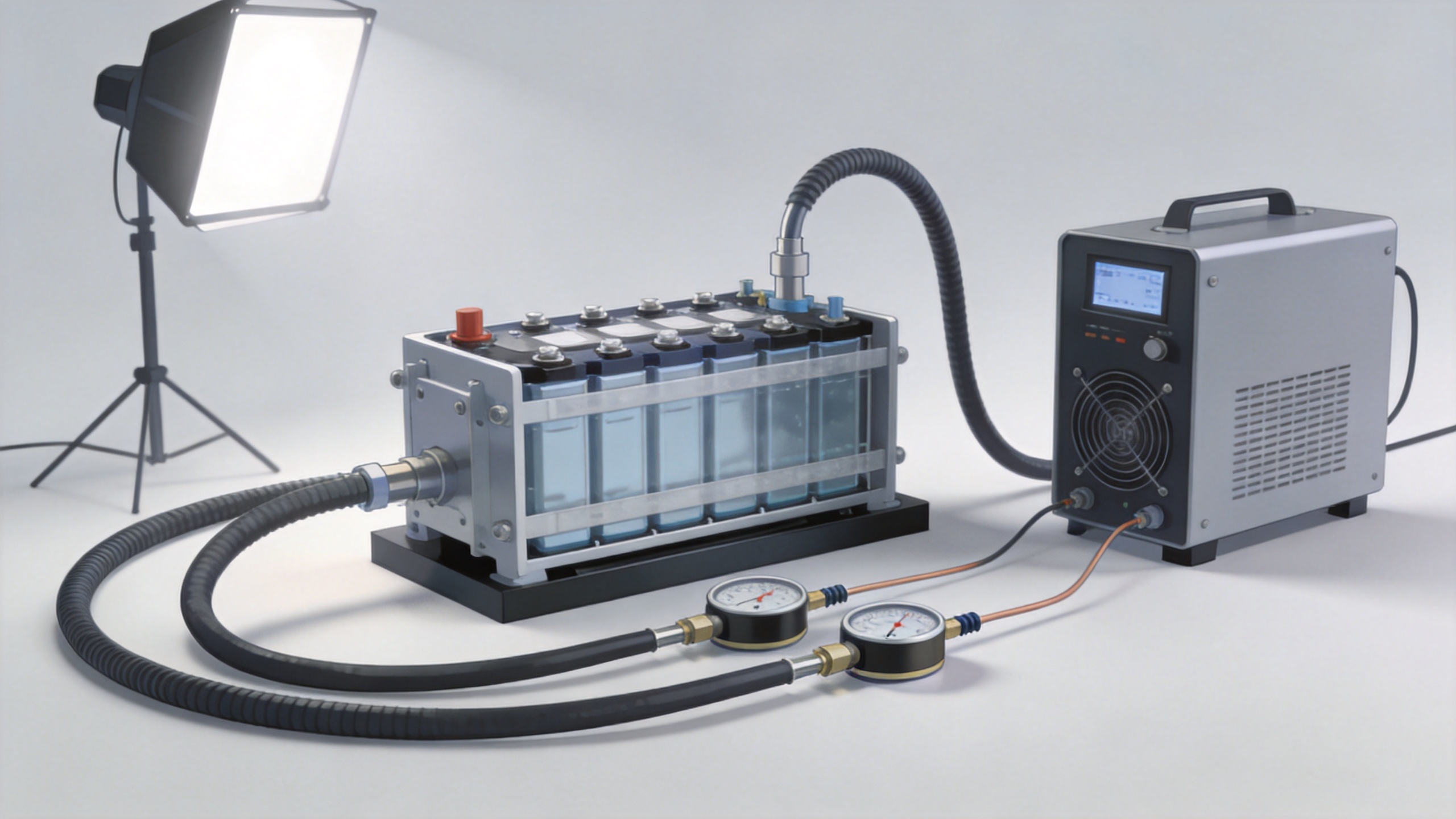
These elements work together. An ev battery test chiller with a tight fluid setpoint can still produce a weak test condition if flow is unstable, a hose run adds unwanted heat gain, or the fixture makes poor contact. Conversely, a capable fixture cannot compensate for a loop that has not been sized for the changing thermal load.
Start with the test profile, not a nominal rating
For an ev battery test chiller, the first sizing input is the actual programme. Map the temperature range, starting condition, expected heat generation, cycle duration, rest intervals, fluid type, target flow, and allowable deviation. If heat load changes sharply, the transient response can matter more than a single steady-state figure.
A practical review also separates cooling from heating. Cold-soak recovery, ambient losses, and temperature-ramp work may call for controlled heat input as well as heat removal. Treating a bidirectional thermal requirement as cooling only can create long stabilisation periods or inconsistent starts. This is why an industrial chiller should be evaluated as part of the complete loop: fixtures, plumbing, insulation, sensors, and the control strategy all shape the result.
Fluid selection belongs in the same conversation. Its usable temperature range, viscosity, materials compatibility, cleanliness requirements, and maintenance plan affect pump performance and heat transfer. The correct choice depends on the test fixture and laboratory procedure; it should not be inferred from a generic equipment description.
Control logic: stable does not mean static
An ev battery test chiller typically uses feedback from its own fluid sensor, while the test programme may use additional sensors near the cell or fixture. Those signals serve different purposes. The chiller regulates the loop; the test team verifies whether the test article remains inside the planned condition.
During commissioning, compare supply, return, fixture, and surface-temperature traces through representative duty cycles. Look for lag, overshoot, oscillation, uneven fixture temperatures, and temperature drift after a current change. A short precondition sequence can be useful before data collection begins, but its duration should be supported by recorded stabilisation behaviour rather than an assumed waiting time.
Clear alarm limits also help. They should distinguish a fluid-loop deviation from a test-article deviation, because the response may be different. For example, a return-temperature rise could indicate a changing heat load, while a local surface-temperature rise may point to contact, flow-distribution, or sensor-location issues. An ev battery test chiller supports diagnosis when its data is interpreted alongside electrical and fixture data.
Common setup errors that weaken repeatability
Many thermal-control problems appear outside the chiller itself. Long uninsulated hose runs can absorb room heat. Trapped air can disturb flow. A fixture can apply uneven contact pressure. Sensor attachment can change from sample to sample. If the programme starts before the cell and fixture have settled, early-cycle data can reflect the setup transition rather than the intended electrical condition.
For that reason, document the full thermal chain: fluid setpoint, flow target, sensor types, sensor locations, fixture layout, insulation, preconditioning rule, and accepted deviation. An ev battery test chiller is most useful when it is treated as a controlled subsystem with a traceable connection to the test article.
A commissioning checklist for the test loop
- Define the required cell or fixture temperature range and the allowable deviation for the specific procedure.
- Estimate transient and steady heat load across the planned charge and discharge profile.
- Confirm the fluid, flow range, hose routing, fittings, and material compatibility.
- Place and label sensors so fluid temperature is not confused with fixture or cell temperature.
- Run a representative cycle, review temperature traces, and record the stabilisation rule.
- Recheck performance after fixture, cell format, current profile, or ambient conditions change.
The checklist does not substitute for a laboratory safety review or the applicable test standard. It does create a disciplined basis for deciding whether the ev battery test chiller is holding the condition the programme intends to study.
Keeping the range is a system task
An ev battery test chiller contributes a controlled thermal boundary; the fixture, sensors, fluid circuit, programme, and data review turn that boundary into credible test conditions. When these pieces are specified together, engineers can separate genuine cell behaviour from avoidable temperature variation. Before selecting an industrial chiller or configuring a loop, collect the target temperature range, load profile, fluid constraints, connections, and measurement plan. Those project details lead to a more relevant thermal-control discussion than a nominal capacity value alone.
 Hot News