
What an Industrial Water Chiller Unit Should Include for Reliability
Reliability is not a catalog adjective. For a process engineer or maintenance team, the equipment has to hold a defined thermal condition while real loads, ambient conditions, water quality, and operator routines change. That is why a process chiller should be evaluated as a system: refrigeration circuit, water circuit, controls, safety devices, service access, and the interfaces around it.
From a thermal-management application engineer’s perspective, start with the operating condition rather than a headline capacity. Confirm the target supply temperature, allowable temperature variation, heat-load profile, fluid, pipe layout, ambient conditions, electrical supply, and required operating hours. A unit that looks suitable at one nominal point may need different safeguards when load swings, water quality, or control integration are part of the project.
Start with the reliability boundary, not a feature list
The first job of this equipment is to remove heat from a circulating liquid repeatably. Before comparing components, define what “reliable” means for the process. Does an out-of-range temperature require an alarm, a controlled process hold, or immediate equipment shutdown? Is the load steady, cyclic, or intermittent? Will the unit serve a single tool or a distribution loop? These answers determine which inclusions matter most.
A useful specification separates design conditions from upset conditions. Ask how the chiller is expected to react to a pump stop, loss of flow, high return temperature, dirty heat-transfer surfaces, or a power interruption. This does not mean every application needs the same redundancy. It means the response to a foreseeable fault should be visible, documented, and appropriate for the process risk.
Core refrigeration components should be matched and protected
An industrial water chiller unit normally brings together a compressor, evaporator, condenser, expansion device, refrigerant piping, and sensors. Reliability begins with correct selection for the temperature range and load profile, then depends on protective logic that keeps those components within workable conditions. Check that the manufacturer can explain the intended operating envelope rather than offering capacity alone.
Useful protection and visibility provisions include high- and low-pressure monitoring, temperature sensing at relevant fluid points, refrigerant-side safeguards, and clear fault indication. The details vary with the design, so a buyer should ask what each alarm detects, what action it triggers, and whether the event can be reviewed later. For an industrial water chiller unit, an alarm that cannot be interpreted or investigated is far less helpful than one linked to a defined troubleshooting path.
The water circuit needs flow, cleanliness, and serviceability
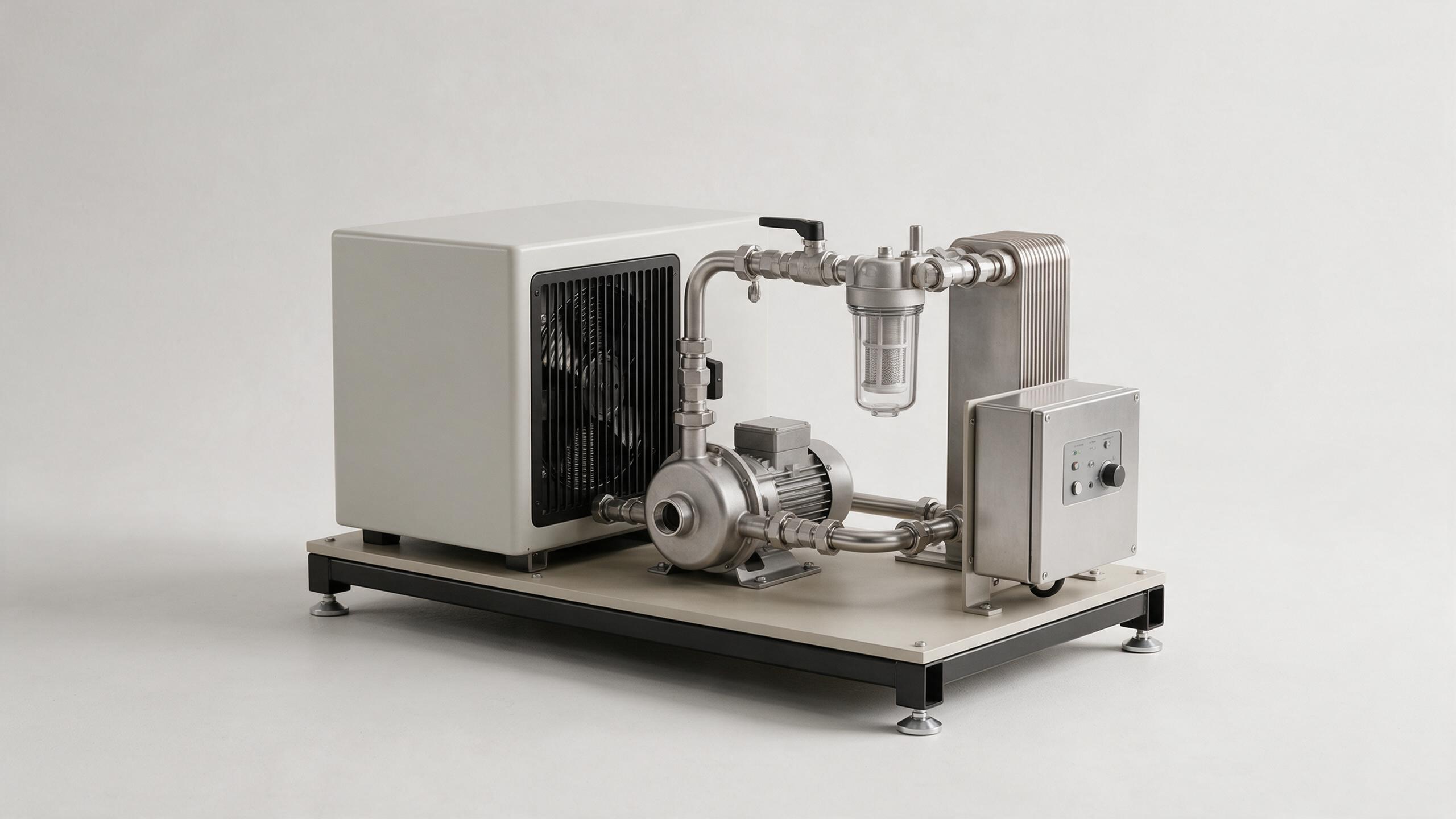
Many reliability problems originate outside the compressor. The process-water side of an industrial water chiller unit should include a pump arrangement suitable for the required flow and pressure, practical isolation points, and a way to observe circulation. Depending on the application, this may mean flow indication, flow proving, a pressure gauge, or a differential-pressure point. The objective is not to prescribe a single layout; it is to make loss of circulation detectable before it becomes a process problem.
Water quality also belongs in the reliability plan. Scale, corrosion products, debris, and biological growth can reduce heat transfer or obstruct passages. Maintenance guidance commonly includes condenser inspection, cleaning, and water-treatment checks, but the appropriate program depends on the loop and local water conditions. Specify filtration or strainers where the system calls for them, and make them reachable for inspection. An industrial water chiller unit with difficult-to-access service points can turn a simple routine task into a deferred task.
For water-cooled arrangements, condenser-water conditions deserve the same attention as chilled-water conditions. High condenser approach can be a diagnostic signal associated with fouling or flow-related conditions. Trendable inlet and outlet temperatures, along with relevant flow information, help a maintenance team investigate a change instead of relying on guesswork. More accurately, that conclusion applies only after the sensor locations and normal operating conditions are confirmed.
Controls should make abnormal conditions actionable
A controller is not merely a display. In a reliable cooling system, it should present useful operating values, preserve meaningful alarm information, and apply protective actions consistently. At a minimum, clarify the available temperature readings, setpoint access, alarm history, remote start/stop behavior, and communication requirements before purchase.
Integration deserves a separate review. A process machine, supervisory system, pump skid, or safety circuit may need an enable signal, run status, common alarm, or measured-value exchange. The industrial water chiller unit should be reviewed with the actual electrical and control interfaces, not assumed to be compatible because the equipment serves a similar industry. Pipework, electrical connections, and control interfaces are worth checking one by one during the design stage.
Ask a practical question: if only the target temperature is known but the heat load and flow range are not, what basis exists for setting alarms or judging stability? That question often exposes missing application data early enough to correct the specification.
Build maintenance into the equipment layout
Reliability improves when the industrial water chiller unit can be inspected and serviced without unnecessary disassembly. Review clearance around panels, access to filters or strainers, visibility of gauges, drain and vent points, connection labeling, and the availability of service documentation. A commissioning record should capture baseline temperatures, pressures where relevant, flow-related observations, setpoints, alarm configuration, and water-treatment responsibilities.
For an industrial water chiller, maintenance intervals should follow actual duty, water conditions, and the equipment documentation rather than a generic calendar alone. Routine work may include inspecting heat-transfer surfaces, checking water-side components, reviewing alarm history, confirming sensor plausibility, and looking for leaks or vibration. The aim is to identify drift before it interrupts production; it is not a promise that one checklist fits every site.
Specify monitoring and contingency at the process level
A process chiller can be dependable only within the support system around it. Where process consequences justify it, consider how operators will receive alarms, who can respond, what spare parts or service support are planned, and whether the process needs a backup cooling path. These are project decisions, not universal equipment claims.
For critical applications, document the difference between a unit fault, a utility fault, and a process-side fault. This makes escalation faster because the operator can separate “no flow,” “temperature rising,” and “controller communication lost” rather than treating every deviation as the same event. An industrial water chiller unit with clear status signals and accessible records supports this disciplined response.
A reliability review checklist before approval
- Has the industrial water chiller unit been sized against the real heat load, temperature range, fluid, and duty cycle?
- Are flow confirmation, water-quality responsibilities, filtration, and service access addressed for the installed loop?
- Do the controls provide the alarms, protective actions, records, and external interfaces the process needs?
- Are condenser conditions, ventilation or water-side conditions, and ambient limits defined for the actual installation?
- Is there a commissioning baseline and a clear plan for inspection, response, and escalation?
The right industrial water chiller unit is therefore not identified by the longest option list. It is the one whose components, diagnostics, interfaces, and maintenance provisions are matched to verified operating conditions. Belonging to the same industry does not replace confirmation of a specific project’s conditions. Use the checklist to turn a broad reliability request into engineering questions that can be answered before the equipment is installed.
 Hot News