
What an Ultra Low Temperature Chiller Enables for Extreme Tests
Extreme-temperature testing is not simply a matter of making a chamber colder. A test article, its fixture, the circulating fluid, the sensors, and the control loop all exchange heat at different rates. From a thermal-management engineering perspective, an ultra low temperature chiller is useful when a test needs a controlled fluid circuit below the range a conventional industrial chiller is intended to support. The practical question is not whether low temperature sounds impressive; it is whether the required temperature, heat load, and transient behavior can be verified together.
An ultra low temperature chiller can provide a repeatable thermal boundary for component development, material evaluation, and process research. That boundary helps teams separate a temperature-driven response from changes caused by electrical loading, mechanical stress, or the fixture itself. Before comparing equipment, however, define the test duty cycle. A setpoint alone is rarely enough.
Why extreme tests need more than a cold setpoint
In an extreme test, the device under test may release heat during a pulse, absorb heat during a transition, or remain nearly idle during a soak. An ultra low temperature chiller supports the test only when it can manage those changes through the full sequence, not merely reach the initial temperature. The most useful record therefore tracks supply and return temperature, flow, pressure, ambient conditions, and the timing of the load.
That distinction matters for validity. If a temperature sensor is stable at the chiller outlet while the fixture temperature is drifting, the test may be reporting an uncontrolled condition. An ultra low temperature chiller belongs in a measurement chain that also considers sensor placement, insulation, line length, and how the control system responds after a load step.
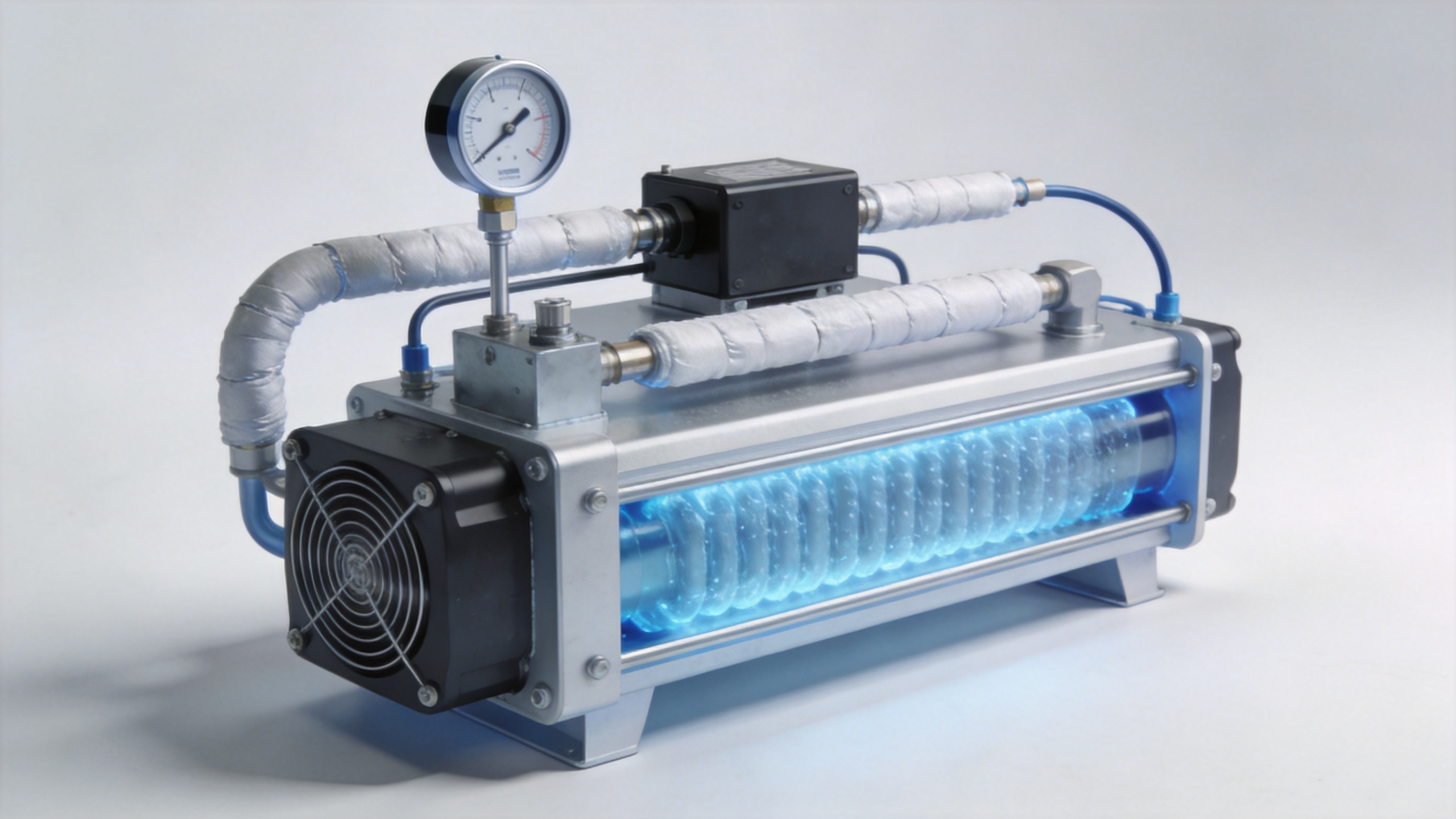
What an ultra low temperature chiller can enable
Controlled cold-soak and conditioning work
An ultra low temperature chiller can circulate a compatible heat-transfer fluid through a plate, jacket, or fixture so a sample reaches a defined thermal starting condition. This is useful when a test protocol calls for a cold soak before electrical, mechanical, or functional checks. The value is the ability to document the conditioning path, not to assume every sample reaches the same internal temperature at the same moment.
Temperature cycling with observable transitions
When a program includes ramps and holds, an ultra low temperature chiller can make the thermal portion of the cycle more observable. Teams can compare commanded values with measured supply, return, and fixture values, then identify where lag occurs. That evidence can reveal whether the limiting factor is cooling capacity, fluid flow, piping losses, contact resistance, or the test article.
Separation of thermal and functional effects
A controlled loop also helps investigators change one condition at a time. With an ultra low temperature chiller, a team may hold a thermal boundary while varying electrical load or mechanical demand. It does not remove every source of variation, but it gives the test plan a clearer basis for deciding which changes require further verification.
Five conditions to confirm before specifying a system
- Target range and tolerance. State the required fluid supply range, allowable deviation at the fixture, soak duration, and the temperature points that must be recorded. An ultra low temperature chiller should be assessed against the actual measurement location, not an isolated catalog value.
- Heat-load profile. Identify steady load, peak load, the length of each peak, and whether heat is removed during ramping. An ultra low temperature chiller sized only for an average load may respond differently during a short but demanding event.
- Fluid behavior and materials. A circulating medium must remain suitable throughout the planned range and must be compatible with seals, hoses, plates, and the test article. The SERP review shows that glycol, brine, and thermal oil are common discussion points; their suitability still needs project-specific confirmation.
- Flow path and interfaces. Review hose length, elevation change, pressure drop, quick connections, insulation, and control signals. An ultra low temperature chiller is part of a system, so a restrictive fixture or poorly insulated line can change the observed result.
- Control and data capture. Confirm how the unit receives a setpoint, reports alarms, and synchronizes with the test stand. An ultra low temperature chiller can support a stronger test record when its operating data can be correlated with the test timeline.
How this differs from a general industrial chiller
An industrial chiller may be appropriate for many process-cooling tasks, especially where the required range, fluid, and load are less demanding. An ultra low temperature chiller is considered when the temperature window moves into a colder regime or when the test requires closer attention to fluid properties, heat leak, and transient control. The decision should remain conditional: a lower setpoint does not automatically make a system appropriate for a particular fixture or test protocol.
For example, a search-result preview references cooling to −45 °C in a very-low-temperature application. That illustrates the range some projects may investigate; it is not a performance claim for every ultra low temperature chiller. The specification still needs the real duty cycle and installation conditions.
Turn capability into a verification plan
Before a test starts, build a short acceptance sheet for the ultra low temperature chiller: target range, fluid, flow range, supply/return sensor locations, load profile, stability window, alarms, and data-file timing. Run an unloaded circulation check, then a representative load sequence. Compare the fixture readings with the chiller readings and document any offset or delay. This approach is more useful than treating a single display value as proof of test conditions.
Lingheng Thermal Control Technology (Suzhou) Co., Ltd. works in precision temperature control and thermal-management discussions spanning semiconductor, new-energy, chemical, and aerospace-related applications. For an ultra low temperature chiller project, the most productive starting point is a structured review of the temperature range, heat load, medium, interfaces, and evidence needed for the intended test.
Conclusion
An ultra low temperature chiller can enable cold conditioning, controlled cycling, and clearer interpretation of extreme-test results when it is matched to the full thermal circuit. Start with the test protocol, verify the fluid and load conditions, and measure at the points that matter. That sequence gives an ultra low temperature chiller a defined role in producing a more defensible test record.
 Hot News