
Why a Pipe Heating System Maintains Stable Specialty Gas Temperatures
Specialty-gas lines are often discussed as if the gas temperature were set at the source and simply carried downstream. In practice, the line itself is part of the thermal process. A pipe heating system helps replace heat lost through tubing, valves, fittings, and instrument branches so that the temperature arriving at a point of use is closer to the temperature intended by the process team. That distinction matters most when a gas has temperature-sensitive vapor behavior, when ambient conditions vary, or when long runs create several opportunities for a local cold spot.
From a thermal-management application-engineering perspective, the first question is not whether every specialty-gas line needs heat. It is whether the actual temperature profile can drift far enough to affect delivery conditions. A well-scoped pipe heating system is therefore a control measure, not merely an insulation accessory. It works with insulation, sensors, controller logic, mechanical installation, and the process specification to manage a defined operating window.
Temperature stability begins with controlling heat loss
Every unheated section exchanges heat with its surroundings. If the process line is warmer than the room, it loses heat through its wall and any exposed metal components. The loss is rarely uniform: support points, valve bodies, regulators, flanges, and small-diameter branches can behave differently from straight pipe. A pipe heating system distributes heat along the route so that those losses are compensated instead of allowed to accumulate downstream.
That does not mean the heater should force every surface to the same temperature. The objective is a stable, verified process condition. In a typical design discussion, engineers define a target range, estimate the heat loss for normal and low-ambient cases, then divide the line into zones that can be measured and controlled. The pipe heating system supplies the energy; insulation reduces the energy required; temperature sensors show whether the combined arrangement is actually holding the intended range.
Why specialty gases can be sensitive to local cold spots
Some specialty gases are supplied or handled under conditions in which temperature affects vapor pressure, phase balance, or the practical behavior of the delivery system. The consequence may not be obvious at the cylinder or gas cabinet. A line can appear acceptable near the source while a cooler valve, pressure-control point, or remote branch becomes the limiting location. For that reason, a pipe heating system should be evaluated along the whole path rather than only at the first heated component.
Where temperature loss could encourage condensation or an undesirable phase change, maintaining a suitable wall and gas temperature can support more consistent downstream conditions. The exact threshold depends on the gas, pressure, flow pattern, materials, and validated process requirements. It would be unsafe to assign one universal setpoint. Instead, the design team should use supplier data, site procedures, and the applicable safety review to establish the permitted temperature window for that service.
Even heat delivery matters as much as heater power
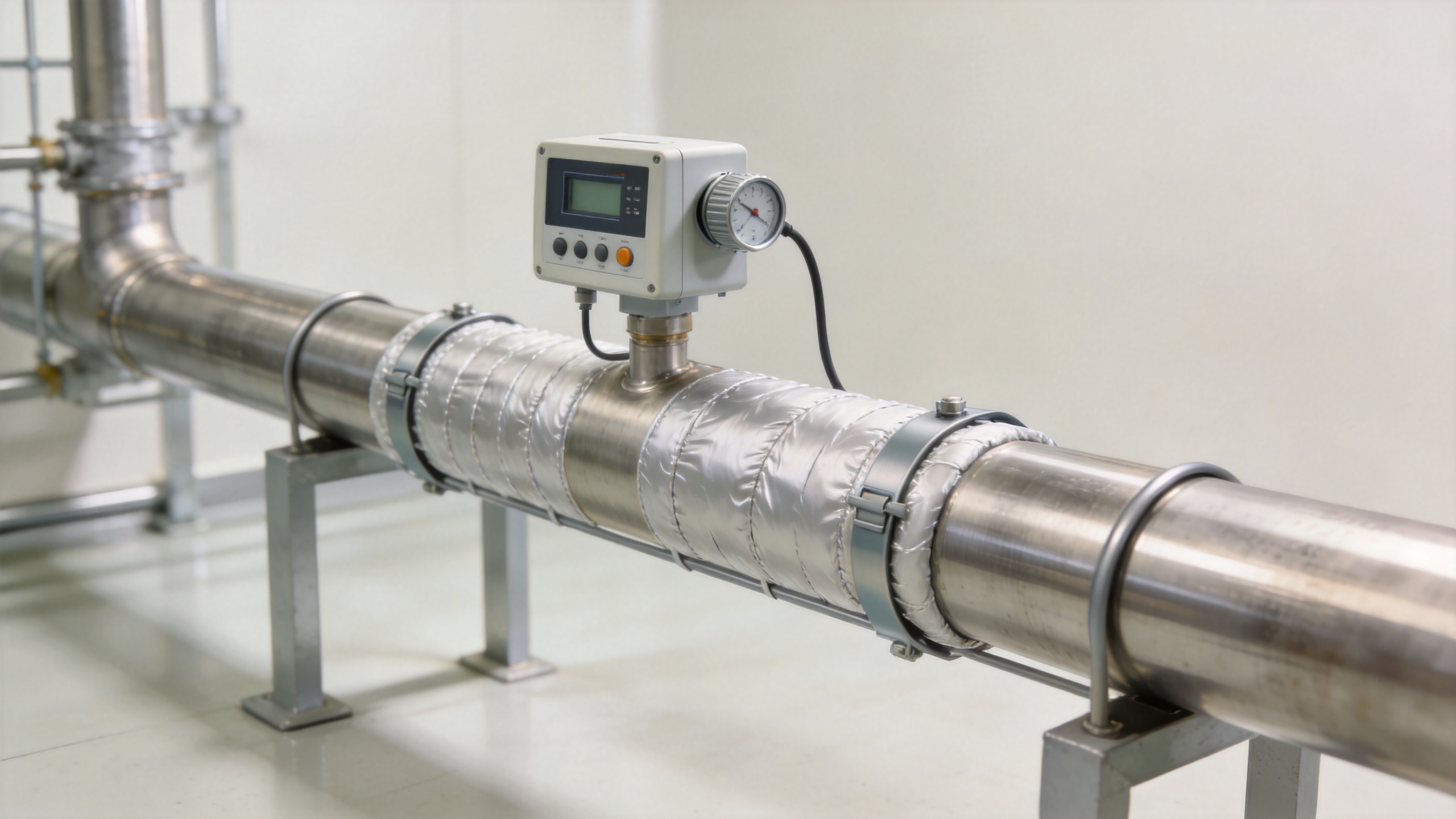
A high wattage rating alone does not guarantee a stable result. A pipe heating system must transfer heat where it is needed and avoid large temperature differences between adjacent sections. Cable spacing, circuit layout, contact with the pipe, insulation continuity, and treatment of fittings all influence the outcome. A poorly installed heater can create a hot section beside an inadequately covered cold section, which makes a single sensor reading misleading.
This is where an industrial heating jacket or a pipe heating jacket may be useful for irregular geometry, removable equipment, or sections that need service access. A flexible jacket can be designed around a valve or a shaped assembly, while fixed tracing may suit long, regular pipe runs. The selection is not a matter of one format being universally better. It depends on the temperature range, access needs, cleanability, mechanical protection, electrical classification, and the ability to inspect the installation.
Control loops turn added heat into repeatable operation
The stability benefit of a pipe heating system comes from closed-loop control, not from continuous maximum output. A sensor placed at a representative thermal location provides feedback to a controller, which adjusts heat input to keep the zone within its defined band. For critical lines, multiple zones or independent sensors may be more informative than one controller for an entire route. This is especially useful where a long run passes through areas with different ambient temperatures or airflow.
Sensor placement deserves careful review. A probe mounted near the heater may report a reassuring temperature while an exposed fitting farther away remains cooler. Conversely, a sensor at a cold-prone feature may provide a more conservative view of the line. The proper location should be based on the thermal risk being managed. Commissioning should compare sensor readings, surface checks, and process observations under representative operating conditions before the pipe heating system is treated as verified.
Insulation and heating must be designed as one assembly
Heating without suitable insulation can waste energy and make the controller work harder. Insulation without appropriate heat input cannot replace a pipe heating system when the process requires maintained temperature. Together, they reduce the effect of ambient swings and improve temperature uniformity. Joints, removable covers, and transitions should receive the same attention as straight pipe because gaps in insulation can become heat-loss paths.
An industrial heating jacket should also be assessed as part of that assembly. Its fit, closure system, coverage of fittings, and clearance from sensors can influence both heat transfer and maintenance. A removable heating jacket can simplify access, but it still needs an installation method that maintains repeatable contact and preserves the safety features specified for the area.
A practical specification and verification checklist
Before selecting or modifying a pipe heating system, collect the information that determines whether the design is meaningful:
- Gas identity, delivery pressure, expected flow range, and the approved operating-temperature window.
- Pipe material, diameter, route length, valve and regulator locations, and any instrument takeoffs.
- Ambient temperature range, airflow, outdoor exposure, and cold-prone sections.
- Required electrical-area classification, controller features, alarms, over-temperature protection, and maintenance access.
- Insulation construction, sensor locations, zoning plan, and acceptance checks for the finished installation.
This checklist moves the conversation from a generic request for heat to a defensible thermal-control plan. It also avoids a common mistake: sizing a pipe heating system from line length alone. Thermal load, insulation, fittings, ambient exposure, control accuracy, and process consequences all affect the design basis.
Stable delivery is a system outcome
A pipe heating system maintains stable specialty-gas temperatures by compensating for heat loss, reducing cold spots, and supporting controlled temperature zones along the delivery path. Its value comes from coordinated design: suitable heat input, continuous insulation, representative sensing, sound controls, and verification against the actual gas-service requirements. When those elements are reviewed together, a pipe heating system can help the gas line behave more consistently without relying on unverified assumptions about a single heater or setpoint.
For a new installation or a retrofit, begin with the temperature window and the locations most likely to lose heat. Then confirm the gas supplier guidance, process constraints, area requirements, and commissioning plan before finalizing the pipe heating system. That sequence provides a clearer basis for stable operation than choosing a heater solely by appearance or nominal power.
 Hot News