
Why a Removable Pipe Heating Jacket Eases Retrofit Projects
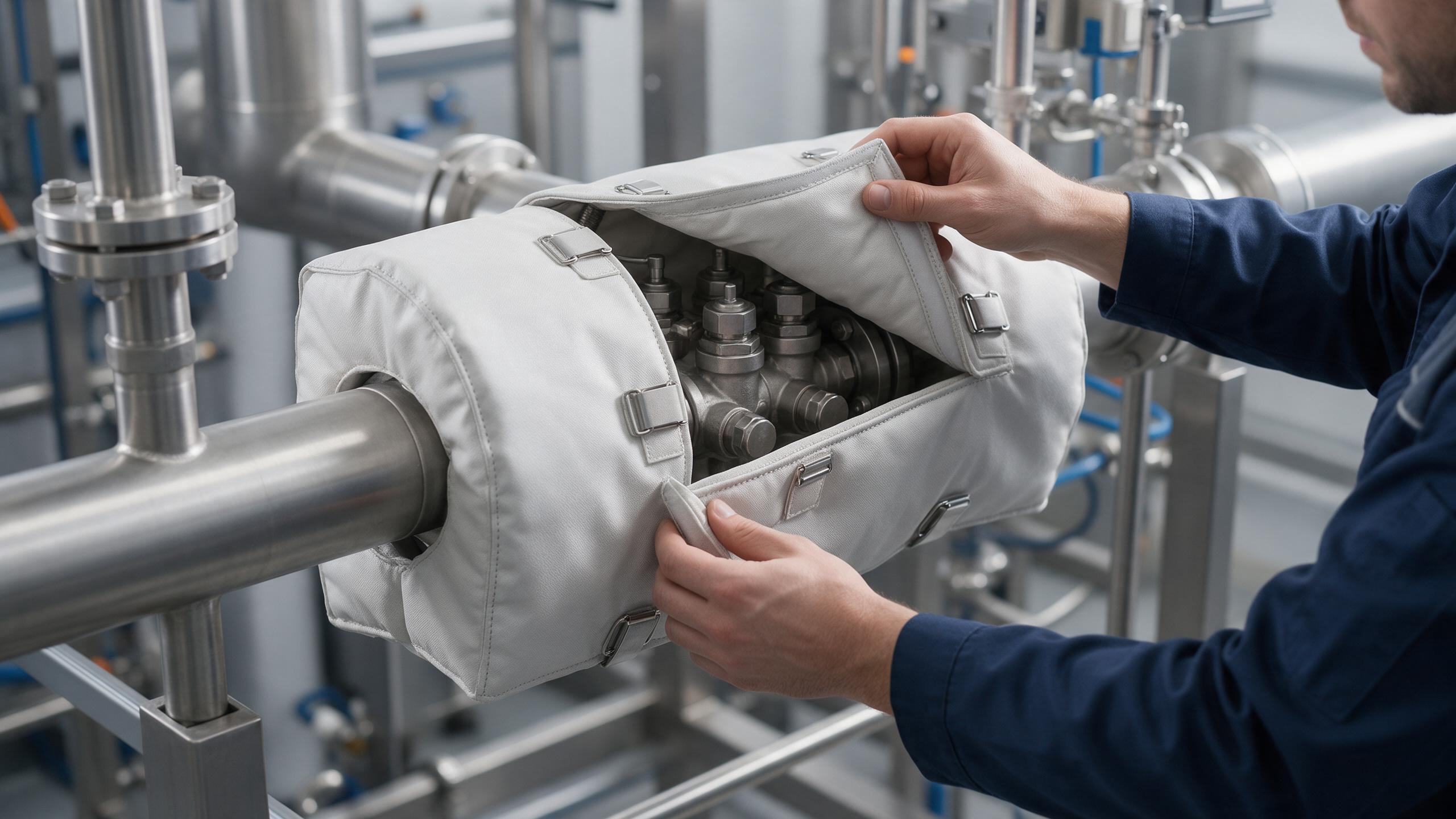
Retrofit work rarely starts with a clean pipe rack and unlimited access. More often, a technician faces live services, legacy supports, closely spaced valves, and a shutdown window that is shorter than the list of tasks. In that setting, a removable pipe heating jacket can be a practical design choice because it separates thermal coverage from permanent cladding. The cover can be opened for a planned inspection, moved aside for a repair, and fitted back around the same component after the work is checked.
From a field-maintenance perspective, the useful question is not whether a jacket is universally suitable. It is whether its construction, fastening layout, temperature duty, and access pattern fit the actual line. A removable pipe heating jacket should therefore be considered alongside the pipe material, fluid, heat-loss risk, controls, available clearance, and maintenance routine.
Why retrofits make access a thermal-design issue
Fixed insulation or a permanently installed heat-tracing assembly may make sense on a stable, accessible run. A retrofit is different. Existing flanges, transmitters, drain points, heat exchangers, and support shoes can turn a simple straight run into a collection of access constraints. Removing and rebuilding conventional insulation after each intervention adds coordination work and creates opportunities for incomplete reinstatement.
A removable pipe heating jacket changes the workflow rather than changing the process requirement. A custom opening pattern can be discussed around valves, instruments, and irregular geometry so that routine access does not automatically require removing the thermal layer. That does not remove the need for isolation, electrical verification, or site safety procedures. It simply makes the thermal assembly easier to inspect and reinstall when those procedures call for access.
A typical retrofit sequence
Consider a typical, anonymized plant situation: a short section of process piping has uneven temperatures near a valve group, while an existing support and nearby cable tray leave little room for a permanent rebuild. The project team may need to assess the line, adjust a component, and return the area to service without expanding the outage scope. A removable pipe heating jacket can support that sequence when its seams and closures are positioned for the actual service path.
- Document the condition. Record pipe outside diameter, straight lengths, elbows, valves, supports, clearance, process temperature range, ambient conditions, and the points technicians must reach.
- Define the thermal purpose. Clarify whether the goal is freeze protection, viscosity management, temperature hold, warm-up assistance, or another verified process need. These duties call for different engineering checks.
- Map the access route. Identify which closures can be opened without disturbing adjacent services, and where a cover can rest safely during maintenance.
- Review controls and power. Confirm the controller, sensors, electrical protection, cable routing, and isolation points before treating a removable pipe heating jacket as an independent accessory.
- Plan reinstallation. Add a visual check for closure engagement, sensor contact where applicable, and clearance from moving or hot adjacent equipment.
Where removability can reduce project friction
The value of removability is often operational rather than dramatic. If a valve body, strainer, or instrument needs periodic attention, a fitted cover can allow maintenance staff to expose that location without dismantling a large surrounding section. A removable pipe heating jacket may also help when the piping arrangement is likely to change during commissioning or staged capacity upgrades.
That advantage depends on disciplined fit-up. An oversized cover may be awkward to close and may leave uneven contact; a cover that ignores a support or actuator can be difficult to remove. Instead of asking for a generic jacket, the retrofit team should supply measured geometry, photos, operating conditions, and service-clearance information. This is especially important when the line includes fittings that cannot be isolated from nearby work.
Keep heating duty separate from chilled-water insulation duty
The auxiliary phrase industrial water chiller matters because a site can contain both heated process lines and cold-service loops. Their thermal concerns are not interchangeable. A removable pipe heating jacket may be evaluated for a line that requires controlled heat input, while chilled-water piping around an industrial water chiller needs insulation and vapor-control details suited to condensation risk.
Industry guidance for chilled-water piping commonly identifies the 33°F to 60°F (0.5°C to 15.6°C) range as condensation-sensitive service. In practical terms, the design team should not place a heating concept around cold-service piping merely because the installation is difficult to access. First confirm the fluid path, temperature range, dew-point conditions, insulation continuity, and the purpose of each layer. A removable pipe heating jacket should be applied only where the process and electrical design support heating.
Questions to settle before specifying the jacket
- What temperature range, fluid, and operating cycle does the pipe actually see?
- Is the task temperature maintenance, warm-up, freeze protection, or an investigation into a different problem?
- Which valves, gauges, drains, supports, and cable entries need routine access?
- What jacket material, closure system, sensor arrangement, and electrical protection suit the site conditions?
- How will the team verify the fit and reinstall the removable pipe heating jacket after service?
- Does the nearby industrial water chiller create a separate cold-service insulation or condensation-control requirement?
Use the retrofit as a chance to improve the maintenance record
A removable assembly is most helpful when the project leaves a clear record behind. Label the served line, retain the measurement sketch and closure orientation, note the controller setpoint and sensor location where relevant, and include jacket inspection in the maintenance procedure. Those small records can make later troubleshooting more orderly, particularly when multiple teams share the equipment area.
For Lingheng Thermal Control Technology (Suzhou) Co., Ltd., thermal-management discussions are approached through operating conditions rather than isolated specifications. When a retrofit involves a removable pipe heating jacket, the next conversation should cover temperature range, heat load, fluid, controls, pipe geometry, and access needs. That creates a clearer basis for deciding whether a removable thermal assembly fits the project and what must be verified on site.
Conclusion
A removable pipe heating jacket can ease retrofit projects by making planned access part of the thermal design. It is not a substitute for correct electrical design, insulation assessment, or a process review. It is a serviceability tool: when the line duty, geometry, closures, and maintenance plan are aligned, the cover can make inspection and reinstatement more manageable. Start with the site conditions, distinguish hot-service needs from industrial water chiller cold-service requirements, and confirm the installation details before finalizing the scope.
 Hot News