
Why an Industrial Heated Jacket Reduces Condensation Risk
In process equipment, condensation is rarely just a cosmetic issue. Moisture on a vessel, valve, pipe section, or instrument connection can make inspections harder, affect insulation condition, and introduce uncertainty where a stable thermal boundary matters. An industrial heated jacket is one way to manage that boundary. It adds controlled heat around an external surface so the surface can stay above the local condensation threshold when the operating conditions support that approach.
For engineers and maintenance teams, the useful question is not whether an industrial heated jacket is universally appropriate. It is whether the jacket, coverage pattern, controls, insulation, and installation details suit the actual temperature range, ambient humidity, process medium, and access requirements. This article explains the reasoning behind that assessment.
Condensation begins at the surface, not in the specification sheet
Air contains water vapor. When a surface becomes cool enough relative to the surrounding air, moisture can settle on that surface. In industrial service, this may occur when a process line carries a colder medium, when a batch changes temperature, or when equipment passes through a shutdown and restart cycle. The visible water is the result; the operating conditions are the cause.
An industrial heated jacket can reduce condensation risk by supplying heat at the outside of the equipment and helping the surface remain above the relevant dew-point condition. That statement needs a practical qualifier: the outcome depends on jacket contact, heat loss, geometry, setpoint behavior, insulation continuity, and ambient changes. A jacket cannot be assessed as a stand-alone layer divorced from the whole assembly.
How an industrial heated jacket changes the thermal balance
A properly considered industrial heated jacket works by adding heat where the equipment otherwise loses it to the surrounding air. On a pipe, it may support a more stable external surface temperature along a selected run. On a vessel or valve, it may address local cold zones that are exposed to air movement or interrupted insulation. The purpose is controlled thermal support, not an assumption that every point will behave identically.
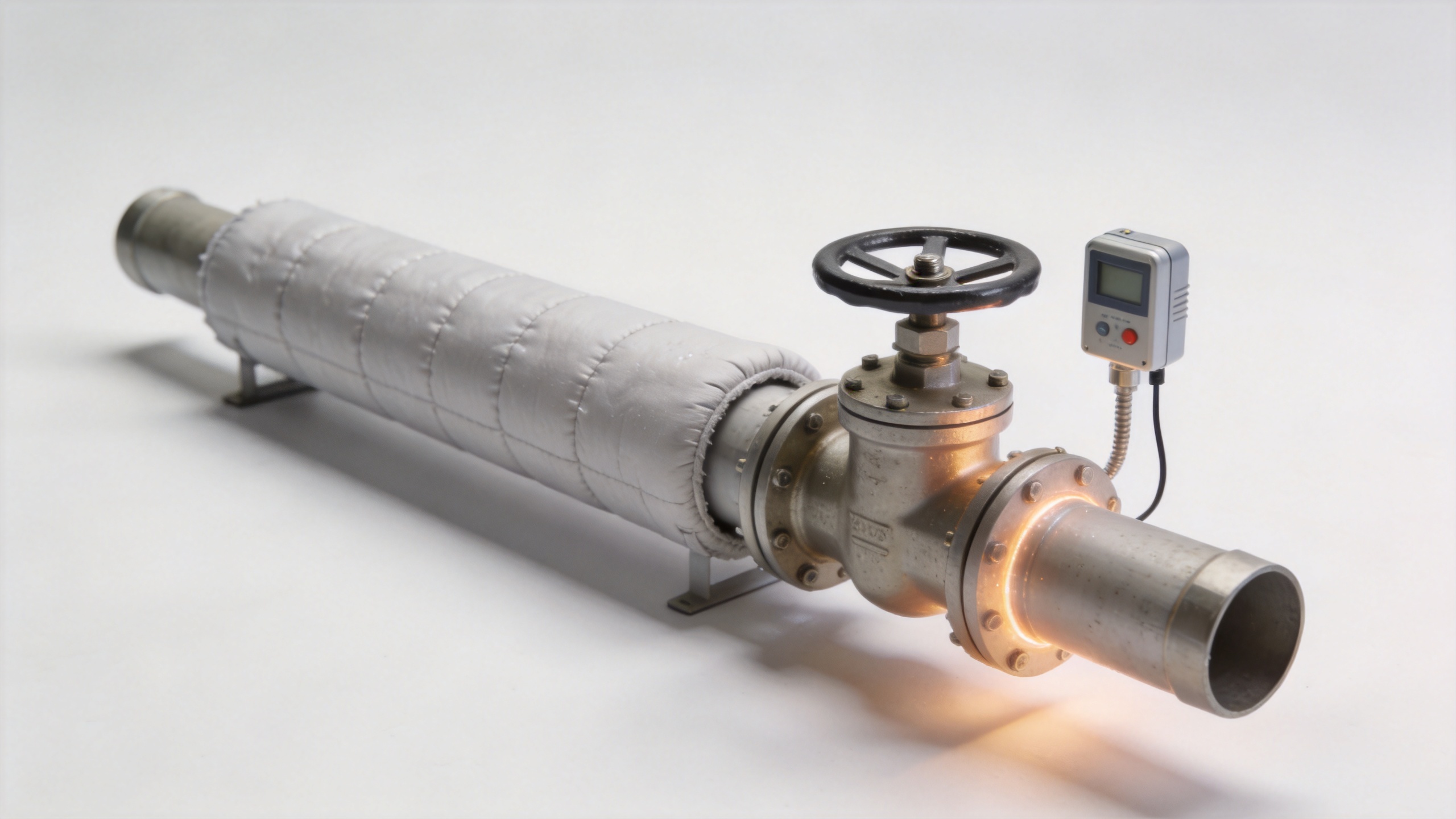
Heat must travel through layers. The jacket construction, the equipment wall, any insulating layer, seams, closures, brackets, and adjacent bare metal all influence that path. An industrial heating jacket that fits the main cylinder but leaves a flange, low point, or connection exposed can still leave a location where condensation is likely. This is why coverage drawings and site observations often matter as much as a nominal jacket rating.
Why coverage and fit matter as much as heat input
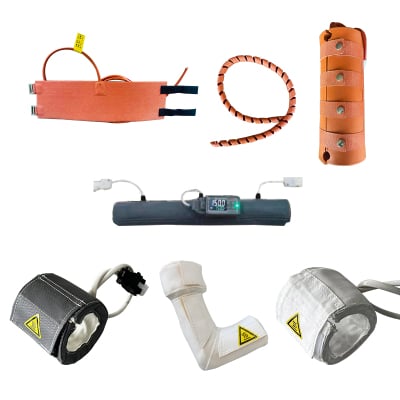
An industrial heated jacket should be evaluated against the actual geometry rather than an idealized shape. Straight pipe is different from a valve body. A vertical vessel may have supports, nozzles, sight glasses, or access doors that interrupt coverage. A removable design can aid inspection and maintenance, but its closures and reinstall procedure should also be checked for gaps that affect thermal continuity.
Think in terms of the coldest plausible external area. If a jacket warms one zone while a nearby uninsulated fitting remains cool, moisture may simply appear at that fitting instead. The same principle applies to seams, bends, supports, and areas exposed to drafts. For this reason, an industrial heated jacket review should include a physical walkdown or a reliable dimensional record, not only a line-item description.
Setpoint control should follow the process, not a generic number
Temperature control is central to condensation management. An industrial heated jacket needs a setpoint and a control method that match the process objective. Raising a surface temperature may reduce the chance of moisture forming, but the acceptable temperature range must also respect the medium, equipment materials, nearby components, and operating procedure.
Before a setpoint is selected, clarify what is known and what still needs verification. Known inputs may include process temperature, typical ambient conditions, available power, and accessible surface area. Items that commonly need verification include humidity swings, airflow, sensor placement, heat loss at discontinuities, and the temperature at the locations where moisture has been observed. An industrial heated jacket is more likely to be useful when those inputs are documented rather than assumed.
Insulation and an industrial heating jacket work as one system
An industrial heating jacket is often discussed alongside insulation because both influence surface temperature and heat loss. The jacket supplies heat; insulation can slow heat leaving the assembly. The exact arrangement depends on the equipment, access needs, safety requirements, and maintenance practice. It should be reviewed as a system instead of treating either layer as a universal substitute for the other.
Pay attention to transitions. A well-covered central section may perform differently from a connection where insulation stops, a support creates a conductive path, or an enclosure admits humid air. When condensation is intermittent, these transitions are useful places to inspect first. They can help the team distinguish a broad heat-input issue from a local coverage or installation issue.
What to verify before specifying an industrial heated jacket
A structured review makes an industrial heated jacket discussion more useful for engineering, procurement, and operations. Rather than asking only for a jacket size, collect the conditions that define the duty:
- Equipment dimensions, orientation, nozzles, supports, valves, and other features that affect coverage.
- Process temperature range, temperature changes over time, and the medium in contact with the equipment.
- Ambient temperature, humidity pattern, washdown exposure, and airflow near the equipment.
- Areas where moisture has been seen, including seams, fittings, low points, and insulation transitions.
- Power availability, control-system connection expectations, sensor locations, and alarm or interlock needs.
- Maintenance access, removal frequency, cleaning steps, and the procedure for reinstalling the jacket.
This list does not prescribe a design. It gives the project team a basis for determining whether an industrial heated jacket can address the observed condition and which boundaries must be confirmed before release.
Use validation to separate a moisture symptom from its cause
After installation, validation should focus on the locations and operating states that created the concern. Observe the equipment during representative changes in ambient conditions and process duty. Compare surface-temperature observations with the areas that previously showed moisture. If condensation remains, check coverage, closures, insulation transitions, sensor response, airflow, and whether the operating case differs from the case used for selection.
This approach keeps an industrial heated jacket in its proper role: a controllable part of a broader thermal-management plan. It can help reduce condensation risk when it is matched to the equipment and verified under relevant conditions. It is not a replacement for understanding the source of the cold surface or for reviewing site-specific safety and operating requirements.
Conclusion
An industrial heated jacket reduces condensation risk by supporting a surface temperature that is less likely to fall below the local condensation threshold. The practical result depends on more than heat input. Coverage, fit, insulation, control logic, ambient exposure, and maintenance practice all shape the outcome. For an industrial heating jacket project, start with the observed moisture location and the operating conditions around it, then use that evidence to define the thermal and installation checks that matter.
 Hot News