
What to Verify with an Industrial Heating Jacket Manufacturer
Choosing an industrial heating jacket manufacturer is not the same as sourcing a battery-heated garment. For a process line, the jacket is a flexible, electrically heated enclosure that must suit a specific vessel, pipe, pump, filter, valve, or other component. The useful question is not “Which supplier looks strongest?” It is “Which industrial heating jacket manufacturer can explain the design basis, document the electrical arrangement, and support verification for this exact duty?”
From an industrial procurement perspective, start with the operating conditions and then compare supplier responses against the same list of questions. That approach makes it easier to spot missing assumptions before a purchase order turns into an installation problem.
1. Confirm That the Supplier Understands the Application
Begin by defining the item being heated and the job the industrial heating jacket manufacturer is being asked to solve. A jacket for a small valve body does not face the same fitting, access, heat-loss, or control issues as one for a drum, pump housing, filter, or irregular vessel. Ask the supplier to restate the application in writing before discussing a proposed construction.
- What component is being covered, and what are its measured dimensions?
- Is the goal freeze protection, viscosity management, warm-up, hold temperature, or another process need?
- What temperature range is required at the component, and how tightly must it be controlled?
- What material, product, or process conditions affect the exterior surface?
- Will the jacket be installed indoors, outdoors, in a washdown area, or near splash, dust, or corrosive exposure?
A capable industrial heating jacket manufacturer should identify information that is still needed rather than treating a sketch and a target temperature as a complete specification. This is especially important when a custom industrial heating jacket must accommodate nozzles, handles, supports, insulation transitions, or removable access points.
2. Ask for the Thermal Design Basis, Not Just a Wattage
A quotation that lists power without explaining the assumptions leaves a major gap. Ask how the proposed heater output was selected and what it is expected to overcome. The answer should connect the design to the desired temperature, starting condition, ambient conditions, component geometry, insulation, heat loss, and warm-up expectation.
For an industrial heating jacket, the number of heating zones and their placement can matter as much as the total rated power. A supplier may need to explain how it avoids concentrating heat near sensitive fittings, how it handles an uneven shape, and where sensors are located. The goal is not to demand a universal formula; it is to make the supplier’s assumptions visible so engineering can judge whether they suit the duty.
Useful questions for the technical quotation
- Which dimensions, temperature conditions, and ambient assumptions were used?
- Is the proposed output based on maintaining temperature, warming up, or both?
- How are heating zones, insulation, and sensor locations arranged?
- What limitations apply if the actual installation differs from the supplied drawings?
3. Verify Fit, Materials, and Service Access
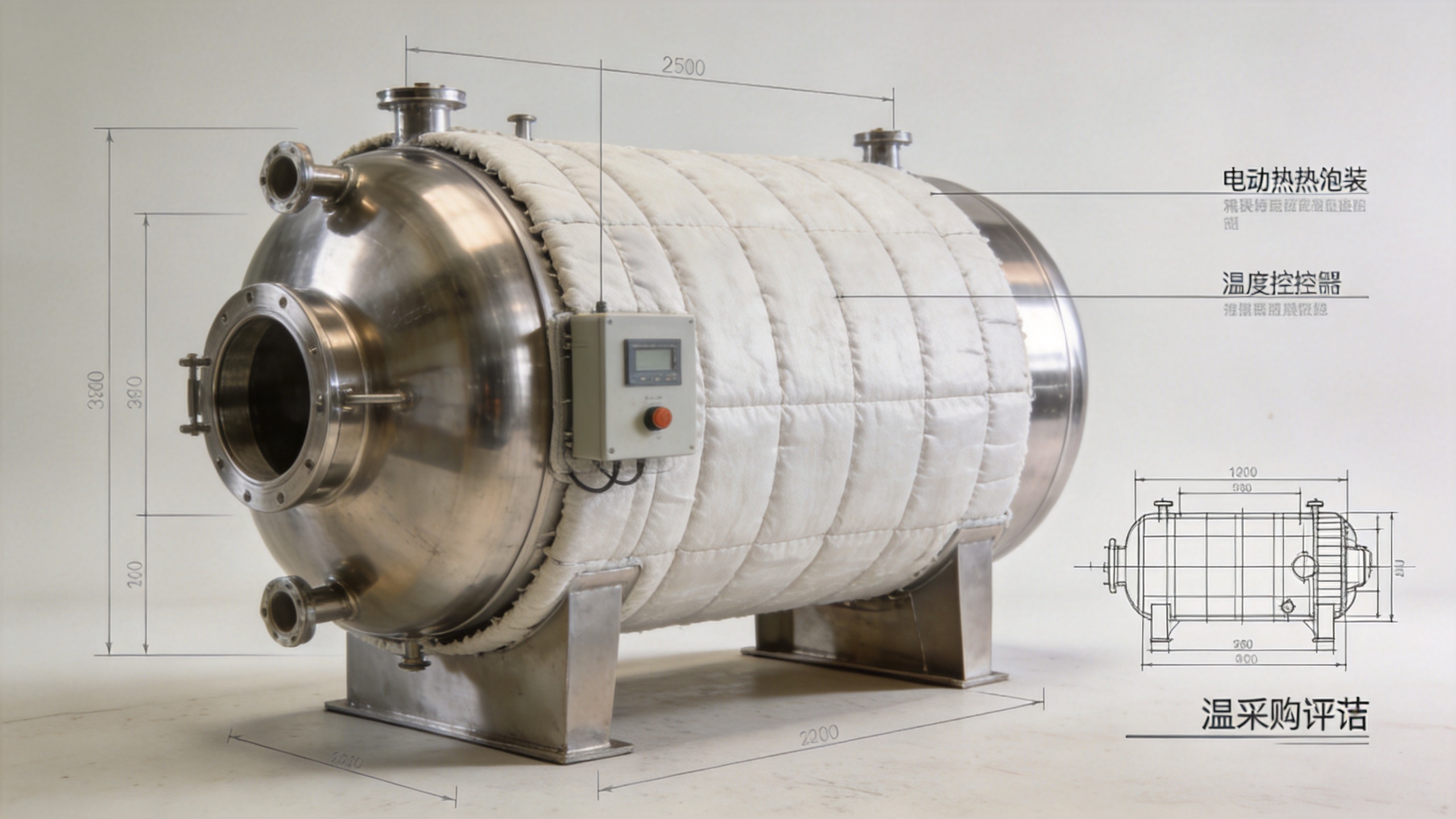
Mechanical fit is a core part of evaluating an industrial heating jacket manufacturer. A jacket should be discussed as an assembly around a real component, not as a generic blanket. Request a dimensional drawing or fit-up document that identifies closures, cable exits, cutouts, seams, and areas that remain accessible for inspection or maintenance.
Material selection also needs a documented basis. Ask what the outer cover, insulation, heating element protection, fasteners, and any seals are intended to withstand. The answer should reflect the expected temperature, contact conditions, cleaning method, moisture exposure, and local installation rules. If the process environment is unusual, provide that information early rather than assuming a standard industrial heating jacket construction will be suitable.
For removable designs, clarify who will remove and reinstall the jacket, how repeatable the fit should be, and whether repeated handling affects wiring, closures, or sensor placement. These practical details influence downtime planning and should be considered alongside initial price.
4. Review Electrical Design and Control Documentation
An industrial heating jacket manufacturer should be able to describe the electrical side in terms your project team can review. Ask for the rated supply requirements, wiring information, grounding approach, control method, sensor type, protection devices, and installation instructions. Do not assume that a controller, lead length, connector, or protective feature is included unless it appears in the proposal.
The controls discussion should also cover what is measured and what happens when a sensor is disconnected, a temperature reading is outside the intended range, or a power interruption occurs. The appropriate response depends on the installation and applicable project requirements, so request a clear explanation of the supplied configuration and the items that remain the purchaser’s responsibility.
| Verification area | What to request | Why it matters |
|---|---|---|
| Power and wiring | Rated voltage, phase, load, cable information, and connection instructions | Supports coordination with the site electrical design |
| Temperature control | Control description, sensor type, sensor location, and setpoint limitations | Shows how the process temperature will be monitored |
| Protection | Documented protective functions and stated operating boundaries | Helps the team evaluate the configuration against project requirements |
| Installation | Mounting, inspection, and maintenance guidance | Clarifies responsibilities after delivery |
5. Check Quality Controls and Acceptance Evidence
Rather than relying on broad claims, ask the industrial heating jacket manufacturer what evidence can be supplied for the exact order. Useful records may include an approved drawing, bill of materials where appropriate, electrical test record, inspection checklist, controller configuration record, packing list, and operating or maintenance instructions. The available documents will vary by product and project, but the supplier should state what is included and what requires separate agreement.
For a custom industrial heating jacket, agree on the acceptance path before production. That may include drawing approval, dimensional confirmation, electrical checks, functional checks at an agreed condition, photos, or other project-specific evidence. If site commissioning is required, distinguish factory checks from installation and startup responsibilities.
6. Compare Communication, Change Control, and After-Sales Support
Supplier capability is also visible in the way questions are handled. A responsive industrial heating jacket manufacturer records assumptions, flags conflicts, and identifies the impact of late changes. Ask who owns the technical review, which information is needed before release, and how revisions to geometry, temperature, supply power, or environment will be controlled.
Before selecting a supplier, clarify the service route for installation questions, replacement parts, sensor or controller issues, and future jackets for similar equipment. A useful comparison looks at response scope and documentation, not only at the quoted delivery date. This helps procurement, engineering, and maintenance work from one requirement list.
A Practical Supplier Verification Checklist
Use the same checklist for each candidate industrial heating jacket manufacturer:
- Confirm the process component, dimensions, target temperature, ambient conditions, and purpose of heating.
- Request the thermal design assumptions, rated output, zone layout, and sensor arrangement.
- Review a dimensional fit document, material description, closures, cutouts, and maintenance access.
- Verify supply requirements, wiring, controls, sensors, protection description, and installation guidance.
- Agree on order-specific drawings, test records, inspection evidence, and acceptance steps.
- Document change control, support contacts, and the boundary between supplier work and site work.
The right industrial heating jacket manufacturer for a project is the one whose proposal can be checked against the actual duty and whose documentation makes open questions visible. Share the component drawing, operating conditions, installation environment, and acceptance needs early. That gives the supplier a clearer basis for a proposal and gives your team a more reliable way to compare it.
 Hot News