What a CVD Gas Line Heating Jacket Protects Against
A CVD gas line heating jacket is not simply insulation wrapped around a tube. In a chemical vapor deposition system, it is part of the thermal-management approach used to keep a temperature-sensitive precursor stream within the conditions established by the process team. From a semiconductor equipment integration perspective, the useful question is not “how hot can the jacket get?” but “which delivery-line risk does this CVD gas line heating jacket address under this gas, routing, and control arrangement?”
That distinction matters because a gas stream may be stable at one point in a delivery path and vulnerable at another. A change in ambient exposure, fitting geometry, valve mass, or line routing can introduce a colder section. When a precursor has limited thermal margin, the resulting change can affect how material reaches the chamber. A well-specified CVD gas line heating jacket helps the engineering team manage that exposure, but it does not replace process qualification, compatibility review, or facility safety controls.
The primary risk: unintended cooling along the delivery path
The main job of a CVD gas line heating jacket is to maintain an intended thermal condition along a defined section of the line. In a CVD process, some vapor-delivery routes need heat maintenance because cooling can raise the chance of condensation or other unwanted phase behavior. Industry material on CVD risk mitigation specifically notes that downstream vapor-delivery lines may need heating to reduce condensation risk. That is a useful starting point, not a universal temperature prescription.
In practical terms, a pipe heating system can help limit the effect of cold spots caused by long runs, exposed bends, metal fittings, or a line passing through an area with a different ambient condition. The jacket does not make every section identical by itself. Its contribution depends on contact coverage, insulation, heater zoning, sensor placement, and the way each component sheds heat. If the process specification calls for a narrow thermal window, those details deserve attention before a setpoint is chosen.
What can go wrong when thermal conditions drift
A CVD gas line heating jacket is often evaluated because the consequences of a poorly managed line are broader than a single temperature reading. The following are common categories of exposure to examine:
- Condensation or deposition in the line. A cooled precursor stream may no longer behave as intended. This can change the material available downstream and may create a cleaning or maintenance issue.
- Flow instability. Changes in phase condition or local temperature can make a delivery response less predictable, particularly when the line includes valves, elbows, or changing diameters.
- Particle and contamination concerns. Where material collects or reacts in an unintended area, the system should be assessed for downstream cleanliness implications. The exact mechanism depends on chemistry and must be reviewed with process documentation.
- Mismatch between heated and unheated hardware. A jacketed straight run may be insufficient if adjacent fittings, valves, filters, or source connections remain thermally different.
- Integration blind spots. An electrical heating solution has to coexist with routing constraints, access for maintenance, sensors, interlocks, and the tool’s existing control arrangement.
These are risk categories rather than promised outcomes. A CVD gas line heating jacket should be selected after the process owner identifies the gas or precursor, the required delivery condition, and the acceptable verification method.
Uniformity matters more than a high setpoint
It is tempting to treat heat maintenance as a single setpoint problem. For CVD delivery hardware, the more useful concern is often temperature distribution. Semiconductor-processing guidance commonly describes uniform line heating as a way to reduce the chance of condensation and potential contamination for gases that require it. A CVD gas line heating jacket therefore needs to be discussed alongside the full thermal path rather than as an isolated sleeve.
Start by mapping the route: source outlet, regulator or vaporizer connection, valves, filter bodies, bends, cabinet penetrations, and chamber-side connection. Then identify which components are inside the controlled zone and which are not. If a sensor reads only one accessible location, that reading may not represent the coldest point. More accurately, the control approach should be checked against the physical layout, thermal masses, insulation boundaries, and anticipated operating states.
This is where a pipe heating system differs from a generic warming accessory. The required power, heater layout, and control logic are meaningful only in relation to the line’s construction and operating context. A higher nominal capability is not automatically a better match if it creates excessive gradients or does not coordinate with the rest of the delivery assembly.
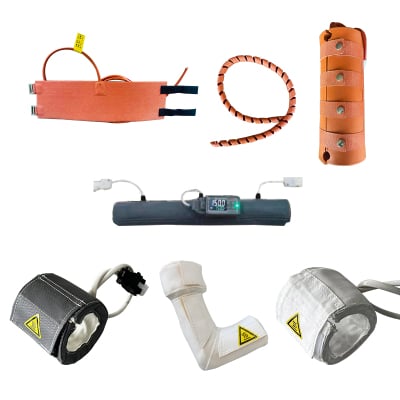
 A thermal-maintenance concept for a controlled CVD gas delivery route.
Questions to resolve before specifying a CVD gas line heating jacket
A structured request for information helps the integration discussion move beyond a general requirement for “heated lines.” Before selecting a CVD gas line heating jacket, compile the following:
- Process material and target condition: What gas or precursor is being delivered, and what temperature boundary has been confirmed by the process owner?
- Line geometry: What are the tubing material, outside diameter, run length, bend locations, fittings, and heat-loss points?
- Operating profile: Is the line held at temperature continuously, cycled between lots, or exposed to long idle periods?
- Control and sensing: Where can sensors be placed, what controller or interlock connections are required, and how will an out-of-range condition be handled?
- Installation and service: Can the jacket be removed for inspection without disturbing critical fittings, and are cable routing and enclosure requirements defined?
- Verification plan: Which measurements, records, and acceptance criteria will show that the installed assembly follows the intended thermal profile?
Asking these questions early is more useful than comparing jackets only by wattage. It turns the CVD gas line heating jacket into one element of a traceable thermal-control plan.
Where the jacket’s boundary ends
A CVD gas line heating jacket can support heat maintenance, but it cannot establish the right process temperature without validated process inputs. It also does not substitute for material compatibility assessment, hazardous-gas handling procedures, electrical protection, leak testing, or chamber-process tuning. Those responsibilities remain with the qualified teams and the applicable site requirements.
For the same reason, the words “uniform heating” should be treated as a verification objective rather than an automatic result. The actual outcome depends on the installed line, contact quality, insulation, thermal losses, instrumentation, and control response. A technical review should distinguish confirmed system information from items that still need testing.
A practical way to move forward
When a deposition line shows concern about thermal drift, begin with the process requirement and trace the delivery route outward. Identify potential cold locations, confirm which items belong inside the controlled zone, and define how the temperature profile will be checked after installation. This sequence gives the CVD gas line heating jacket a clear role: supporting a controlled delivery condition where the process actually needs it.
For engineering and procurement teams, the most useful next step is a concise line-data package covering media, temperature boundary, geometry, electrical constraints, control connections, and maintenance access. With those inputs, a CVD gas line heating jacket and the surrounding pipe heating system can be assessed against the real integration task rather than a generic product description.
 Hot News