
What an Industrial Heater Jacket Must Deliver for Pipe Heat
For pipe heat, an industrial heater jacket is not simply a warm covering. It is a removable part of the process thermal system. From a thermal-management application engineer’s perspective, the first question is not “Which jacket has the highest rating?” It is whether the jacket can transfer controllable heat to the actual pipe assembly while fitting the operating temperature, medium, insulation layout, electrical arrangement, and maintenance routine.
Search results for this term can be misleading because they often mix process equipment with wearable heated clothing. A process-facing industrial heater jacket should therefore be evaluated as an engineered pipe-heating component. The practical outcome is stable, reviewable operation—not a headline specification considered in isolation.
Start with the pipe section, not the catalog description
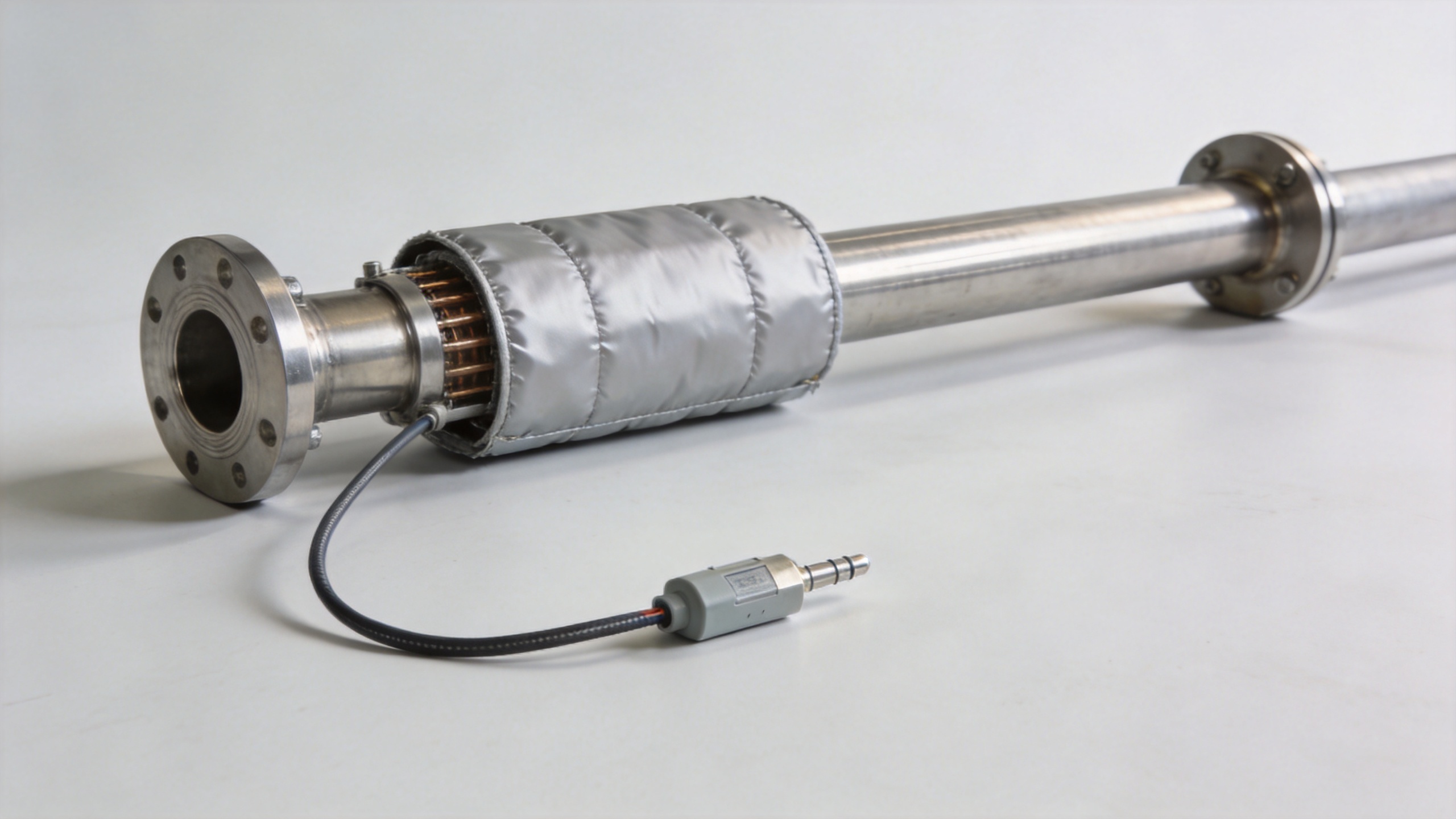
An industrial heater jacket must match the pipe section it is expected to heat. Record the outside diameter, straight length, wall material, fittings, valves, supports, insulation thickness, and available clearance before requesting a design. A jacket that fits a nominal diameter but leaves a gap at a flange, elbow, or instrument connection may heat unevenly. That unevenness matters when the process fluid is temperature-sensitive, viscous, or prone to changing behavior as it cools.
For an industrial heater jacket, “fit” also includes repeatable installation. The closure method, lead orientation, and access around clamps or valves should allow technicians to remove and reinstall the jacket without changing its position each time. If the location is routinely opened for inspection, a removable industrial heating jacket should support that work rather than turn it into a lengthy reassembly task.
Deliver useful heat where the process loses it
The duty of an industrial heater jacket is to add heat at a useful rate and distribute it across the target surface. That requires a conversation about heat loss, not only heater wattage. Ambient conditions, airflow, upstream temperature, line length, insulation condition, and expected operating schedule all influence the result. A short exposed section beside a valve may need different attention from a long, insulated transfer line.
Ask the supplier to explain the intended contact area and the treatment of discontinuities. An industrial heater jacket that is well suited to a straight pipe may need a separate design for an elbow, tee, reducer, or valve body. Splitting a circuit into practical zones can also make sense where one section has a different heat loss or needs different access. The aim is to avoid assuming that one uniform heating pattern will suit every geometry.
Provide controllability, not just heat output
Pipe heat is usually part of a process condition, so an industrial heater jacket must work with an appropriate temperature-control approach. Confirm where temperature will be sensed, what the control target represents, how the controller responds to deviation, and what happens after a power interruption. A sensor placed where it does not represent the critical process condition can make a capable jacket difficult to manage.
For an industrial heating jacket, the electrical review should cover supply voltage, circuit loading, lead routing, connector selection, grounding arrangements, and the control enclosure. In locations with additional site requirements, involve the responsible electrical and safety teams early. The appropriate protection and installation details depend on the application; they should be confirmed from the project’s conditions rather than assumed from a general product description.
Work with insulation and the surrounding assembly
An industrial heater jacket should be assessed together with insulation, not as a replacement for every thermal-control measure. Insulation helps retain supplied heat and reduces sensitivity to changing ambient conditions. The order of layers, gaps around penetrations, and removable insulation sections all affect heat flow and service access.
This system view is especially important when the line includes instruments, flexible joints, supports, or nearby equipment. An industrial heater jacket needs clearance for these interfaces and a plan for cable routing that does not create pinch points or obstruct routine work. A design review that maps pipe, heater, insulation, controls, and access points is more useful than a list of isolated component ratings.
Support safe inspection and practical maintenance
A well-chosen industrial heater jacket should make routine observation possible. Operators need a clear way to identify the heated zone, check the closure, inspect leads, and confirm that the control arrangement is behaving as expected. Maintenance teams also need a documented isolation procedure and a reasonable path to remove the jacket when a component behind it requires service.
Before installation, clarify the expected inspection points: fabric or outer-cover condition, seam and closure integrity, lead condition, sensor placement, controller indication, and changes in the insulated assembly. Keeping these points in a commissioning and maintenance record can help teams compare the installed condition after shutdowns or modifications.
Use a requirements checklist before specifying the jacket
For a defensible industrial heater jacket selection, gather the following inputs:
- Pipe material, outside diameter, straight length, and every fitting or obstruction within the heated zone.
- Process medium, normal and abnormal operating conditions, and the required temperature range.
- Ambient exposure, airflow, existing insulation, and likely heat-loss locations.
- Available power, control approach, sensor location, cable routing, and site electrical requirements.
- Removal frequency, cleaning needs, access constraints, and the people responsible for inspection.
- Acceptance checks for fit, control response, surface coverage, and documentation before handover.
This checklist turns an industrial heating jacket discussion into a shared engineering review. It also helps procurement, maintenance, and process teams ask consistent questions when comparing proposals.
Define acceptance before the first heat-up
Commissioning is where an industrial heater jacket moves from a purchased item to a verified part of the installation. Before the first heat-up, agree how fit, sensor placement, controller operation, electrical checks, and access will be reviewed. If the project needs temperature mapping or a staged heat-up, define the method and who records the observations.
An industrial heater jacket delivers value for pipe heat when its physical fit, thermal behavior, controls, and serviceability are evaluated together. Treating those factors as one requirement set gives the project team a clearer basis for design, installation, and later maintenance.
 Hot News