
How an EV Battery Test Chiller Keeps Cells Within Range
During battery validation, temperature is not background noise. It changes resistance, charge acceptance, delivered capacity, and the way a cell responds to a current profile. An EV battery test chiller gives engineers a controlled thermal boundary while cyclers, sensors, and safety equipment collect the evidence needed for a test decision. It is not simply a small HVAC unit connected to a fixture. A well-planned EV battery test chiller is part of a measurement system whose job is to make the programmed thermal condition repeatable and observable.
From a thermal-management application engineer’s perspective, the useful question is not “what temperature can the unit reach?” It is “can the EV battery test chiller hold the intended coolant condition while the cell, fixture, and electrical load change?” That distinction helps a laboratory avoid treating a nameplate range as a test result.
What “within range” means in a battery test
“Within range” has at least three layers. First is the programmed coolant supply setpoint. Second is the temperature at the fixture or cold plate after hoses, manifolds, and heat exchange have introduced a difference. Third is the measured cell temperature at the defined sensing location. An EV battery test chiller controls the first layer directly; the other two depend on the complete thermal path and the test setup.
That is why a test record should identify the controlled variable and the acceptance variable separately. A stable supply temperature does not automatically mean every cell surface is at the same temperature. Conversely, a short cell-temperature excursion may reflect changing current, contact pressure, sensor placement, or flow distribution rather than a control fault in the EV battery test chiller.
Published testing discussions often use several temperature conditions to characterize EV cells. For example, searches related to IEC 62660-2 describe conditions such as -20°C, 0°C, 25°C, and 45°C for particular characterization work. These figures are useful context, not a universal setpoint list. The approved procedure, cell chemistry, fixture design, and applicable standard edition determine the actual range for a given program.
How the thermal control loop works
At its core, an EV battery test chiller circulates a conditioned fluid through a loop. A temperature sensor near the supply side reports the process value. The controller compares that value with the setpoint and adjusts cooling or heating capacity to reduce the difference. A pump moves the fluid through the fixture, and the returning fluid carries information about the heat being added or removed by the test article.
The loop becomes more demanding when electrical loading begins. During discharge, internal losses and electrochemical behavior can add heat. During low-temperature operation, the fixture and surrounding environment may absorb heat faster than expected. A responsive EV battery test chiller needs enough usable capacity around the relevant operating point, not only at a favorable catalog condition.
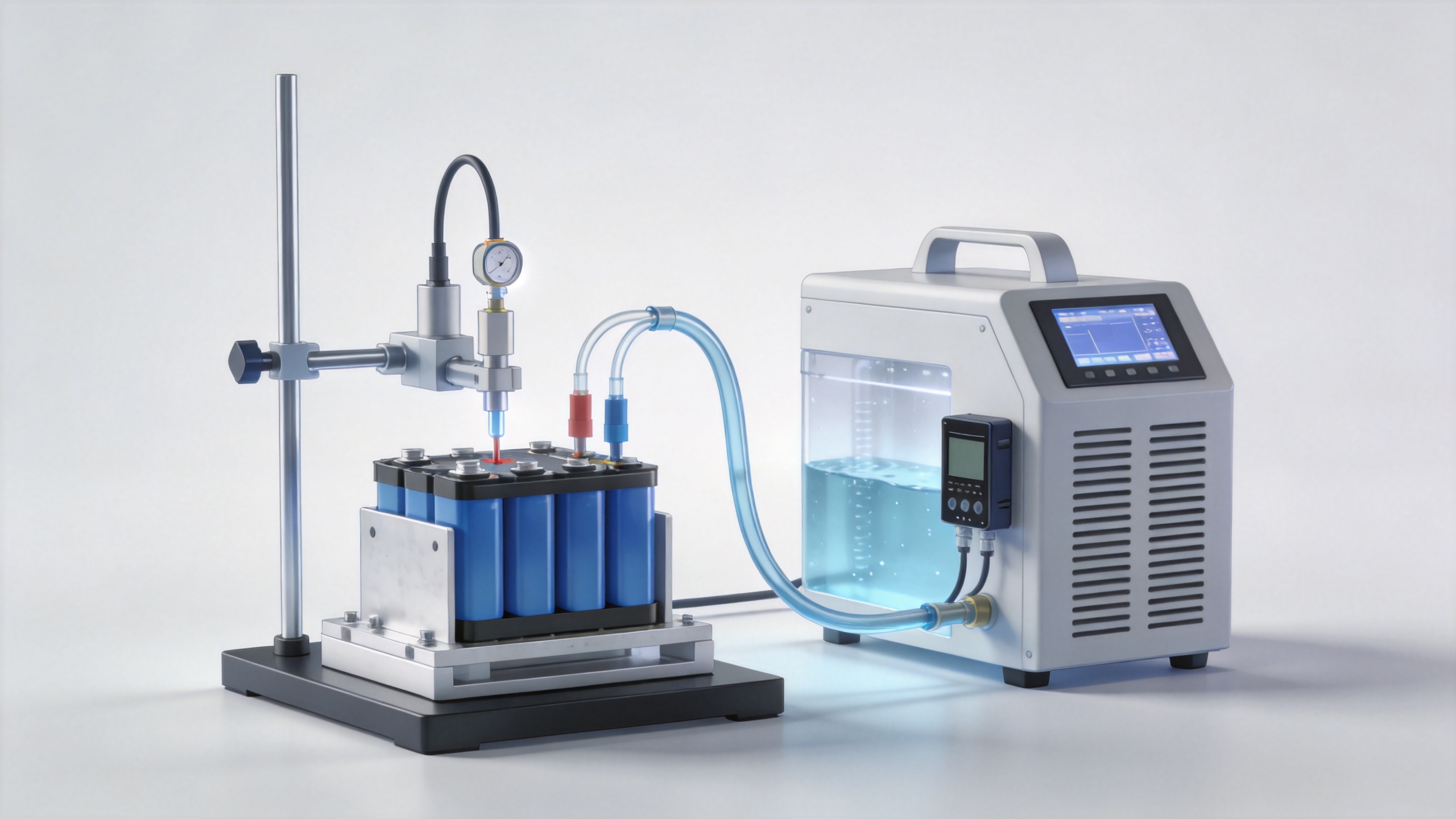
Flow matters as much as temperature. If flow is too low, the fluid can warm or cool substantially across the fixture and make one sensor location look acceptable while another drifts. If flow is excessively high, pressure drop, hose routing, and fixture limits may become the next constraint. The EV battery test chiller therefore needs to be evaluated with the intended coolant, hose length, manifold geometry, and test article—not as an isolated box.
Why cell temperature can lag the chiller setpoint
Every part between the coolant and the active material adds thermal resistance: tubing, cold plate, interface pad, cell can, contact area, and the cell’s internal structure. Thermal mass adds delay. When the current step changes, the measured cell temperature may continue moving even after the EV battery test chiller has returned the coolant to its setpoint.
This lag is normal physics, but it must be built into the method. Before a capacity or pulse segment starts, the test may need a dwell criterion based on sensor stability rather than a fixed timer alone. When a program contains rapid transitions, the team should decide whether the target is coolant conditioning, surface-temperature tracking, or a chamber-controlled ambient condition. An EV battery test chiller can support each approach only when its control boundary and instrumentation are defined clearly.
Inputs that shape chiller performance during a test
Selection begins with a heat-load estimate, but it should not stop there. The following inputs make an EV battery test chiller assessment more useful:
- Temperature window: the planned setpoints, ramps, and dwell periods, including the expected laboratory ambient.
- Dynamic thermal load: heat generation or absorption across charge, discharge, rest, and fault-simulation segments.
- Coolant and flow target: fluid properties, required flow, pressure-drop allowance, and materials compatibility.
- Thermal interface: cold-plate area, contact material, clamping approach, and sensor locations.
- Controls and records: setpoint resolution, logging interval, alarm handling, and the communication link to the cycler or supervisory system.
An industrial chiller used in general process cooling may share refrigeration hardware with a test system, yet a battery program asks more of the controls, instrumentation, and part-load behavior. For that reason, comparing an EV battery test chiller by nominal cooling capacity alone can hide the factors that influence test repeatability.
Managing transitions, not only steady state
Steady-state operation is only one part of validation. A program may call for a cold soak, a high-current pulse, a rest period, and a move to another temperature condition. During each transition, the EV battery test chiller has to react to the fixture’s stored energy as well as the cell’s changing heat release. A unit that looks stable with water in a simple loop may behave differently after insulated hoses, a heavy plate, and multiple parallel channels are connected.
It is practical to run a commissioning sequence before formal data collection. Record supply and return temperature, flow, pressure, relevant fixture temperatures, cell sensors, ambient conditions, and electrical load. Then apply representative steps and observe settling time and any difference between channels. This evidence helps determine whether the EV battery test chiller is following the planned condition or whether the fixture needs rebalancing.
A useful review also separates control instability from measurement uncertainty. Sensor type, attachment method, calibration status, and log timing can all affect an apparent excursion. The EV battery test chiller should be evaluated alongside the measurement chain, because a clean control trace cannot correct a poorly located sensor.
Practical setup checks before a validation run
- Confirm the test method’s temperature boundary, tolerance, and sensor location before choosing the EV battery test chiller setpoint.
- Verify coolant compatibility, fill level, hose connections, flow direction, and leak-check procedures.
- Compare expected electrical load steps with the available cooling and heating capacity at the required temperature.
- Check that return-temperature, flow, pressure, and cell-temperature channels are logged on a common time basis.
- Run a representative dry fixture or instrumented shakedown to establish settling behavior.
- Define alarm responses and stop criteria with the laboratory’s safety and test procedure owners.
These checks turn an EV battery test chiller from a temperature source into a documented part of the experiment. They also make it easier to distinguish a changing cell condition from a change in coolant delivery.
Reading results without overclaiming
The most credible conclusion is usually conditional: under the specified fixture, coolant, flow, electrical profile, and sensor layout, the EV battery test chiller maintained the defined control point and the recorded cell locations behaved within the method’s acceptance band. That wording leaves room for the engineering facts that matter—different cells, interfaces, current profiles, or ambient conditions can require a new check.
For a new EV test project, begin by collecting the temperature window, heat-load profile, coolant details, flow and pressure limits, fixture drawing, control-link requirements, and required data channels. With those inputs, an EV battery test chiller can be assessed as part of a complete thermal-control plan rather than as a generic industrial chiller purchase.
 Hot News