What Is a Gas Line Heating Jacket and Why Do You Need One?
When engineers ask what is a gas line heating jacket, they are usually trying to solve a process-temperature question rather than simply add heat to a pipe. In practical terms, a gas line heating jacket is an externally applied heating assembly that helps a gas-transfer line stay within a defined temperature range. It is commonly considered where temperature loss along a line may affect gas behavior, process repeatability, or the condition of connected equipment. The right answer to what is a gas line heating jacket depends on the gas, the line geometry, the required temperature window, and the surrounding environment.
From a thermal-management engineer’s viewpoint, the useful question is not whether heat can be applied. It is whether the whole arrangement—heater, insulation, sensing, controls, power connections, and operating procedure—matches the actual duty. An industrial heating jacket is therefore part of a system decision, not a stand-alone label.
What Is a Gas Line Heating Jacket Designed to Do?
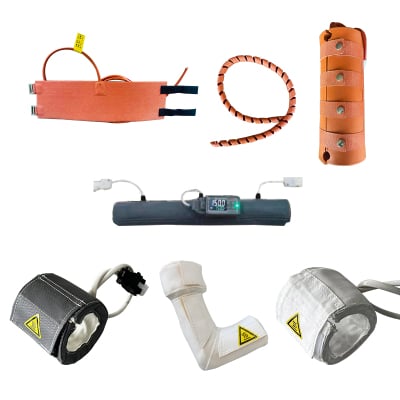
At its core, the term describes a method for adding controlled heat around a gas line. The assembly may use flexible heating sections, insulation, fastening features, temperature sensing, and a controller selected for the application. Its purpose is to reduce unwanted temperature drop between process points. That can matter when a process needs a stable line temperature, when a line passes through a cooler area, or when operating conditions change during a production cycle.
This type of jacket should not be treated as a universal fix. Heat requirements are shaped by pipe size, material, length, ambient conditions, heat loss at valves and supports, target temperature, and thermal properties of the gas or associated process stream. If only the target temperature is known, the design basis is still incomplete.
How It Differs From General Pipe Insulation
A common source of confusion is the difference between heating and insulation. Insulation slows heat exchange with the surroundings; it does not actively add heat. A gas line heating jacket actively supplies heat, while insulation helps retain that heat and makes the system more efficient. In many industrial layouts, the two are planned together rather than as alternatives.
Installation guidance for electric heat-tracing systems also emphasizes thermal insulation and a protective vapor barrier. These layers can help protect the insulation from moisture and physical damage. The exact materials, layout, and electrical arrangement must be verified against applicable equipment instructions and site requirements. An industrial heating jacket is only as effective as the installation details around it.
A gas line heating arrangement should be evaluated together with insulation, sensing, and controls.
When Does a Gas Line Need Heating?
Understanding this type of line-heating arrangement starts with identifying the temperature risk. A line may need evaluation when it crosses unconditioned spaces, has long runs, includes fittings that lose heat, or carries a stream whose process behavior is temperature-sensitive. In semiconductor, chemical, pharmaceutical, and other controlled industrial environments, engineers may also look at how the line interfaces with chambers, valves, filters, instruments, and control logic.
That does not mean every line requires an industrial heating jacket. A line can be suitable for passive insulation alone, a different heat-tracing method, or no thermal treatment at all. The decision should follow a documented assessment of the process requirement and heat-loss conditions.
Key Parts of the Heating Arrangement
To define the arrangement clearly, it helps to separate the main elements:
-
Heating section: the component that transfers heat to the outside of the line.
-
Temperature sensing and control: elements that support monitoring and control relative to the approved setpoint.
-
Insulation and outer protection: layers that limit unwanted heat loss and protect the assembly.
-
Power and connection hardware: components that must be compatible with the electrical design and environment.
-
Mounting and access provisions: details that influence coverage, service access, and inspection.
These parts explain why what is a gas line heating jacket cannot be answered by wattage alone. The practical performance of an industrial heating jacket depends on how these parts work together under actual operating conditions.
What to Confirm Before Selecting One
Before specifying a gas line heating jacket, collect the conditions that determine suitability. This checklist is more useful than comparing a catalog number in isolation:
-
Temperature range: What temperature range must the line maintain, and how tightly must it be controlled?
-
Line geometry: What are the pipe diameter, routing, fittings, valves, supports, and heated length?
-
Ambient exposure: What are the ambient temperature, airflow, washdown, and access conditions?
-
Media compatibility: What gas or process conditions affect material selection and safe handling?
-
Control integration: How will sensors, controls, alarms, and upstream equipment communicate?
-
Site compliance: What electrical classification, protection, installation practice, and inspection requirements apply at the site?
Asking these questions gives a more reliable basis for evaluating the line-heating need. It also helps distinguish a process need from an assumption based only on a cold spot or a single temperature reading.
Installation and Inspection Matter as Much as Selection
Even a properly chosen heating assembly needs careful installation. The heating section must make intended contact with the line, and insulation details need attention at fittings, supports, and other locations where heat can escape. Installation documentation for heat-tracing systems commonly includes insulation-resistance checks before final energization. This is a useful reminder that inspection is part of commissioning, not an optional afterthought.
For the same reason, the proposed line-heating arrangement should be discussed with the electrical and process teams together. The applicable design, manufacturer instructions, and local requirements determine the final installation and testing method. A generic article cannot substitute for a site-specific safety review.
Working With the Right Thermal Partner
Lingheng Thermal Control Technology (Suzhou) Co., Ltd. focuses its technical solutions on precision temperature-control and thermal-management requirements for advanced industrial applications. When evaluating a gas line heating jacket, a collaborative discussion starting from the target temperature range, line geometry, heat load, control interfaces, and maintenance conditions can yield a much more reliable implementation path than selecting from a generic specification.
Conclusion: Why an Industrial Heating Jacket Supports Process Planning
An industrial heating jacket can give project teams a practical way to address line-temperature conditions while keeping the discussion focused on verifiable inputs. Rather than making broad claims, teams can work from the target temperature, heat load, gas conditions, interfaces, and maintenance access. That approach is especially helpful when a system must coordinate piping, electrical controls, and process equipment.
So, what is a gas line heating jacket? It is a controlled external heating approach for a gas line, selected and installed as part of a complete thermal-management arrangement. When the operating conditions are clearly defined, the engineering conversation can move from a generic product request to a workable verification plan.
 Hot News