
Why a Heated Gas Line Jacket Prevents Precursor Condensation
In a precursor delivery system, a gas line is not merely a connection between a source and a process chamber. It is part of the process window. As a thermal-management engineer would point out, vapor can leave a source in an acceptable state yet encounter a colder valve body, fitting, regulator, or tube segment downstream. If the local wall temperature falls below the condition needed to keep that material in the vapor phase, molecules can collect on the surface, form liquid or solid residue, and change what reaches the process.
A heated gas line jacket surrounds the vulnerable section with controlled heat and insulation. Its purpose is to keep the line temperature sufficiently stable along the actual gas path, including the locations that cool faster than the controller sensor. Used with an appropriate temperature-control strategy, it helps maintain precursor transport conditions and reduces the chance of condensation-related flow instability.
Condensation starts at the coldest point, not at the controller display
Precursor behavior depends on temperature, pressure, composition, and the condition of the wetted surfaces. For a vaporized liquid or sublimed solid precursor, the available vapor pressure changes with temperature. A pressure drop through a valve, mass-flow device, filter, or long tube can alter the margin between the vapor state and a phase change. A line that appears warm at one sensor may still contain a colder elbow or fitting.
This is why a nominal setpoint alone is not a design result. The relevant question is whether every section from the source outlet to the downstream connection remains above the process-specific condensation threshold under realistic ambient conditions, gas flow, and heat loss. An open cabinet door, airflow from a fan, a metal mounting bracket, or an uninsulated union can be enough to create a local weak point.
Industry guidance on heated sampling follows the same physical principle: maintain the gas stream above its dew-point or reaction-temperature condition during transport. Precursor delivery adds another layer of care because the material, transport gas, delivery pressure, and downstream restrictions may all affect the needed thermal margin.
How a heated gas line jacket supports stable precursor transport
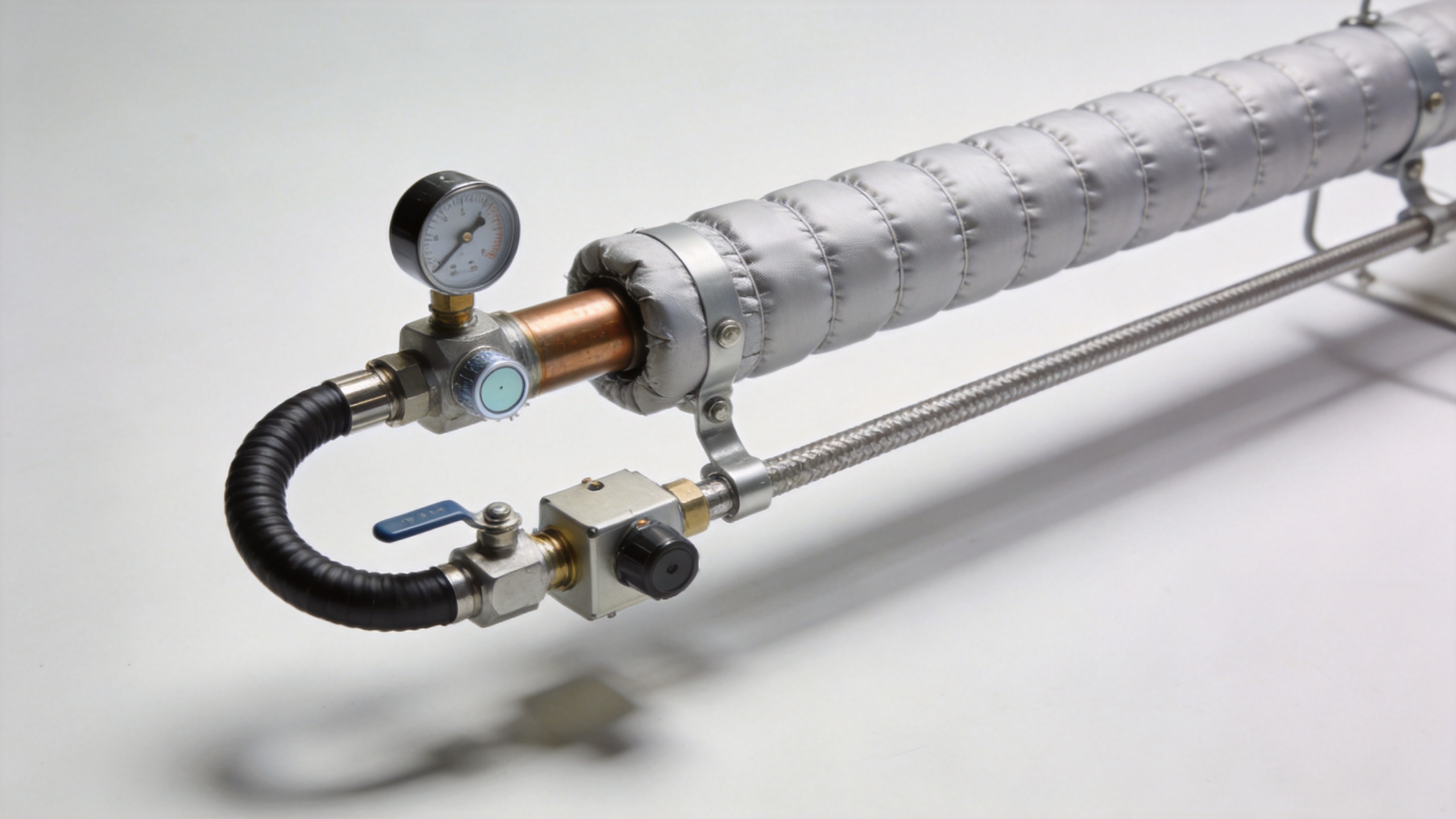
A heated gas line jacket applies distributed heat around tubing and, where the design permits, around fittings or compact valve sections. The insulation layer slows heat loss to the surrounding air, while a controller regulates the supplied power. This combination is more useful than an exposed heater on a short segment because the jacket can reduce temperature gradients rather than simply raise one measured location.
For systems that use liquid or solid precursors, thermal continuity matters across the whole route. Raising source temperature can increase vapor pressure and help the vapor move through a restrictive flow-control path, but that benefit can be lost when a downstream component runs cooler. A jacket therefore belongs in a coordinated temperature plan that considers the source, outlet hardware, transfer line, valves, mass-flow components, and destination connection.
Uniformity is usually more valuable than a high setpoint
It is tempting to respond to a condensation event by selecting a much hotter industrial heating jacket. That approach can create another problem if it overlooks material limits, seal compatibility, or the temperature of adjacent components. A more defensible method is to establish the required operating range from precursor documentation and process engineering, then reduce low-temperature excursions with appropriate coverage, insulation, sensor placement, and control logic.
The jacket should fit the geometry closely enough to transfer heat consistently without crushing tubing or obscuring service points. Gaps around tees, elbows, valves, and brackets deserve specific attention. They often lose heat differently from straight tubing, so a straight-run temperature reading may not describe the actual coldest location.
What to specify before selecting an industrial heating jacket
A suitable industrial heating jacket is selected from system conditions, not from pipe diameter alone. Start with the precursor’s documented handling range and the maximum expected pressure drop through the delivery path. Then map the ambient environment: enclosure airflow, nearby cooled equipment, line length, mounting hardware, maintenance access, and potential washdown or chemical exposure.
- Coverage: Identify straight runs, bends, valves, unions, and other components that can become cold spots.
- Temperature capability: Choose a controllable range that supports the engineered setpoint without overstressing tube materials, seals, or adjacent hardware.
- Sensor strategy: Place sensors where they represent the thermal risk, not merely where wiring is convenient.
- Insulation and enclosure effects: Account for heat loss through supports, exposed fittings, and forced airflow.
- Electrical and safety requirements: Review local electrical classification, grounding, over-temperature protection, and access procedures with qualified personnel.
These questions turn a jacket from an accessory into a controlled process component. They also help separate a genuine thermal issue from a different cause, such as incorrect source conditions, contamination, a restriction, or unsuitable tubing geometry.
A practical commissioning sequence
Before introducing a valuable precursor, inspect the installed line from source to destination and document each heated and unheated component. Bring the system to the planned thermal condition, allow time for the assembly to stabilize, and verify temperatures at representative high-risk locations. Surface measurements should be interpreted carefully because insulation, contact quality, and sensor attachment can influence the reading.
- Confirm the process-specific temperature range with the precursor supplier and internal process owner.
- Check jacket coverage, insulation seams, connector strain relief, and clearance around fittings.
- Verify controller readings against measurements near likely cold spots, including elbows and valve bodies.
- Observe the system during normal flow and during expected ambient changes, such as cabinet ventilation cycling.
- Record setpoints, measured temperatures, flow conditions, and any residue or delivery variation for later troubleshooting.
This sequence favors verification over assumption. If a problem remains, check the coldest component first. Increasing the setpoint without locating the thermal discontinuity can hide the symptom while leaving the underlying gradient in place.
Signs that the delivery path needs a thermal review
Recurring flow drift, delayed stabilization after idle periods, residue near fittings, or a change in response after room conditions shift can all justify a review of the delivery-line temperature profile. None of these signs proves condensation by itself; they are prompts to inspect the process conditions, compare source and downstream temperatures, and look for restrictions or exposure points.
For semiconductor, chemical, and other tightly controlled applications, it is useful to review the gas path as a system. A heated gas line jacket can reduce temperature variation along the route, but its value depends on correct coverage, credible sensor feedback, compatible materials, and a setpoint derived from the actual precursor process.
Conclusion
A heated gas line jacket helps keep a precursor delivery route thermally continuous so vapor is less likely to meet a cold surface and change phase. The soundest design does not chase a generic temperature. It identifies the coldest credible point, maintains an appropriate process margin across sources, fittings, and tubing, and verifies the result under operating conditions. With that system-level approach, an industrial heating jacket becomes a practical tool for steadier precursor transport and more informed troubleshooting.
 Hot News