
How a High Temperature Heating Jacket Survives Severe Duty
A high temperature heating jacket is not simply insulation wrapped around hot equipment. In severe duty, it is a controlled thermal assembly that has to tolerate repeated heat cycles, retain its shape around awkward geometry, and keep heat where the process needs it. That distinction matters because search results for “jacket” often point to wearable garments, while an industrial heating jacket is part of a process-temperature strategy.
From a thermal-management application perspective, the useful starting point is the duty cycle: what is being heated, how quickly its temperature changes, where heat escapes, and what happens when the process stops. A high temperature heating jacket that looks acceptable in a short trial can still struggle when exposed to cycling, vibration, washdown conditions, or frequent removal for inspection.
Severe duty starts with a defined thermal duty
Before selecting a high temperature heating jacket, define the target temperature, expected heat loss, ambient exposure, process medium, equipment geometry, and available power. These conditions affect one another. For example, a jacket around a vessel may face a different heat-loss pattern at seams, flanges, supports, valves, and instrument penetrations than on a smooth barrel.
It is also important to separate steady-state operation from warm-up. A high temperature heating jacket may be asked to raise the temperature after a long shutdown, then maintain a narrower process band for many hours. If those two duties are not distinguished, the heater circuit and control approach can be mismatched even when the nominal temperature appears suitable.
In practical reviews, heat load should be treated as a curve rather than one isolated number. Product mass, incoming material temperature, phase changes, insulation gaps, and plant airflow can all move the load. This is why a heating jacket should be evaluated with the surrounding equipment and controls, not as a standalone textile item.
Layered construction controls heat and mechanical stress
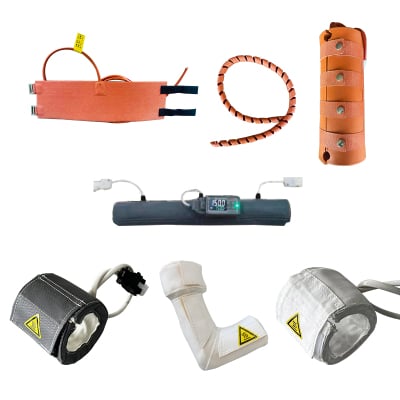
A severe-duty high temperature heating jacket generally relies on several layers with different jobs. The heating element provides thermal input; insulation reduces unwanted loss; an outer cover helps resist handling and environmental exposure; and the fastening system must keep contact consistent without overstressing the assembly. Search evidence on industrial insulation jackets also describes multi-layer constructions that combine heat resistance with insulation performance. The exact materials and temperature limits must still be confirmed for the proposed build.
Material choice is not only about a headline temperature rating. The inner layer must suit the surface and possible contamination. Insulation thickness and density affect heat transfer and exterior touch temperature. Outer fabrics, seams, and edge binding influence abrasion resistance. Where the equipment includes removable covers, a high temperature heating jacket also needs bend tolerance at the same points that operators open, fold, and refit it.
Openings require the same care. Cutouts for nozzles, sensors, lifting points, and pipe branches can become thermal bridges or stress concentrators. A custom heating jacket layout should identify those areas before fabrication so the heater zones, insulation overlap, and closures can be arranged around actual access requirements.

Heating zones and sensing limit uneven temperatures
A high temperature heating jacket survives longer when its heat is distributed for the equipment shape rather than concentrated wherever wiring is easiest. Long pipe runs, conical sections, valves, and large vessels do not absorb heat evenly. Zoned circuits can make it possible to address distinct areas, but zoning is only useful when the control plan and sensor locations reflect the process.
Temperature sensors need a deliberate location. A reading at one accessible point may not represent the coldest section, the highest-loss edge, or the hottest point near an element. For that reason, the control sensor, any monitoring sensor, and the process measurement should be reviewed together. A high temperature heating jacket should not be judged from one controller display alone.
Independent protective functions deserve a separate check. The normal controller handles routine regulation, while a separately configured high-limit device or other suitable protective arrangement can respond to an abnormal condition. The precise protective architecture depends on the application, electrical design, and applicable requirements, so it should be verified by qualified personnel rather than assumed from a generic product description.
Mechanical details often decide service life
In severe duty, the electrical and mechanical details of a high temperature heating jacket are closely connected. Leads need strain relief where they exit the cover. Connectors need a suitable location clear of abrasion, heat concentration, and routine traffic. Closures must be accessible when equipment is hot only after safe isolation, and they must maintain repeatable fit after repeated use.
A heating jacket that is regularly removed should have a documented fitting sequence. Marking orientation, checking that insulation laps correctly, and confirming that no section is pinched during closure reduce the chance of cold spots or damage. This is not a promise of outcome; it is a practical inspection routine that makes deviations easier to detect.
For pipework, flexible sections may need extra support near elbows, branches, and valve bodies. For vessels, straps and fasteners should account for local geometry and clearances. A high temperature heating jacket that is stretched tightly across a tight edge can age differently from one supported around a smooth cylindrical surface.
Use commissioning to validate the design assumptions
Commissioning turns a proposed high temperature heating jacket into an evidence-based process component. Record the starting condition, setpoint, sensor locations, warm-up observations, controller behavior, and any areas that require adjustment. Where feasible, compare the process response during an initial controlled run with the intended duty cycle.
The goal is not to declare a universal rating. One search result describes insulation-jacket applications up to 500°C, which illustrates why a number without construction and operating conditions is not enough. For every high temperature heating jacket, confirm the proposed temperature range, surface, atmosphere, duty cycle, ingress exposure, and electrical protection from the relevant documentation.
A severe-duty review checklist
- Confirm the process temperature range, warm-up target, hold period, and expected thermal load.
- Map seams, penetrations, fittings, sensors, supports, and areas exposed to airflow or contact.
- Review the high temperature heating jacket layer stack, heater zoning, fastening arrangement, and lead exit points.
- Define controller sensing, independent protective functions, alarms, and shutdown expectations.
- Plan inspection after installation and after the first representative operating cycle.
- Keep the final construction and operating limits tied to current technical documentation.
Conclusion
A high temperature heating jacket endures severe duty through a combination of condition-matched materials, balanced heat distribution, credible sensing, protective controls, and maintainable mechanical details. The right question is not whether a heating jacket has a high nominal temperature label. It is whether its full assembly matches the actual thermal, electrical, and maintenance conditions of the equipment it will serve.
For industrial thermal-management projects, Lingheng Thermal Control Technology (Suzhou) Co., Ltd. approaches temperature-control discussions by clarifying the target temperature range, heat load, medium, and system interfaces before configuration decisions are made. That process helps turn a broad heating requirement into a reviewable set of operating conditions.
 Hot News