
What Is an Industrial Chiller and How Does It Benefit You
When a production line, test loop, or laboratory process creates more heat than its surroundings can absorb, temperature stops being a background detail. What is an industrial chiller? It is a purpose-built cooling system that removes heat from a circulating process fluid and releases that heat elsewhere. In practical terms, the answer to what is an industrial chiller is not simply “a cooling machine.” It is a controlled part of a process system that helps equipment, materials, and tests operate within a defined temperature window.
From a heat-management application engineer’s perspective, what is an industrial chiller is answered most usefully by first looking at heat load, target temperature, fluid, and connections. Those conditions determine whether a chiller can support a process as intended. This article explains the basic working principle, common benefits, and the questions worth clarifying before selection.
What Is an Industrial Chiller, Exactly?
What is an industrial chiller in a process setting? It is equipment that cools a recirculating liquid—often water or a suitable water-based fluid—so the loop can carry heat out of machinery, tooling, reactors, test fixtures, or other heat-generating loads. An industrial chiller is different from comfort cooling because its job is tied to process conditions: load changes, fluid compatibility, control stability, piping, and equipment interfaces.
For many facilities, the useful answer is therefore a system view. The unit is only one part of the thermal path. Pumps move fluid, heat exchangers transfer heat, controls respond to changes, and piping connects the loop to the load. A stable result depends on how those elements work together, not on a single nameplate figure alone.
How Does an Industrial Chiller Work?
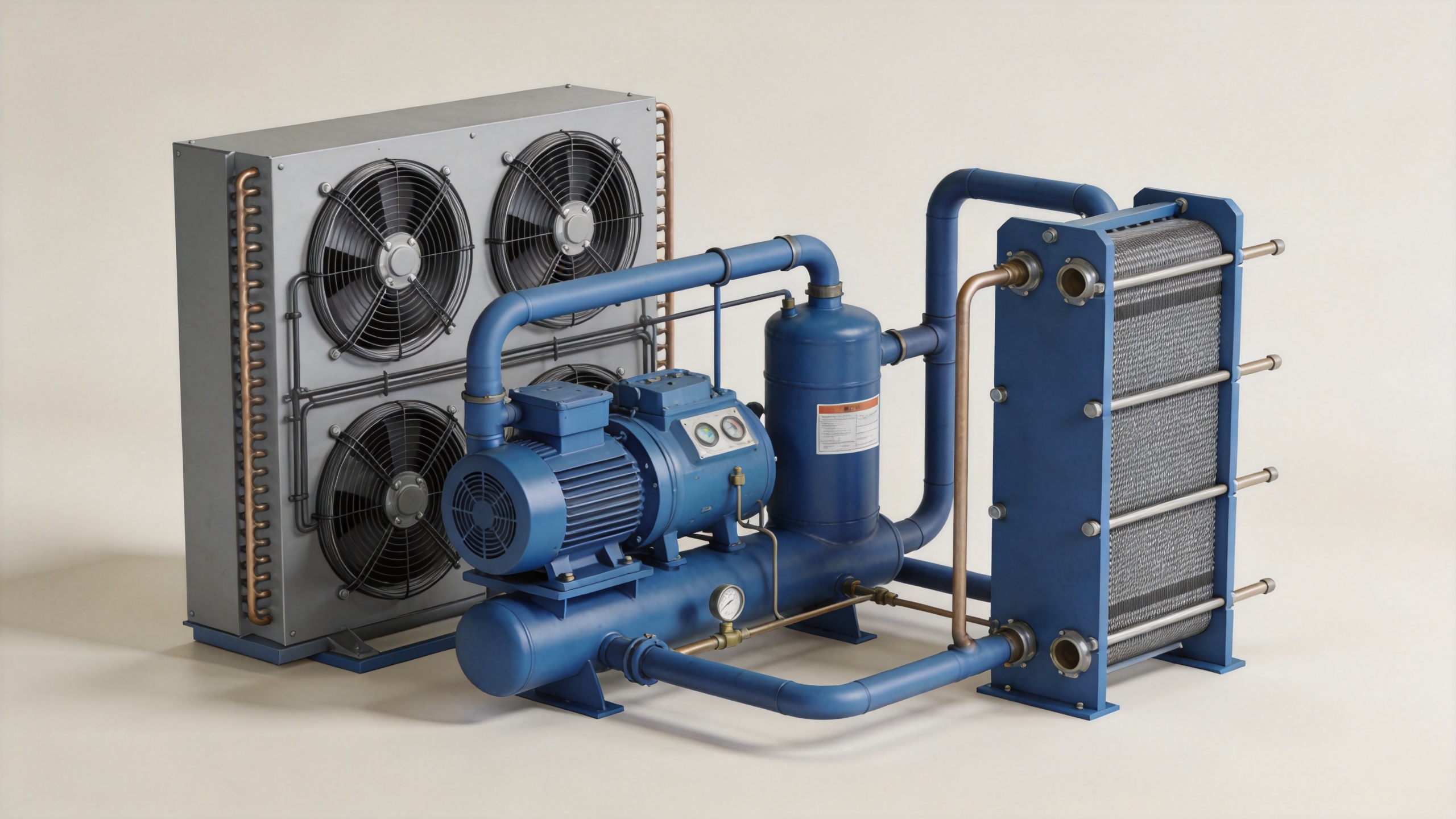
To understand the cooling principle, it helps to follow the heat rather than focus only on cold fluid leaving the unit. In a common vapor-compression arrangement, refrigerant circulates through four main functions: compression, condensation, expansion, and evaporation. The evaporator acts as a heat exchanger between the refrigerant and the process loop. Heat from the warmer process fluid transfers into the refrigerant, leaving the process fluid cooler before it returns to the load.
The refrigerant then carries that heat through the rest of its circuit. The compressor raises its pressure, the condenser rejects heat to air or water, and the expansion device lowers pressure before the refrigerant returns to absorb heat again. That cycle is why what is an industrial chiller is fundamentally a heat-removal question. The unit transfers process heat outward; it does not create “cold” in isolation.
Why Does Controlled Cooling Matter?
The benefits become clearer when temperatures drift. A changing fluid temperature can affect cycle time, material behavior, measurement repeatability, component stress, or the way a tool performs. A properly matched process-cooling unit gives the process a managed source of cooling rather than relying on ambient conditions or inconsistent utility water.
- More consistent process conditions: A controlled loop can help reduce temperature variation when heat loads change within the unit’s specified operating range.
- Clearer test conditions: In battery, motor, electronics, and other thermal tests, repeatable thermal inputs can make results easier to compare. The test method and sensors still need their own validation.
- Heat removal at the equipment level: Cooling can be delivered near a tool, fixture, or heat exchanger instead of depending solely on building-wide cooling.
- Better planning for operating changes: A system with appropriate controls and monitoring can give an operator useful signals when flow, temperature, or load shifts.
These are conditional benefits, not automatic outcomes. The follow-up should be: what heat must be removed, at what temperature, with what fluid, and under which operating changes?
Where Is an Industrial Chiller Used?
This type of cooling equipment may support semiconductor temperature control, chemical or pharmaceutical processing, new-energy thermal testing, aerospace-related testing, laser or machine-tool cooling, and other applications where process heat must be managed. The same equipment category can serve very different duties. For example, a loop that cools a test fixture may need different control behavior from one serving a continuous production process.
This is why the question cannot be answered with a universal configuration. The required temperature range, heat load profile, allowable fluid, ambient conditions, available utilities, and control connections all influence the discussion. A compact footprint can matter in one installation, while service access or remote monitoring may matter more in another.
What Should You Confirm Before Choosing One?
Rather than beginning with model comparisons, use the initial question as the start of a requirements conversation. Four inputs usually make that conversation more productive:
- Temperature requirement: Define the supply temperature, acceptable variation, and whether the process needs cooling only or a broader heating-and-cooling range.
- Heat load: Identify steady heat, peak heat, start-up behavior, and likely future changes. A target temperature alone does not describe the duty.
- Fluid and flow: Confirm the process fluid, cleanliness needs, flow range, pressure drop, and materials compatibility.
- Integration conditions: Review piping, electrical supply, ambient environment, controls, alarms, and communication with the larger system.
These questions also clarify the role of the equipment at your site: a standalone cooler, a controlled process loop, or one component in a larger thermal-management system. In each case, documented operating conditions are more useful than broad performance claims.
How to Evaluate the Benefit for Your Process
When evaluating a process-cooling system, connect each expected benefit to a measurable process concern. If the concern is test repeatability, define the temperature and flow conditions that need observation. If the concern is equipment heat, identify when the load peaks and where the heat enters the loop. If maintenance access matters, map the installation space and planned service routine. This approach turns a general search question into a practical engineering brief.
It is also wise to distinguish published capability from project confirmation. Performance descriptions need to be read with their stated temperature, fluid, load, and ambient conditions. Before a final choice, request applicable technical documentation and discuss the actual process connections. That verification step is especially important when the load varies quickly or temperature tolerance is tight.
Conclusion
What is an industrial chiller? It is a system for moving heat out of a process loop so temperature can be managed with greater consistency. Its potential value lies in how well the refrigeration circuit, fluid loop, controls, and process connections match the application. Start with the real thermal conditions, then use those facts to assess an appropriate solution.
 Hot News