
How to Choose an Industrial Cooling Equipment Manufacturer
Choosing an industrial cooling equipment manufacturer is not simply a matter of comparing a chiller catalog. The supplier becomes part of a process-control decision: its equipment, engineering assumptions, documentation, controls, and service response all affect how a plant manages heat. For procurement teams, a useful starting point is to define the duty before requesting quotations. That helps distinguish an industrial cooling equipment manufacturer that can work through the application from one that can only price a standard unit.
From an engineering buyer’s perspective, the most productive evaluation is a documented conversation. Ask each industrial cooling equipment manufacturer to explain what it needs to size the system, what it will verify, and what remains the customer’s responsibility. The same approach applies whether the project is a semiconductor tool loop, a chemical process, a battery test environment, or another industrial cooling system.
Start with a clear process requirement
Before contacting an industrial cooling equipment manufacturer, create a one-page application brief. It should state the target supply temperature and allowable variation, peak and normal heat loads, fluid or coolant, flow and pressure requirements, operating hours, ambient conditions, utility limits, footprint, and control connections. A manufacturer can make a more meaningful proposal when these inputs are known; without them, two quoted capacities may not represent the same operating point.
Also map the load over time. A process with a short high-load pulse needs different consideration from one with a steady load, even if their daily energy use is similar. Tell the industrial cooling equipment manufacturer whether heating and cooling occur in separate stages, whether the load changes with product recipes, and whether future expansion is likely. This is a practical way to avoid buying around a single headline rating.
Compare engineering scope, not just equipment capacity
A capable industrial cooling equipment manufacturer should be able to discuss the boundary between the unit and the wider loop. That includes pumps, buffer volume, filtration, piping, valves, insulation, electrical supply, sensors, controls, and the customer’s process connection. Ask for a simple responsibility matrix: who supplies each item, who reviews the handoff, and who tests it during commissioning.
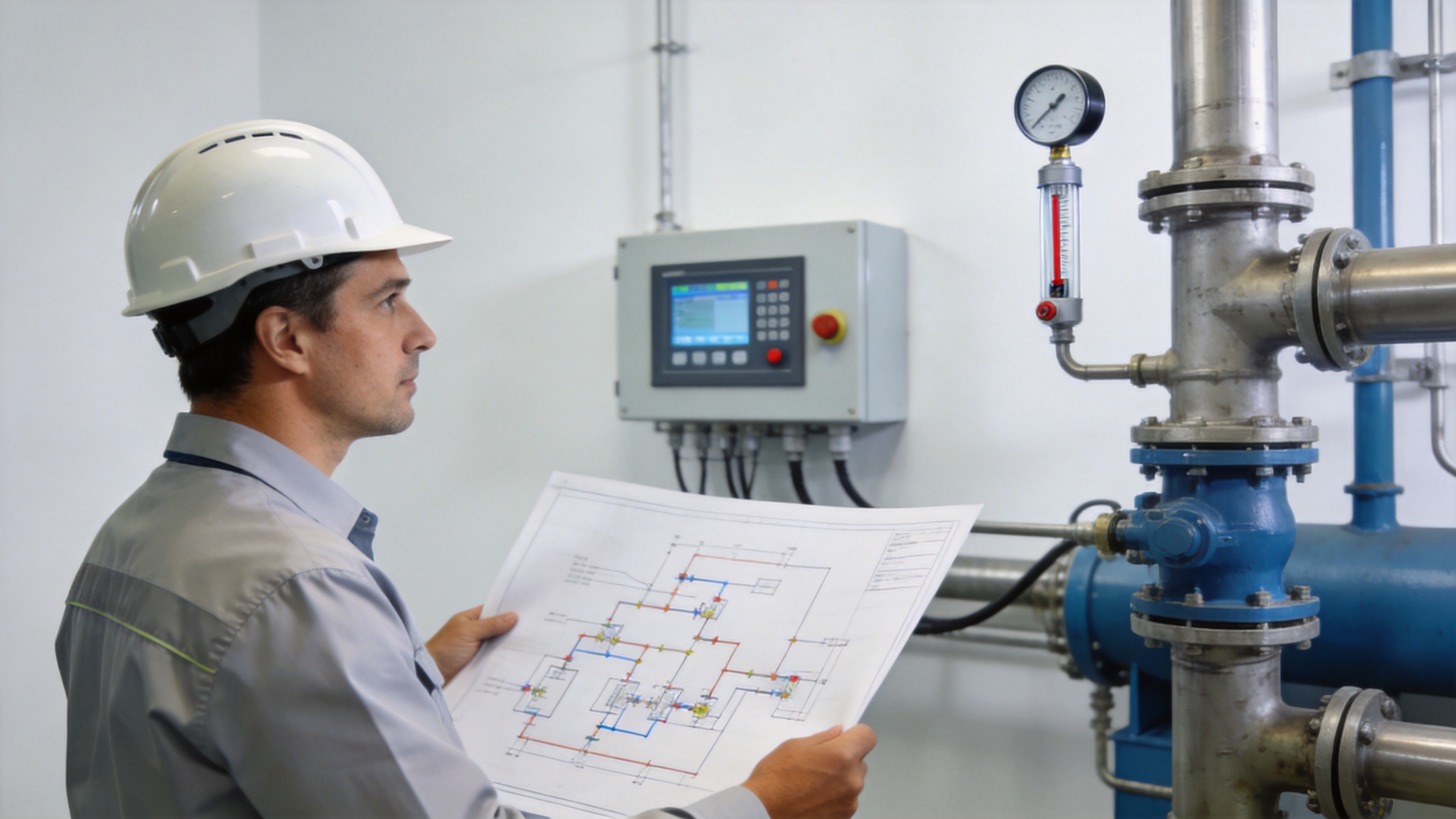
For a complex industrial cooling system, request a preliminary sequence of operation. It does not need to be a final controls document at the quotation stage, but it should show how setpoints, alarms, interlocks, remote signals, and abnormal conditions will be handled. This makes it easier to compare one industrial cooling equipment manufacturer with another on coordination quality rather than on price alone.
Check the supplier’s selection method
Ask each industrial cooling equipment manufacturer to identify the design conditions used in its calculation. Useful questions include: What heat load margin is assumed? Which fluid properties are used? At what ambient temperature is performance evaluated? Is the stated capacity net of pump heat and loop losses? What happens at minimum load or during start-up? Clear answers reveal whether the proposal is tied to the process or based on a generic selection.
Refrigeration-system selection also has a safety and installation context. ISO 5149-1:2014 specifies classification and selection criteria for refrigerating systems and heat pumps, while ISO 5149-2:2014 addresses design, construction, and installation elements such as piping, components, materials, and ancillary equipment. The relevant rules depend on jurisdiction and project conditions, so ask the industrial cooling equipment manufacturer how applicable standards and local requirements are considered rather than assuming a standard label settles every question.
Review evidence, documentation, and service readiness
Evidence is more valuable than broad capability statements. Request the documents that are relevant to your project: a data sheet tied to the specified duty, a general arrangement drawing, utility requirements, electrical information, control-connection details, an outline of inspection or test records, and recommended maintenance tasks. An industrial cooling equipment manufacturer should be able to say which information is available before order, during design review, and at handover.
Service planning deserves equal attention. Ask where technical support is coordinated, what fault information can be read remotely if remote access is permitted, which consumables or service parts should be identified beforehand, and what training or handover material is included. For an industrial cooling system supporting production, a well-defined escalation path can be as important as the original equipment configuration.
Turn commissioning into a selection criterion
Do not leave acceptance until the equipment arrives. Agree early on the measurable conditions that will be checked: supply temperature, stability band, flow, pressure, alarm behavior, control response, and the operating load or simulation method. A responsible industrial cooling equipment manufacturer can help clarify which results are verified at its facility, which are verified after installation, and which depend on site utilities and the connected process.
This matters because a factory test and a site acceptance test answer different questions. The factory test can confirm agreed equipment functions under defined conditions. Site commissioning checks the assembled industrial cooling system, including piping, controls, utilities, and process connections. Writing those boundaries into the purchase specification reduces ambiguity for both the buyer and the industrial cooling equipment manufacturer.
Use a weighted shortlist instead of a quick ranking
Create a comparison table with the same categories for every bidder: application understanding, duty-point transparency, system-connection scope, controls coordination, safety and documentation approach, testing plan, service model, delivery assumptions, and commercial terms. Give each category a weight that reflects the project’s exposure. For example, a temperature-sensitive process may assign more importance to control strategy and acceptance testing than to cabinet finish or a nominal capacity difference.
Then hold a technical clarification meeting with the shortlisted industrial cooling equipment manufacturer candidates. Provide the same unanswered questions to each supplier and record revisions. This creates an auditable decision trail and often exposes differences that do not appear in first quotations.
Final questions before placing an order
- Has the industrial cooling equipment manufacturer confirmed the design duty, fluid, ambient, utilities, and control connection in writing?
- Are equipment scope, site scope, and responsibilities separated clearly?
- Are drawings, test records, manuals, spare-parts guidance, and training deliverables identified?
- Does the acceptance plan define what will be measured, where it will be measured, and under what load?
- Does the supplier identify assumptions and open technical risks instead of hiding them in a quotation?
The right industrial cooling equipment manufacturer is the one whose proposal can be traced back to your process conditions and verified through agreed evidence. By comparing selection logic, integration scope, documentation, and commissioning criteria—not just initial price—you can build a more reliable basis for an industrial cooling system purchase.
 Hot News