
How a Custom Semiconductor Heating Jacket Meets Unique Specs
A custom semiconductor heating jacket is not simply insulation with a heater added. In semiconductor equipment, the jacket has to fit a real assembly, transfer heat in a controlled way, and work alongside sensors, wiring, process connections, and service access. That is why the most useful conversation begins with the equipment conditions rather than a catalog shape.
From an equipment-integration viewpoint, a custom semiconductor heating jacket should be defined by the component it surrounds and the process it supports. A straight section of pipe, an irregular valve body, a chamber connection, or a vessel can create very different design questions. The goal is to turn the thermal requirement into clear inputs and then verify the configuration against the installation.
Start with the semiconductor equipment scenario
A custom semiconductor heating jacket may be considered where a process line, chamber-related component, or fluid-handling assembly needs controlled heat retention or a managed warm-up profile. The same phrase can describe very different installations, so the first task is to identify what is being heated, why its temperature matters, and which parts of the assembly may remain exposed.
For semiconductor equipment, thermal uniformity is often a process concern rather than a cosmetic specification. A jacket that follows the geometry poorly may leave local heat-loss paths. Conversely, a close mechanical fit alone does not establish a suitable solution; the process temperature target, heat loss, thermal mass, ambient conditions, and operating sequence all affect the judgment.
Before selecting a custom semiconductor heating jacket, collect a drawing or dimensional survey, the component material, the intended temperature range, the expected operating duration, and any insulation or access constraints. If the heating need changes by production phase, document the phases separately. That distinction helps separate a steady holding duty from a staged warm-up requirement.
Translate unique specs into design inputs
The value of a custom semiconductor heating jacket comes from converting vague requirements into measurable design inputs. “Tight space,” “sensitive process,” or “difficult access” are useful starting points, but they need to become dimensions, clearance limits, connection locations, and acceptance checks.
Geometry and thermal contact
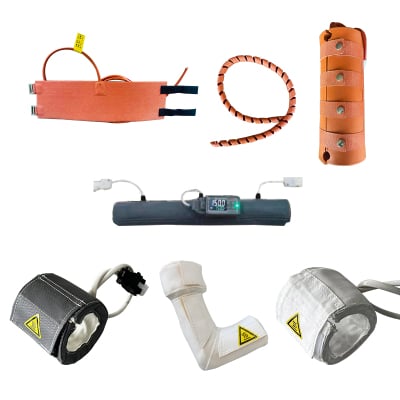
Shape is usually the first customization issue. Bends, fittings, flanges, supports, sensors, and removable covers can interrupt a uniform wrap. A custom semiconductor heating jacket may need sections, cut-outs, closures, or a split construction so it can be installed without disturbing adjacent equipment. Each feature should be reviewed for its effect on contact, insulation continuity, and removal during maintenance.
Ask where the jacket may touch the equipment, where it must stop, and which locations need access after installation. A design that looks compact in a drawing can still conflict with a cable route, a clamp, or a service procedure. A simple fit-up review before fabrication can surface these conflicts early.
Temperature control and sensing
For a custom semiconductor heating jacket, the heater, controller, sensor location, and protective functions should be treated as one control system. The sensor position influences what the controller sees; it may not represent every point on a complex surface. Where the process is sensitive, the team can decide whether one measured location is sufficient or whether zoning and additional verification points are needed.
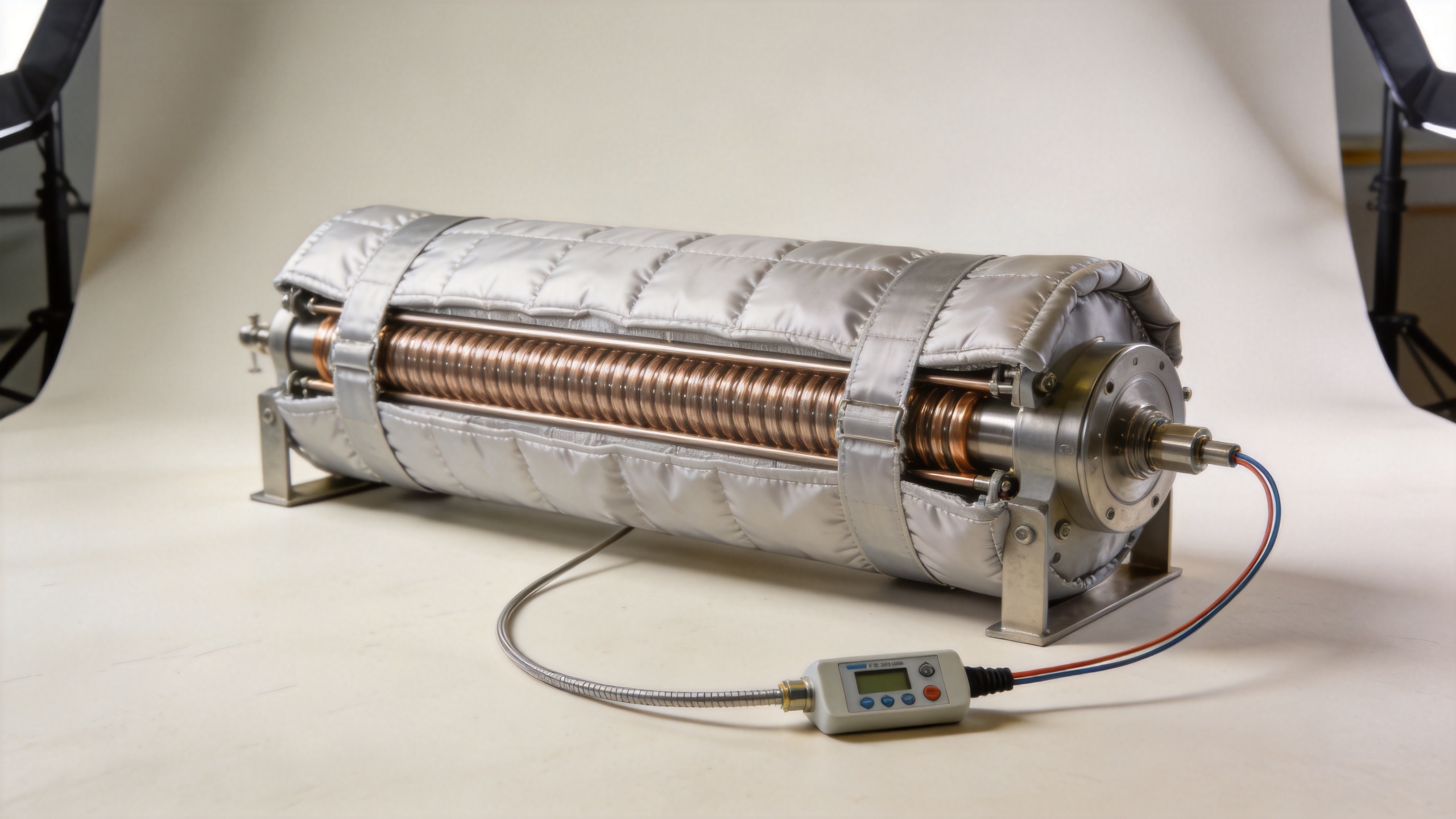
Safety guidance for heated semiconductor equipment commonly calls attention to automatic temperature control, power interruption, suitable materials, and fail-safe over-temperature protection in applicable situations. That does not mean every installation has identical obligations. It does mean those items belong on the project review list, along with the applicable site rules and equipment documentation.
Materials, cleanliness, and interfaces
Material selection for a custom semiconductor heating jacket depends on the surrounding environment and the component being covered. Consider surface-contact compatibility, possible process exposure, particulate-control expectations, cleaning methods, and the temperature range. Electrical leads, sensor wiring, grounding arrangements, and connector placement also need to fit the equipment layout rather than becoming an afterthought.
Integration extends beyond the jacket itself. Review electrical supply details, control signals, alarms or interlocks, support points, and the route used for installation. When a system already has a higher-level controller, clarify who owns setpoint control, alarm handling, and shutdown logic. Those questions are more useful than assuming a standalone jacket will automatically fit an existing system.
Build a configuration and verification plan
A custom semiconductor heating jacket is more reliable as a project definition when configuration and validation are planned together. The supplier and equipment team can use the same checklist to reduce gaps between the initial request and commissioning.
- Define the duty: record the temperature objective, ambient environment, operating sequence, and available heating time.
- Confirm the envelope: provide dimensions, obstructions, access points, tolerances, and preferred closure direction.
- Map interfaces: identify power, sensor, control, grounding, cable routing, and any alarm or interlock expectations.
- Review materials: check compatibility with the equipment surface, local environment, cleaning approach, and process restrictions.
- Set acceptance criteria: agree on fit, functional checks, sensor response, protective-function checks, and any required site review before installation.
It also gives teams a clearer basis for comparing alternatives. Rather than comparing only wattage or an outer material, compare how each custom semiconductor heating jacket addresses the complete equipment envelope and the verification work that remains.
Common specification gaps to address early
Several omissions can slow a custom semiconductor heating jacket project. One is providing a target temperature without the component mass, insulation condition, or expected ramp time. Another is omitting the location of sensors, ports, brackets, and service panels. A third is treating wiring and control integration as field details after the thermal design is already fixed.
It is also wise to distinguish an initial engineering concept from a released configuration. A custom semiconductor heating jacket can be evaluated against drawings and stated conditions, but final suitability still depends on confirmed installation details and appropriate functional checks. This is especially relevant where the heater is near process hardware or where temperature behavior affects a sensitive step.
What to send with a custom request
To move a custom semiconductor heating jacket discussion forward, prepare a concise technical package: photographs or drawings of the component, key dimensions, a list of nearby obstructions, the desired temperature range, operating cycle, material and cleanliness considerations, power availability, controller preference, and required documentation. Include questions that remain open rather than filling gaps with assumptions.
Lingheng Thermal Control Technology (Suzhou) Co., Ltd. discusses thermal-management projects through application conditions such as temperature range, heat load, medium, and control interfaces. For a semiconductor installation, that condition-based conversation helps engineering and procurement teams decide which details must be verified before a heating jacket configuration is released.
Make customization a controlled engineering step
A custom semiconductor heating jacket meets unique specs when the requirements are specific enough to guide geometry, contact, control, protection, materials, and integration. The next step is to move beyond a generic description. It is to assemble the equipment data, identify the interfaces, and define the checks that will confirm the jacket fits the intended duty. With that information in hand, a heating jacket can be reviewed as part of the semiconductor equipment system rather than as an isolated accessory.
 Hot News