Why an Etch Heating Jacket Boosts Process Consistency
An etch heating jacket is easy to underestimate because it sits outside the process zone. In semiconductor etch work, however, temperatures at chamber walls, delivery components, exhaust-adjacent hardware, and other exposed surfaces can influence how consistently a tool reaches and holds its intended state. An etch heating jacket does not replace wafer-chuck control, gas-flow management, pressure control, or recipe qualification. It can support those controls by reducing a thermal variable that might otherwise drift between runs.
From a process engineer’s perspective, it is more useful to ask than simply whether any etch heating jacket raises temperature. The question is whether its temperature zone, heat transfer, sensing, insulation, and control response fit the hardware and process window. When those conditions are verified, a heating jacket can help an engineering team create a more repeatable thermal environment around selected components.
Thermal consistency is part of etch consistency
Plasma etching is sensitive to interacting conditions. Wafer temperature, chamber condition, gas chemistry, pressure, RF power, surface state, and elapsed time after cleaning can all affect results. Published technical discussions of plasma etching likewise identify temperature as a meaningful process variable and describe thermalized conditions as one route to better temperature control and reproducibility. That does not mean an external etch heating jacket controls all of those variables. It means the jacket should be treated as one element in a wider control plan.
For example, a component that repeatedly cools during idle periods may take longer to return to a stable state at startup. If that component also sees reactive gases or condensable by-products, its surface temperature can become a practical troubleshooting point. A properly specified etch heating jacket may help narrow temperature variation at that location. The effect on etch results still needs to be demonstrated through the facility’s own qualification method.
Where an etch heating jacket can add value
Supporting stable surface conditions
The jacket assembly can be applied around hardware where controlled external heating is appropriate, such as selected lines, fittings, valves, chambers, or ancillary assemblies. The aim is usually not to make every surface hotter. It is to hold a selected surface within an agreed operating band after the mechanical design, material compatibility, safety review, and process requirements are understood.
Uniform contact matters. A loose wrap, poorly matched geometry, uninsulated gaps, or a sensor located far from the area of concern can make the controller display look settled while the hardware still has a gradient. This is why an etch heating jacket should be reviewed as an installed thermal assembly, not merely as a heater with a rated wattage.
Reducing startup and recovery uncertainty
After maintenance, wet cleaning, recipe changes, or planned downtime, a tool may require a stabilization period. The duration and purpose of that period depend on the process. A controlled thermal wrap can support a documented warm-up sequence for its assigned component. It cannot establish readiness by itself; pressure behavior, leak checks, sensor values, wafer-level metrology, and recipe-specific criteria remain part of the decision.
On the shop floor, the conversation usually starts with a few plain questions: Which location is being heated? What temperature must it reach? How is the temperature measured? How long does equilibrium take under actual airflow and surrounding loads? The installed assembly earns its place when those questions have measured answers rather than assumed ones.
Managing local cold areas
Cold areas can be relevant when a process or gas-delivery arrangement has temperature-sensitive behavior. Yet the selected heating assembly should not be specified from that statement alone. Heating one area can shift the thermal balance elsewhere, so the surrounding insulation, heat sinks, clamps, access panels, and nearby cooling circuits need review. Extra heat is not automatically a better result; a controlled, verified distribution is the target.
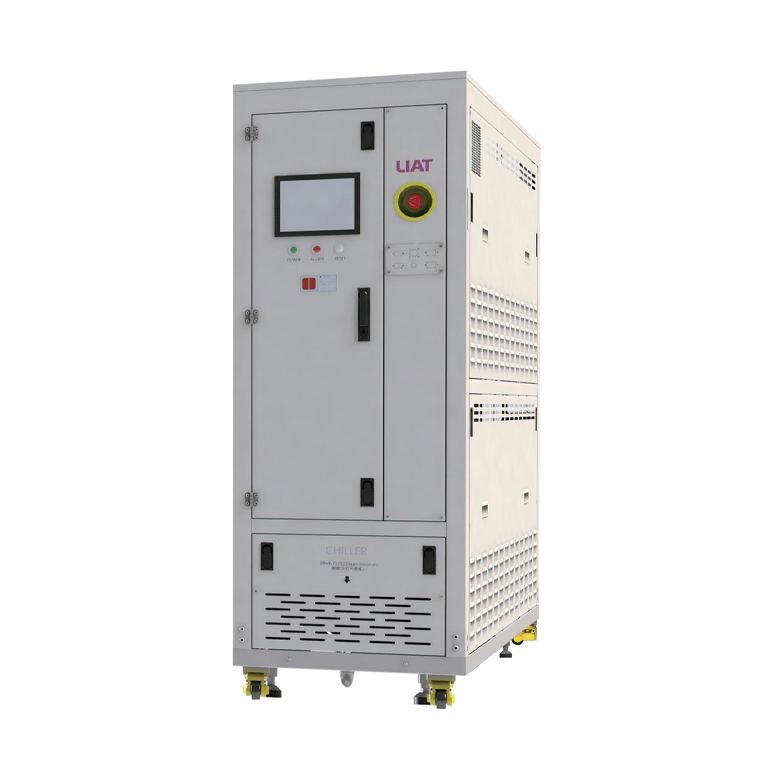
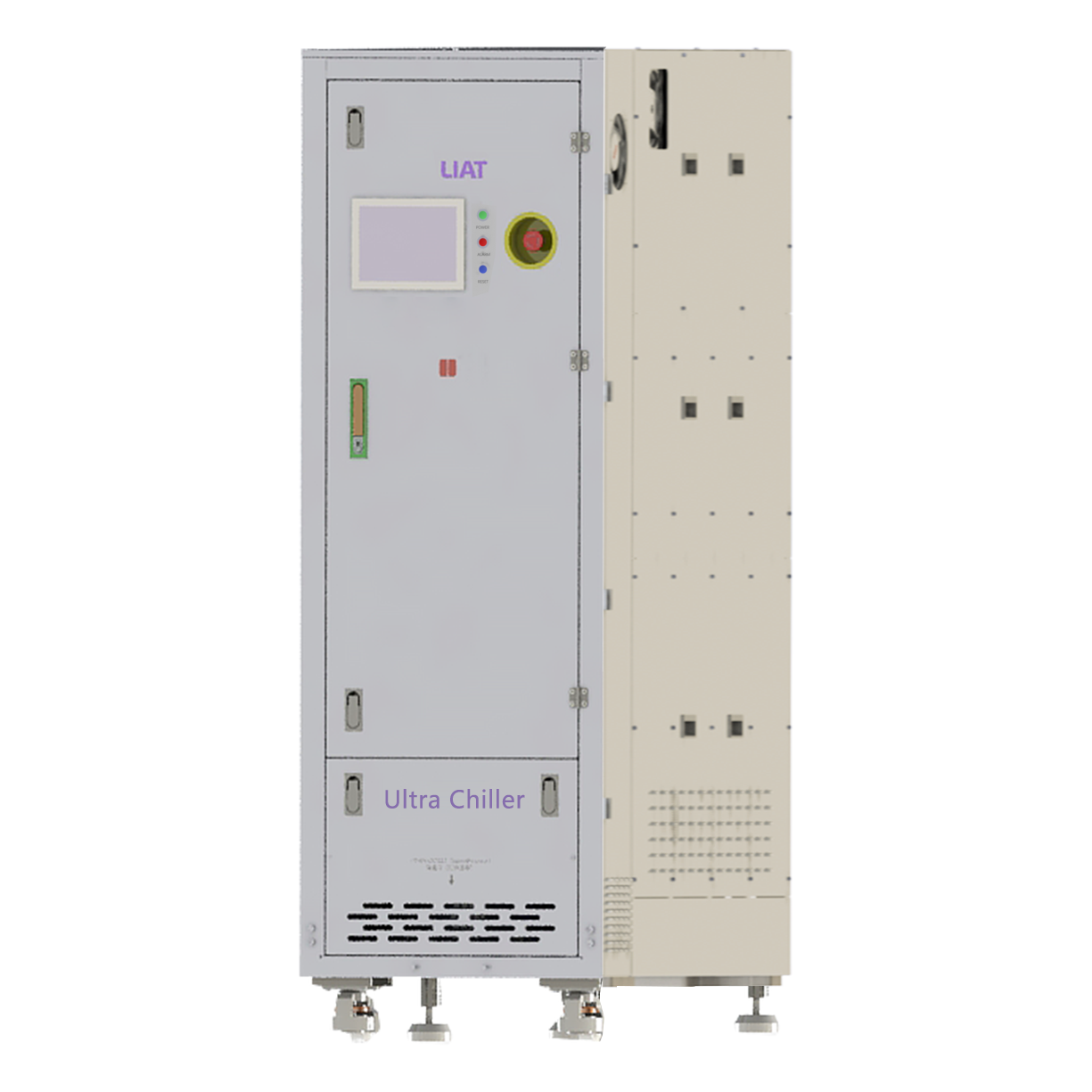
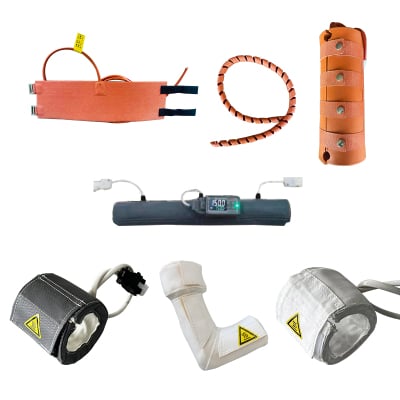
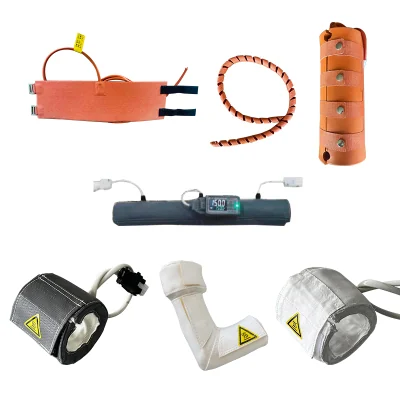 Concept image illustrating a fitted heating jacket and external temperature-control hardware.
What separates a process-ready heating jacket from a generic wrap
A generic heating jacket may not match the geometry, cleanroom practices, electrical routing, control integration, or service access of semiconductor equipment. For an etch heating jacket, the engineering conversation should cover the following points:
- Geometry and coverage: Define the real heated length, bends, ports, flanges, brackets, and access areas rather than relying on a nominal diameter.
- Temperature range and uniformity target: Set the allowable band at the component, not only the controller setpoint.
- Sensor strategy: Confirm sensor type, placement, attachment method, redundancy needs, and how sensor readings will be checked.
- Control behavior: Review ramp limits, overshoot response, alarms, interlocks, and the interface with the tool or facility controls.
- Materials and serviceability: Verify compatibility with the local environment and allow removal for inspection or maintenance.
These details matter because an etch heating jacket is used in a system, not in isolation. A strong specification maps the jacket configuration to the component, its thermal load, adjacent equipment, utilities, and required maintenance steps.
A practical commissioning sequence
Before process use, establish a baseline. Record temperatures at agreed points during idle, warm-up, steady operation, and recovery. Then introduce the etch heating jacket under a controlled change procedure and compare the same conditions. If process monitoring is available, correlate the thermal record with relevant indicators such as endpoint behavior, chamber conditioning trends, or wafer-level outcomes. Correlation is not proof, but it helps focus the next experiment.
Next, test realistic disturbances. Open and close permitted panels, run the normal utility configuration, simulate the expected pause between lots, and observe whether the etch heating jacket reaches equilibrium without excessive overshoot. Check cable routing, strain relief, sensor attachment, insulation condition, alarm response, and access for technicians. The acceptance record should state what was tested and what remains outside the jacket’s scope.
How to avoid common specification mistakes
The first mistake is choosing an etch heating jacket solely by maximum temperature or watt density. Those figures may be relevant, but they do not describe installed uniformity. The second is treating the controller display as the component temperature. The third is omitting a maintenance plan: damaged insulation, shifted sensors, contaminated surfaces, or changed clamps can alter heat transfer over time.
A more reliable approach is to define an etch heating jacket as a controlled subsystem. Document the target component, temperature band, sensor locations, operating sequence, alarm limits, inspection points, and requalification triggers. If the process changes, reassess the jacket rather than assuming an earlier setup remains appropriate.
Questions to ask before selecting an etch heating jacket
- Which component needs thermal stabilization, and what evidence identifies it as a contributor to variation?
- What operating band is required at the component under actual process conditions?
- How will an etch heating jacket fit around ports, supports, instrumentation, and service access?
- Which sensor locations represent the temperature that matters to the process?
- What control, interlock, documentation, and maintenance requirements apply to the installation?
That line of questioning turns a product feature list into an engineering decision. They also help separate a useful etch heating jacket application from a change that adds heat without resolving the original source of drift.
Conclusion
An etch heating jacket can contribute to process consistency by helping stabilize selected thermal conditions around etch equipment. Its value depends on the process window, component geometry, heat-loss paths, sensing strategy, controller behavior, and verification plan. When it is specified and qualified as part of the whole thermal-control system, a heating jacket can give engineers one more measured lever for reducing avoidable variation.
 Hot News