
How a Heating Jacket Maintains Even Heat on Process Lines
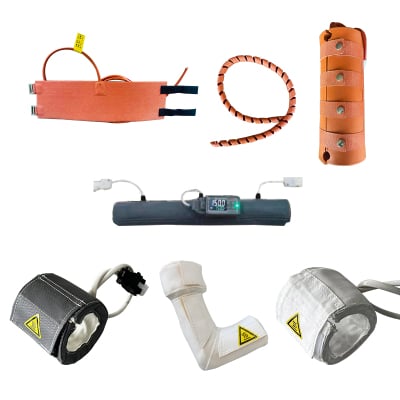
On a process line, a heating jacket is not simply insulation with a power lead. It is a controlled heat-transfer assembly wrapped around a pipe, valve, filter, or other component to offset heat lost to the surroundings and hold the product within a usable temperature band. When a process fluid becomes more viscous as it cools, begins to crystallize, or must remain near a defined temperature, even heating matters because one cold section can affect the whole line.
From a thermal-management application engineer’s perspective, the useful question is not “How hot can the jacket get?” It is whether the heat input, contact area, insulation, sensing, and control strategy match the pipe geometry, medium, heat loss, and operating cycle. That is how an industrial heating jacket helps create a more even temperature profile rather than merely making one point feel hot.
The basic job: replace heat that the process line loses
A pipe carrying a warm liquid loses energy through its wall, insulation, fittings, and exposed surfaces. The loss changes with ambient temperature, airflow, line diameter, insulation condition, pipe material, and the temperature difference between the fluid and its environment. A heating jacket supplies thermal energy around the external surface so the system can compensate for that loss.
Unlike passive insulation, active heating is adjustable. The insulation layer reduces outward loss, while the heating layer provides input where the process needs it. This combination is why a heating jacket can be useful for temperature maintenance, controlled warm-up, freeze protection, or viscosity management. However, insulation alone does not guarantee uniformity. The jacket still needs suitable coverage and control.
Why surface coverage matters for even heat
Even heat begins with distributing the heater over enough of the component surface. A pipe heating jacket normally conforms to the outside of a straight section, elbow, valve, or instrument body instead of concentrating heat at a single narrow band. Flexible heating elements arranged through the jacket place heat closer to the full circumference, and the outer insulation slows the loss of that energy to the environment.
Good physical contact reduces air gaps between the heated layer and the process component. Large gaps, loose closures, damaged insulation, or an incorrectly shaped jacket can turn a designed heating pattern into local hot and cold areas. This is especially important at geometry changes. Flanges, valves, supports, and bends often shed heat differently from a straight pipe, so a pipe heating system should treat those locations as design checks rather than afterthoughts.
It is also useful to separate two ideas: a jacket can heat its own surface quickly while the pipe wall and fluid respond more slowly. Wall thickness, flow rate, fluid properties, and starting temperature influence how the heat moves inward. For that reason, a uniform external jacket pattern supports even process temperature, but it does not remove the need to verify the actual process response.
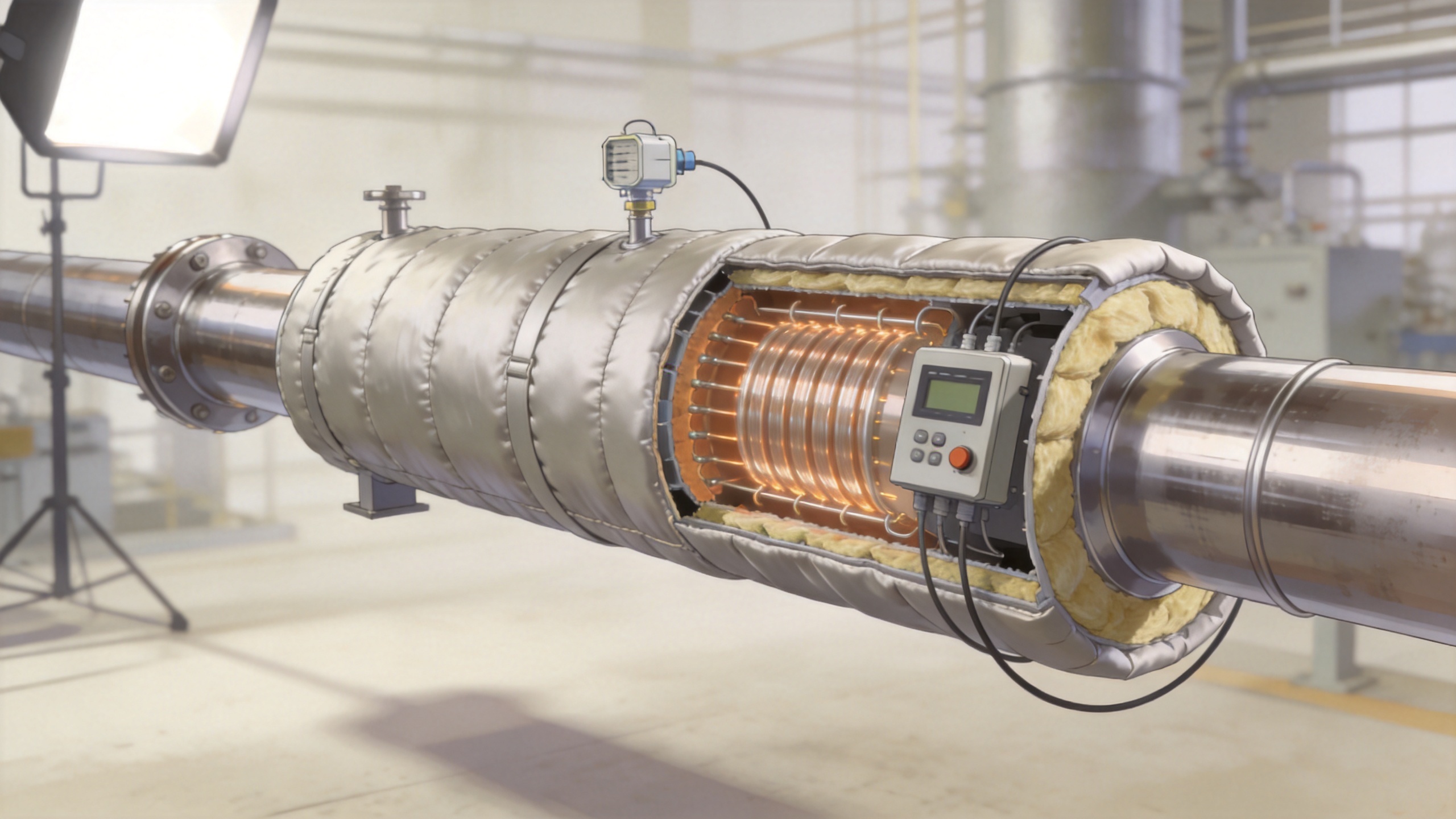
Heating zones prevent one condition from dictating the whole line
Long lines and complex assemblies can experience different heat loss. A section close to an open door, a valve cluster, or a metal support may cool faster than a sheltered straight run. Dividing a heating jacket arrangement into independently controlled zones lets the system respond to these differences. Each zone can receive a suitable amount of power based on its sensor reading and the operating requirement.
That does not mean every line needs many zones. More zones add wiring, controls, and commissioning work. The practical decision depends on line length, geometry, ambient variation, temperature tolerance, and the consequences of a cold spot. If the only known input is a target temperature, the requirement is still incomplete; heat loss and expected load variation are needed before zone boundaries can be evaluated.
Sensors and controllers turn heat input into temperature control
A heating element without feedback may continue adding energy after process conditions change. A controlled industrial heating jacket uses temperature sensing and a controller to compare measured temperature with a setpoint. The controller then cycles or modulates the heat input to reduce the difference. Depending on the application, the sensor may be placed on the pipe wall, within the medium, or at a representative point identified during engineering.
Sensor location is not a minor installation detail. A sensor positioned in a sheltered warm area may tell the controller that the line is at temperature while an exposed section remains cool. Conversely, a sensor close to a concentrated heat source can make the controller reduce output too early. A sensible verification plan looks at where heat is lost, where the process is most sensitive, and whether the selected point represents the condition that needs protection.
Control tuning also matters. A controller that reacts too aggressively can create repeated overshoot and undershoot; a response that is too slow can allow temperature drift during flow or ambient changes. The appropriate settings depend on the thermal mass of the pipe and contents, the jacket watt density, the sensor arrangement, and the required stability. Those settings should be validated for the actual line, not borrowed blindly from another installation.
Insulation makes the heating jacket more consistent and efficient
Once heat reaches the pipe, it can still escape outward. The jacket’s insulation layer limits this loss and helps the heating element work against the process rather than against the room. It also reduces the difference between exposed and sheltered areas, provided the insulation coverage remains continuous.
Seams, closures, wet insulation, damaged outer covers, and uninsulated attachments can become weak points. In a pipe heating jacket installation, inspect these areas alongside electrical connections. A well-sized heater cannot fully compensate for an installation that loses heat unpredictably around joints and fittings.
Common reasons a process line still heats unevenly
- Incorrect heat-loss assumptions: Ambient conditions, airflow, pipe supports, and exposed fittings may be different from the original estimate.
- Incomplete coverage or poor fit: Gaps and loose sections reduce heat transfer and increase localized losses.
- One sensor for varied conditions: A single measurement may not represent the coldest or most critical location.
- Insufficient zoning: One controller may be trying to serve sections with very different thermal loads.
- Process changes: Altered flow rate, product formulation, batch cycle, or ambient conditions can change the thermal demand.
- Installation or maintenance issues: Damaged insulation, degraded fasteners, wiring faults, and unverified controller settings can all affect temperature consistency.
A practical verification checklist
Before specifying or troubleshooting a pipe heating system, collect the conditions that shape the heat balance. This prevents a nominal temperature rating from being treated as a complete design answer.
- Define the target temperature band and the maximum permitted variation.
- Identify the fluid or medium, including whether viscosity, crystallization, or freeze risk changes with temperature.
- Map the line: diameters, lengths, bends, valves, flanges, supports, and exposed components.
- Record ambient temperature range, airflow, washdown or weather exposure, and available installation space.
- Estimate heat loss and expected changes in load during start-up, steady operation, and process transitions.
- Decide where zones and sensors should represent the most demanding conditions.
- Verify the installation with measured temperatures at several meaningful locations, not at only one convenient point.
The engineering takeaway
A heating jacket maintains even heat by combining distributed contact, appropriately selected heating capacity, insulation, temperature sensing, and feedback control. The jacket is one part of a thermal system, not a substitute for understanding the line. With a clear picture of heat loss, geometry, medium, and control points, an industrial heating jacket can support steadier process conditions and make deviations easier to identify.
For a new installation or a troublesome existing line, begin with the process conditions and the coldest observed locations. Then confirm coverage, fit, sensor placement, zoning, and controller behavior against those conditions. That sequence gives a more reliable basis for evaluating a pipe heating jacket than comparing a single headline specification.
 Hot News