
Why Pipe Heating System Reliability Protects Process Repeatability
When a process becomes inconsistent, the cause may lie beyond the vessel, pump, or raw material. Temperature drift along transfer lines can change viscosity, flow resistance, crystallization behavior, and the time required for a material to reach the next operation. A reliable pipe heating system helps prevent that hidden source of variation by keeping the actual pipe condition closer to the intended process condition.
From a heat-management application engineer’s perspective, the useful question is not whether a pipe heating system can get hot. It is whether the system can deliver controlled, observable heat at the locations and times the process needs it. That distinction matters when repeatable batches, predictable transfer, and stable start-up behavior are more valuable than a high heater rating on paper.
Repeatability begins with the temperature of the material, not the controller set point
Many process specifications define a temperature window for a liquid, slurry, resin, wax, oil, or other temperature-sensitive medium. Yet a controller set point does not automatically prove that the medium stays in that window throughout a line. Ambient loss, fittings, valves, supports, insulation gaps, changing flow rates, and uneven heat contact can all create local differences.
A well-engineered pipe heating system addresses this gap by treating the line as a thermal path rather than a single device. It applies controlled heat to pipes and associated components so the process medium can be maintained at an intended condition. In practical terms, that gives operators a more consistent starting point before they judge pump performance, mixing behavior, fill time, or downstream quality.
This does not mean every process requires the same temperature or the same construction. The correct approach depends on the target temperature range, pipe geometry, medium, heat loss, operating cycle, cleaning method, electrical classification, and control requirements. Before choosing equipment, confirm those conditions; a nominal heater output alone is not enough to establish suitability.
How unreliable heating creates process variation
An unreliable pipe heating system can introduce variation in several ways. A slow warm-up may delay production or encourage operators to begin before the line has stabilized. A hot spot can alter sensitive material near one location while a cold section raises viscosity elsewhere. Intermittent sensor signals may cause the controller to cycle heat at the wrong time. A loose or poorly positioned temperature sensor can accurately report the wrong surface condition.
- Transfer inconsistency: a colder section can raise resistance and make flow or delivery time less predictable.
- Material-condition variation: a medium may become more viscous, partially solidify, or behave differently at the next process step.
- Operator workarounds: manual overrides, improvised insulation, or longer warm-up periods can hide the original control problem while adding new variation.
- Recovery uncertainty: after a shutdown, maintenance event, or product changeover, the line may not return to the same thermal state without a defined restart sequence.
These are system-level issues. A pipe heating system should therefore be evaluated with the pipe, insulation, controls, power supply, mounting method, and process procedure in view. Looking only at the heater can miss the interface where repeatability is lost.
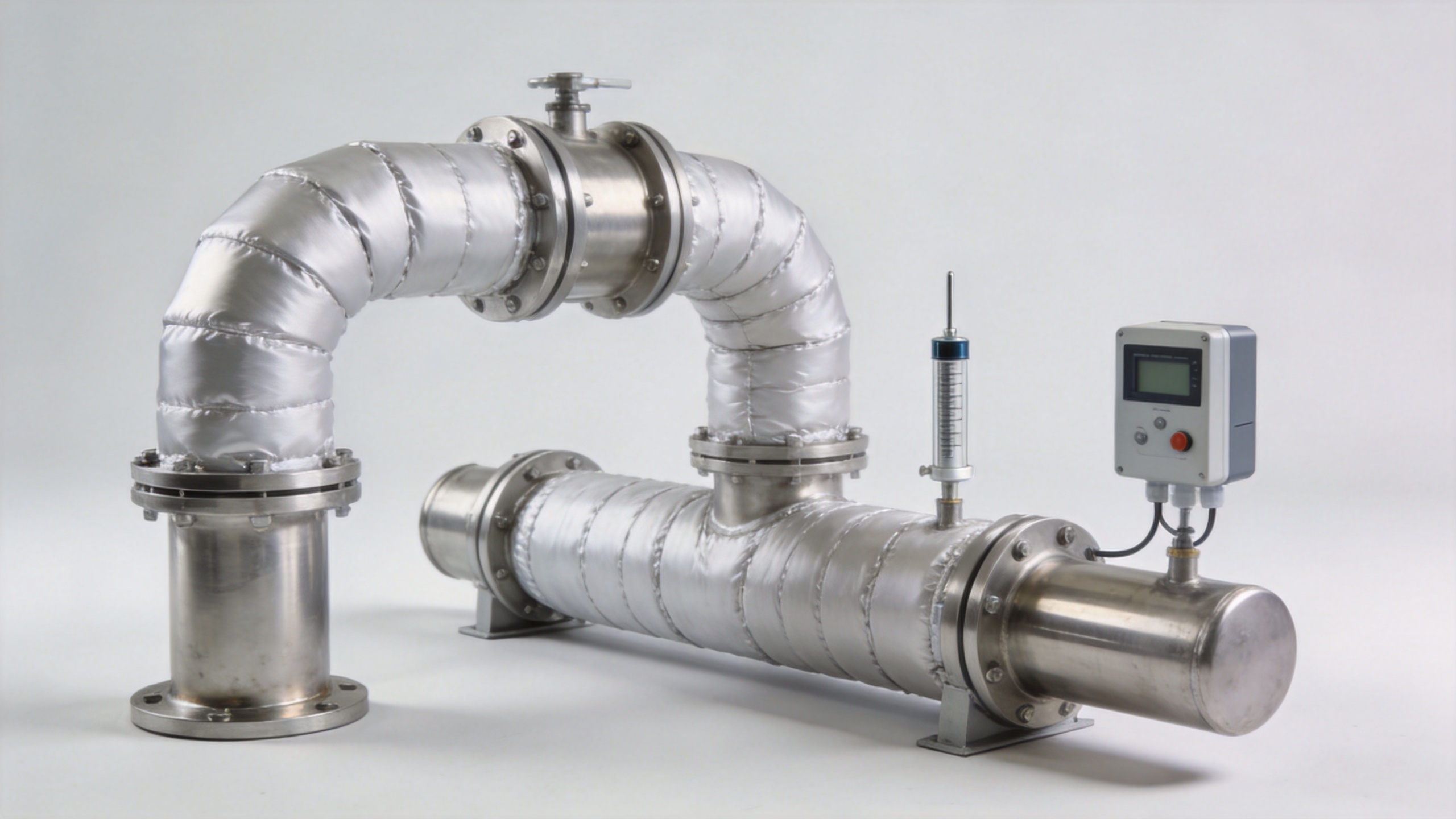
Why feedback control matters more than simple heat input
A dependable pipe heating system uses a feedback loop: a sensor measures a relevant temperature, the controller compares that signal with a set point, and the system adjusts heat output. The basic concept is straightforward, but execution determines whether the result is repeatable.
First, select a measurement point that represents the decision being made. If the objective is material temperature, a measurement location that only reflects a remote outer surface may need additional validation. Second, define what normal controller cycling looks like under real flow and ambient conditions. Third, set alarm and response rules that help the team recognize sensor faults, unexpected heat loss, or an abnormal warm-up before production is affected.
A pipe heating system with temperature control is most useful when the control logic is paired with a commissioning record. Record the set point, sensor location, line configuration, insulation condition, expected warm-up behavior, and verified response after a controlled disturbance. That record makes future troubleshooting more objective: the team can compare observed behavior with a known baseline rather than rely on memory.
Where a pipe heating jacket supports stable thermal contact
For lines with bends, valves, flanges, or complex access constraints, a pipe heating jacket can be a practical way to place heat around the equipment while retaining service access. The value of a pipe heating jacket is not simply flexibility. It is the ability to create a repeatable installation method when the jacket fits the actual geometry, closes consistently, and works with the specified insulation and sensor arrangement.
A heating jacket should be assessed for contact coverage, closure condition, removable sections, cable routing, sensor clearance, and the condition of adjacent insulation. On unusual pipe sections, a pipe heater jacket may make inspection and replacement easier than a permanent arrangement. However, a pipe heater jacket still needs a defined installation orientation and a documented check after reassembly. A jacket that is correctly designed but inconsistently fitted may produce different thermal results from one maintenance cycle to the next.
A practical reliability checklist for a pipe heating system
Use this checklist to make a pipe heating system part of process control rather than a passive utility:
- Define the process objective. State whether the line must prevent freezing, reduce viscosity variation, maintain transfer temperature, or support controlled warm-up.
- Map the thermal path. Identify pipes, valves, instruments, low points, exposed fittings, and insulation transitions that can affect temperature uniformity.
- Verify sensor relevance. Confirm that each sensor location supports the control decision and can be inspected or replaced without guessing.
- Test under operating conditions. Observe warm-up, steady operation, flow changes, and recovery after a planned interruption instead of validating only at idle.
- Document the baseline. Keep the set point, sensor location, control settings, jacket configuration, insulation condition, and acceptance observations together.
- Maintain the interfaces. Include electrical connections, controllers, sensors, heater sections, closures, and insulation in planned inspections.
The checklist should be adapted to the actual medium and operating constraints. For example, a heating jacket used around a valve may deserve a different inspection point than a straight-run jacket, while a long pipe heating system may require several thermal zones rather than one measurement point.
Reliability protects the process window
The strongest case for a pipe heating system is not that it adds heat. It is that it helps protect a defined process window across normal production, start-up, changeover, and recovery. When material temperature enters the next step more consistently, teams can make better decisions about the variables that remain.
Start with the process conditions: target range, heat loss, medium behavior, line layout, sensor placement, control expectations, and service access. Then verify the installed pipe heating system against those conditions. A reliable design, paired with disciplined commissioning and maintenance, gives repeatability a thermal foundation instead of leaving it to operator intervention.
 Hot News