
How a Water Cooled Industrial Chiller Delivers Continuous Duty
A water cooled industrial chiller is often selected when a process needs heat removed for long shifts rather than in short, isolated bursts. Continuous duty is not a switch that a chiller simply has or does not have. It is the result of a refrigeration circuit, process-water circuit, condenser-water circuit, controls, and maintenance routine working within verified conditions. From a thermal-management application engineer’s perspective, the useful starting point is the heat load, required supply temperature, fluid, and operating schedule—not a nameplate comparison alone.
For an industrial water chiller, sustained operation means the system can repeatedly absorb process heat, move it through the refrigeration circuit, and reject it at the condenser without drifting outside the agreed process limits. The actual duty point still needs confirmation against the project’s load profile, ambient conditions, flow, water quality, and control logic.
What continuous duty means in an industrial cooling loop
In practical terms, continuous duty describes operation through the production period while maintaining a stable process-water condition. It does not mean that the compressor must run at one fixed output all day, nor does it mean the chiller can support any load indefinitely. A well-matched water cooled industrial chiller cycles or modulates in response to load while the system maintains the required heat-transfer path.
That path has three connected jobs:
- Process side: water or another approved fluid transports heat from the equipment or process.
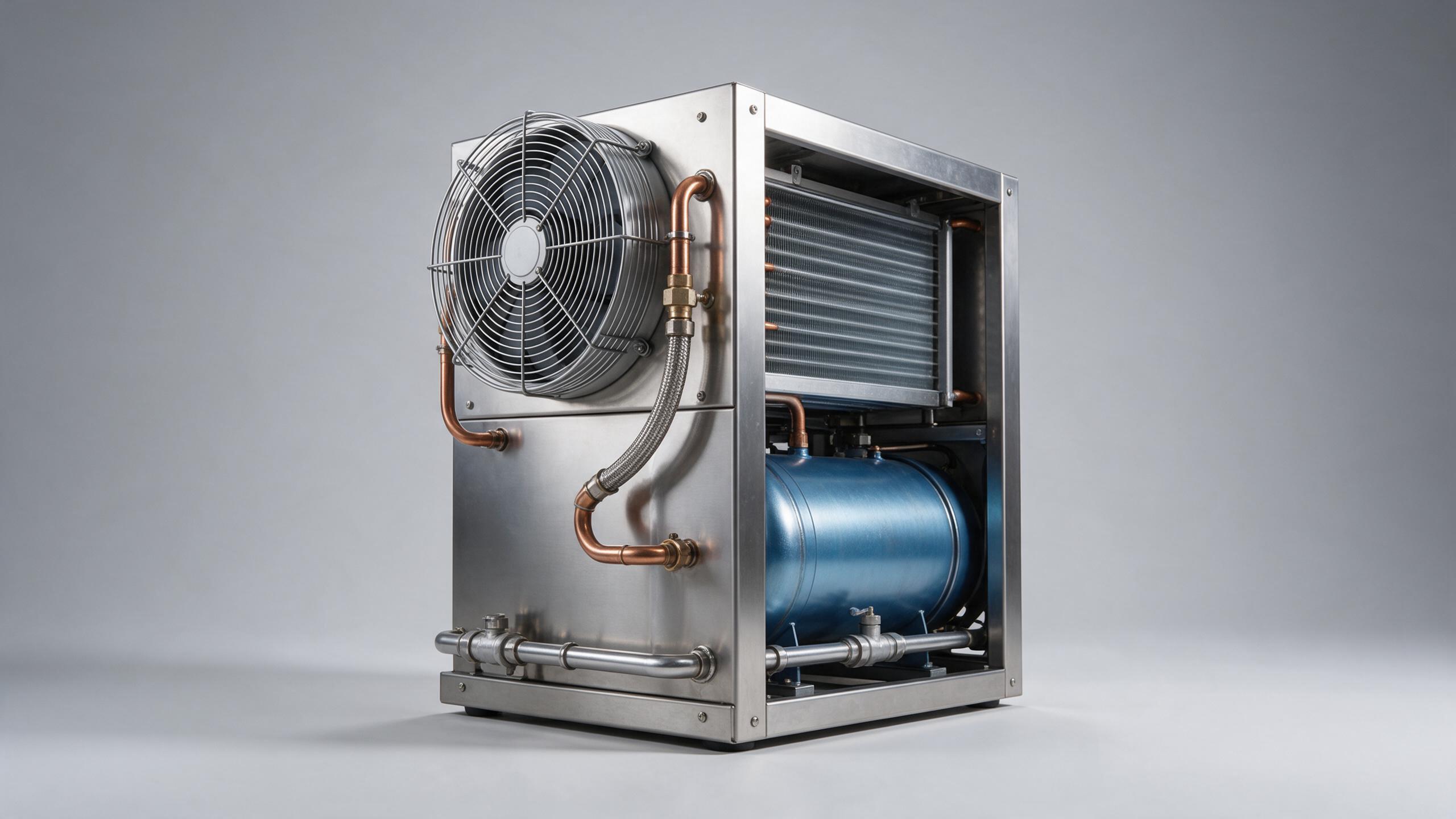
- Refrigeration side: the evaporator absorbs that heat; the compressor, expansion device, and condenser move it through the refrigerant circuit.
- Condenser-water side: water removes heat from the condenser and transfers it to the site heat-rejection system, commonly a cooling tower or another engineered loop.
If any one of these paths is restricted, the remaining components have less room to compensate. That is why continuous duty should be discussed as a system operating condition.
Why the condenser-water circuit matters
The condenser-water loop gives a water cooled industrial chiller its route for releasing process heat. Warm refrigerant leaving the compressor must reject heat at the condenser. If condenser-water flow falls, entering-water temperature rises beyond the design condition, or heat-transfer surfaces become fouled, the system may need to operate at a less favorable condensing condition. The controls may then reduce capacity, stage equipment differently, or issue an alarm depending on the configuration.
Sequence matters as well. Industry sequence-of-operation guidance commonly ties a chiller stage to proof that the corresponding condenser-water path and pump are available. The exact sequence must match the installed plant, but the operating principle is straightforward: establish the heat-rejection path before expecting the chiller to carry the process load.
Water quality is part of this same conversation. Scale, sediment, and biological growth can limit heat transfer. A routine that trends conductivity, make-up water, blowdown, temperatures, and differential pressure gives operations staff a way to spot changes before they become a process interruption. Water-treatment requirements and local safety obligations should be set by the site’s qualified water-management team.
How the process loop supports stable temperature
On the evaporator side, the industrial water chiller must receive sufficient, stable process-fluid flow. The process equipment transfers heat into the circulating fluid; the chiller removes that heat and returns fluid toward the target temperature. In a continuous process, rapid changes in load or flow can create temperature swings even when the refrigeration circuit is mechanically sound.
Useful commissioning questions include:
- What is the minimum, normal, and peak process heat load over a shift?
- What supply and return temperatures are required at the actual process connection?
- What fluid is used, and do its concentration and cleanliness remain within the approved range?
- What flow range reaches the evaporator after pipe length, valves, filters, and process branches are considered?
- How quickly does the process load change during start-up, idle periods, or recipe transitions?
These questions avoid a common mistake: treating a target outlet temperature as the whole specification. When the heat load changes significantly, temperature alone is not enough to establish whether a water cooled industrial chiller is correctly matched.
Controls turn hardware into a continuous-duty system
Controls coordinate the equipment around real operating conditions. Depending on the system, they may use temperature sensors, flow switches, pressure readings, pump status, remote enable signals, and alarms to decide when cooling should be enabled or limited. A buffer volume may also help moderate short process-load swings, but it should be selected as part of the overall hydraulic and control design rather than assumed to solve every instability.
For continuous production, the control strategy should define what happens during a flow-loss event, an out-of-range condenser-water condition, a sensor fault, a power interruption, or a planned process pause. Clear interlocks and alarm priorities help operators distinguish a minor trend from a condition that needs immediate action. The details should be confirmed during controls review and site commissioning.
Operating practices that protect sustained performance
An industrial water chiller is easier to keep on duty when routine checks focus on trends rather than a single reading. Record supply and return temperatures, process and condenser flow indications, pump status, alarm history, and water-treatment observations at intervals that suit the process. Compare those records with the validated operating window and investigate persistent drift.
- Keep strainers, filters, and accessible heat-transfer surfaces on the planned maintenance schedule.
- Verify that valves are in their intended operating positions after service work or a changeover.
- Review cooling-tower or external heat-rejection readiness before extended production periods.
- Check that sensor readings are plausible and that safety interlocks have not been bypassed.
- Document changes to process recipes, fluid concentration, piping, or load so the duty assessment stays current.
These actions do not replace the equipment manual or site procedures. They create a disciplined basis for deciding when the water cooled industrial chiller is operating within its verified envelope and when the system needs review.
A practical way to evaluate duty before purchase or expansion
Before specifying a water cooled industrial chiller, assemble a duty profile instead of a single headline load. Include the process heat load across time, target temperatures, fluid properties, process-side flow, condenser-water conditions, utility availability, anticipated fouling controls, and required uptime response. Then evaluate the chiller, pumps, piping, heat-rejection equipment, and controls together.
For an existing system, compare measured conditions with the original validated basis where available. If process demand, water quality, or cooling-tower behavior has changed, an updated engineering review can identify whether the limitation is capacity, heat rejection, hydraulics, controls, or maintenance. That evidence-based approach is more useful than assuming a continuous-duty issue has one universal cause.
Conclusion
A water cooled industrial chiller delivers continuous duty by maintaining an uninterrupted route for heat: from the process fluid, through the refrigeration circuit, and out through the condenser-water system. Reliable results depend on confirmed load and flow conditions, workable heat rejection, coordinated controls, and steady maintenance practices. Start by documenting the real operating envelope, then use it to validate the complete cooling system.
 Hot News