How a Wafer Fab Heating Jacket Protects Sensitive Delivery Lines
A wafer fab heating jacket is not an item of heated apparel. It is a controlled heating layer applied around a process gas or chemical delivery line, valve area, fitting, or related assembly where temperature stability matters. In semiconductor work, a line can be physically small and still have a large effect on process consistency if its thermal condition changes between the source and the point of use.
From an equipment-integration perspective, the useful question is not simply whether a jacket can get hot. It is whether the wafer fab heating jacket fits the line geometry, target temperature window, process media, control scheme, safety requirements, and maintenance routine. Those conditions determine whether the heating approach supports a stable delivery environment.
Why Sensitive Delivery Lines Need Thermal Attention
Some semiconductor process gases and chemical vapors are sensitive to temperature changes during delivery. When a low-vapor-pressure material cools below a suitable condition for the application, condensation or deposition can become a concern. A line-heating approach can help maintain a planned thermal profile, but the required setpoint and coverage depend on the chemistry, pressure, line construction, and process documentation.
This is why a wafer fab heating jacket should be considered as part of a delivery system rather than as an isolated accessory. The line may include regulators, bends, filters, valves, sensors, and transition points. Each part can have a different mass, surface exposure, or heat-loss path. A nominal temperature at one point does not automatically describe the temperature at every point in the assembly.
An industrial heating jacket can also be relevant where condensation control, warm-up behavior, or temperature consistency is under review. However, it should not be assumed that every line needs the same construction or operating range. The process owner should define the thermal target and acceptance criteria.
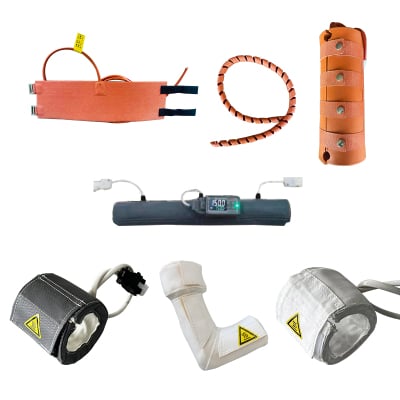
Controlled heat around a delivery-line assembly is evaluated with its process and control connections.
What a Wafer Fab Heating Jacket Does in Practice
In practical terms, a wafer fab heating jacket distributes controlled heat around a defined section of the delivery path. Depending on the approved design, it may be paired with insulation, temperature sensing, a controller, and installation features that accommodate the actual routing of the line. The purpose is to make temperature management more deliberate at locations where uncontrolled cooling could complicate delivery conditions.
That role has several parts:
-
Maintain a planned temperature zone: Heat is applied to support the temperature condition defined for the material and process, rather than relying on ambient conditions alone.
-
Reduce uneven exposure: A correctly fitted jacket can help address sections that lose heat more readily, such as bends, fittings, or exposed runs.
-
Support controlled startup and observation: The system can be included in a documented sequence for warm-up, temperature verification, and process readiness.
-
Make connections visible: Specifying a heating jacket forces the project team to discuss power, controls, sensors, clearances, insulation, and access for inspection.
A heating jacket is one part of an engineered thermal arrangement, and its value depends on how it is integrated and checked.
Start With the Delivery-Line Conditions, Not the Jacket Model
A common early mistake is to name a jacket before the line conditions have been documented. In a wafer fab, that can leave important questions unresolved. A better starting point is a short, cross-functional information set that connects process engineering, facilities, EHS, and equipment integration.
-
Define the material and thermal objective: Identify the process medium, the reason for temperature control, the intended temperature window, and the consequence that the project team is trying to avoid. This may involve vapor-phase stability, condensation control, viscosity behavior, or a defined process connection condition.
-
Map the physical delivery path: Document line diameter, length, fittings, valve bodies, supports, bends, branch points, nearby equipment, and sections that are exposed to drafts or different ambient conditions. A wafer fab heating jacket that fits a straight run may not cover a complex valve cluster in the same way.
-
Clarify the heat-loss environment: Installation space, airflow, adjacent equipment, enclosure design, and insulation affect the thermal result. More heat is not automatically a better answer. The target is a controllable, verified condition appropriate to the actual installation.
-
Confirm electrical and control connections: Control architecture matters as much as the heater itself. Confirm power availability, controller placement, sensor type and location, alarm philosophy, interlocks, cable routing, and communication expectations before the final configuration is selected.
Key Design Choices for an Industrial Heating Jacket
An industrial heating jacket for a sensitive delivery line is usually evaluated through a combination of geometry, materials, controls, and serviceability. The following table helps turn a broad request into a usable engineering discussion:
| Decision area | Questions to verify | Why it matters |
| Coverage and fit | Which line sections, fittings, or valve bodies need coverage? What clearances are available? | Gaps or poor contact can create temperature variation and obstruct service access. |
| Temperature control | What temperature range, sensor location, controller logic, alarms, and tolerances are required? | These inputs determine how the target condition can be monitored and verified. |
| Materials and cleanability | What line materials, external environment, cleaning practices, and compatibility constraints apply? | Outer materials, closures, and routing should suit the approved installation environment. |
| Integration | How will the jacket interact with insulation, supports, cabinets, power, and controls? | Thermal performance is affected by the surrounding assembly, not just the heater surface. |
| Maintenance | Can technicians inspect fittings, remove the jacket, and restore it without changing the approved setup? | Service access helps keep the solution practical over the equipment lifecycle. |
Protect the Line by Planning Verification, Not by Relying on a Setpoint Alone
Temperature setpoint is important, but it is not the whole verification plan. A wafer fab heating jacket can be assessed more usefully when the project defines what will be measured, where it will be measured, and under which operating conditions. This may include warm-up observations, temperature mapping at representative locations, controller response checks, and inspection after installation changes.
For example, a sensor near the controller does not necessarily demonstrate the condition at the most exposed fitting or the far end of a complex run. The right measurement arrangement depends on documented thermal risk points. If a line changes configuration, insulation, airflow exposure, or operating cycle, prior observations may need review.
Installation and Maintenance Checks That Deserve Attention
Once the design direction is agreed, the installation sequence should be deliberate. Before energizing a wafer fab heating jacket, teams commonly review physical fit, fastening, cable strain relief, sensor contact, insulation boundaries, labels, and controller settings against the approved plan.
-
Verify the delivery-line route and component identities against the installation drawing.
-
Check that jacket segments close correctly without pinching cables or blocking fittings that require inspection.
-
Confirm sensor placement and controller wiring according to the approved control documentation.
-
Inspect coordination with insulation, supports, cabinets, and adjacent utilities.
-
Run the documented commissioning sequence and record the observations required by the project.
-
Define periodic inspection points, including closure condition, cable condition, sensor attachment, and any configuration changes.
Partnering With Lingheng Thermal Control
Lingheng Thermal Control Technology (Suzhou) Co., Ltd. focuses its technical expertise on precision temperature-control and thermal-management equipment for advanced semiconductor applications, industrial heating solutions, and specialized thermal systems. When evaluating a wafer fab heating jacket for critical gas or chemical delivery lines, collaborating with an experienced partner ensures that geometry, heating performance, control integration, and maintenance access are properly balanced.
Conclusion
A wafer fab heating jacket is most useful when it turns engineering questions into an organized thermal-control plan. By treating it as part of the delivery system—rather than a generic wrap—teams can focus on fit, control coordination, verification, and maintainability. That approach supports better technical conversations while leaving site-specific temperatures, materials, and acceptance limits to the qualified process and facility teams.
 Hot News