
How to Compare Modular Chiller Manufacturers
Choosing among modular chiller manufacturers is not mainly a brand-ranking exercise. It is an evidence-and-fit exercise: can the supplier show how several chiller modules will meet your process duty, control together, be serviced, and expand without creating avoidable operating risk? For an industrial chiller project, a short comparison based on a single catalog capacity or a headline efficiency figure can hide the conditions that determine actual performance.
A practical comparison starts with the load profile, not a preferred model. Define the required leaving-fluid temperature, entering-fluid temperature, flow, heat load, ambient or condenser-water conditions, duty cycle, allowable temperature variation, utility limits, and space constraints. Give every bidder the same basis of design. Then ask each supplier to state exactly where its offer differs.
Begin with the operating duty, not nominal capacity
Modular equipment combines independent cooling units so capacity can be staged as demand changes. That flexibility can be useful for phased projects, partial-load operation, redundancy planning, and constrained plant rooms. It also means that two quotations with the same nominal total capacity may behave differently at your design condition.
Ask modular chiller manufacturers for a duty table rather than one capacity number. The table should identify module quantity, capacity per module, total available capacity, electrical input, fluid temperatures, flow rate, ambient or condenser-water condition, and any stated derating. If cooling a process rather than a comfort loop, add fluid type, concentration, pressure-drop allowance, fouling assumptions, and heat-load variation by production step.
Performance-rating documentation matters because a published number is only comparable when its test or rating basis is comparable. AHRI 550/590 is associated with performance rating criteria for factory-made water-chilling packages. That does not make every offer interchangeable; it gives buyers a clear question to ask: which standard, test condition, and unit configuration supports the submitted data?
Compare the system, not just the module
A modular chiller arrangement needs a system-level answer. Request a simple hydraulic and controls narrative showing headers, isolation valves, pumps, buffer volume where relevant, sensors, alarms, and the staging sequence. A supplier should explain what happens when one module is unavailable, when the load changes quickly, and when a module is added later.
Questions that expose integration quality
- What is the minimum and maximum number of modules that can run together under the proposed controls?
- How are lead-lag rotation, run-hour balancing, fault isolation, and restart handled?
- Which temperature and flow sensors govern staging, and where are they installed?
- What interlocks are needed from the process, pump package, building system, or safety circuit?
- What changes are required if the industrial chiller plant grows in a later phase?
These questions are especially useful when a project combines cooling and heating, has a narrow temperature band, or needs consistent thermal response during changing production loads. A manufacturer that documents limits and connections is often easier to evaluate than one that offers broad claims without a project-specific control narrative.
Use efficiency figures in their proper context
Energy use should be compared at the stated operating points, including part-load conditions that resemble the expected annual profile. ASHRAE 90.1 materials address minimum full-load and part-load efficiency requirements for applicable chillers, but compliance references do not replace a project calculation. Ask bidders to identify the rating conditions, electrical components included in the figure, and any assumptions about pumps, fans, or condenser-water equipment.
For modular chiller manufacturers, the most useful discussion is often about staging logic and turndown. How does the control sequence choose the number of operating modules? Does the proposal avoid keeping lightly loaded modules running when fewer modules can satisfy the duty? The answers should be reviewed alongside temperature stability, start frequency, and service strategy—not in isolation.
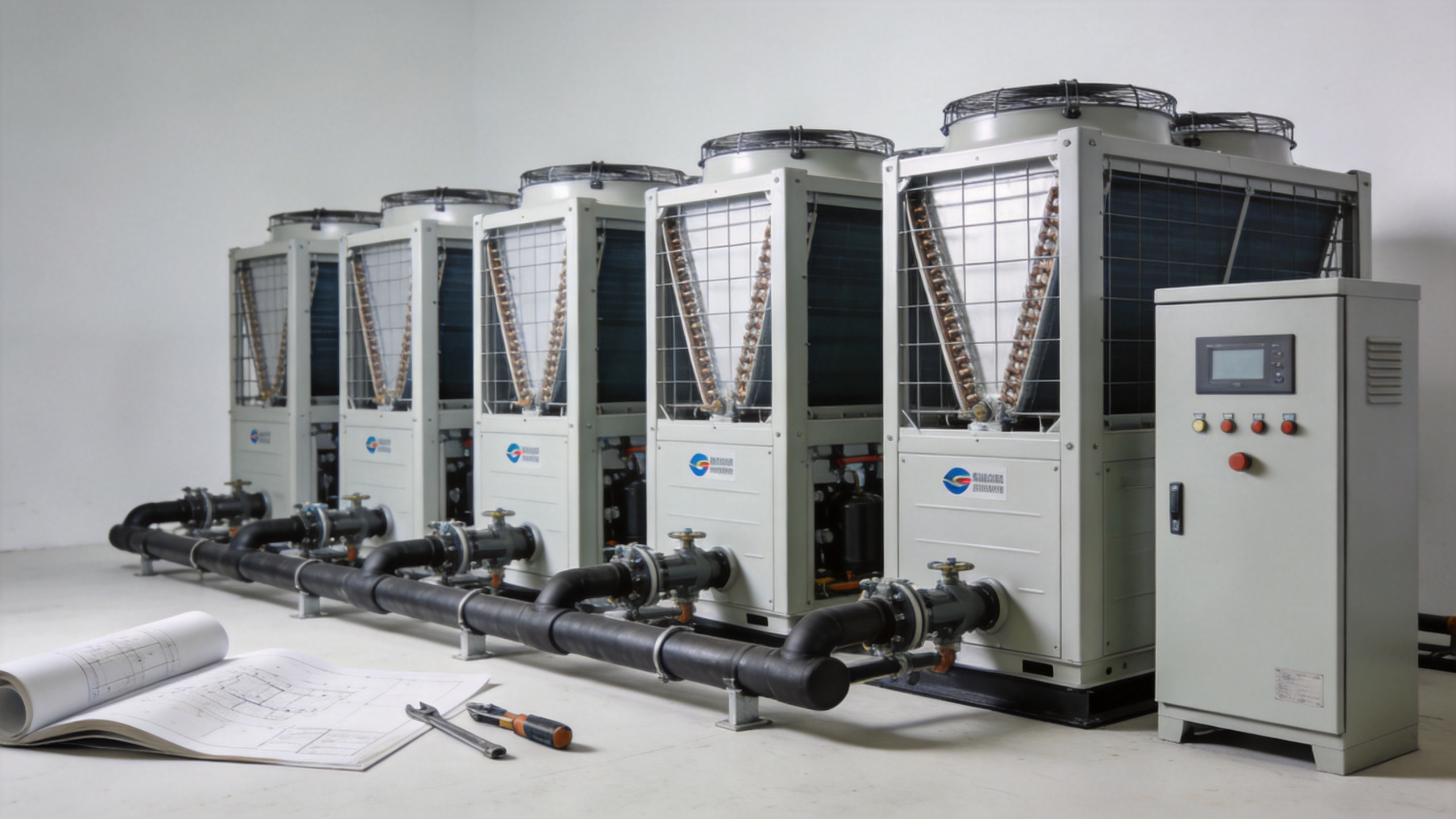
Review manufacturing and quality evidence
Manufacturing capability is easier to assess through documents and process evidence than through marketing language. Request a current data sheet, general arrangement drawing, electrical schematic, piping diagram, bill-of-material boundaries, inspection plan, and sample test record appropriate to the project. If the application is sensitive, define the witness-test scope before release.
| Evaluation area | Evidence to request | Why it matters |
|---|---|---|
| Thermal duty | Performance table at project conditions | Shows whether capacity and power were calculated on the same basis for every bid. |
| Controls | Sequence of operation and points list | Clarifies staging, alarms, integration, and future expansion. |
| Fabrication | Drawings, component list, inspection plan | Defines what is included and supports technical review before delivery. |
| Testing | Factory test procedure and report format | Sets a measurable acceptance path rather than relying on verbal assurances. |
| Service | Commissioning scope, recommended spares, escalation path | Helps the owner plan response when a module or sensor needs attention. |
Evaluate serviceability before you place the order
The modular layout may allow one unit to be isolated while others continue operating, but that depends on piping, valves, controls, access clearances, and the actual duty margin. Ask each manufacturer to identify the maintenance tasks that require shutdown, the common wear or service items, diagnostic access, remote-support boundaries, and the documents provided at handover.
For an industrial chiller installation, service planning should include local electrical standards, water treatment responsibility, refrigerant handling, lifting access, spare-part lead times, and who performs commissioning. These are procurement questions as much as engineering questions. Capture the answers in the comparison matrix so the decision is traceable months later.
Score suppliers with a consistent comparison matrix
Use one weighted sheet for every qualified supplier. A useful starting point is to score technical fit, evidence quality, controls and integration, service plan, commercial clarity, delivery scope, and lifecycle considerations. Set the weights before opening the final quotations. If temperature precision or continuous production is critical, technical fit and test evidence may deserve more weight than a small difference in initial price.
- Issue one duty schedule and one documentation checklist.
- Normalize each response to the same operating condition and included scope.
- List assumptions, exclusions, and unresolved connections beside each score.
- Hold a technical clarification call focused on the highest-risk gaps.
- Make factory testing, commissioning, and acceptance records contractual deliverables where appropriate.
Build a comparable manufacturer questionnaire
Before reviewing quotations, issue the same questionnaire to every supplier. It turns a broad search for modular chiller manufacturers into a controlled comparison. Ask each respondent to complete the same operating-duty table, equipment-scope list, controls narrative, and test-plan statement. This approach helps procurement and engineering teams see whether modular chiller manufacturers are answering the same question or presenting different assumptions under similar capacity labels.
The questionnaire should request module dimensions, weights, service clearances, electrical characteristics, fluid connections, noise data where relevant, controls protocol, alarm list, recommended installation layout, and startup responsibilities. Ask modular chiller manufacturers to identify what they supply, what the customer supplies, and which site conditions must be confirmed before fabrication. For an industrial chiller project, also ask how the proposal addresses water quality, filtration, process-fluid compatibility, and expected load swings.
Use a separate evidence column for each answer. For example, a statement about capacity from modular chiller manufacturers should point to a performance table at the requested condition. A statement about stable operation should point to a sequence of operation or test procedure. A statement about service access should point to a general arrangement drawing. This discipline reduces the chance that an industrial chiller decision is driven by incomplete scope.
Suggested questions for every bidder
- Which stated conditions support the proposed capacity, power, and temperature-control values?
- How do the proposed modular chiller manufacturers define redundancy, and what capacity remains during a module outage?
- What controls documents and communication points accompany the industrial chiller package?
- Which factory checks are included, which are optional, and what report is issued after testing?
- What installation, commissioning, training, and service responsibilities sit with each party?
Keep clarification responses in the same matrix. When modular chiller manufacturers revise a selection, record whether the change affects capacity, energy input, delivery scope, controls, or the industrial chiller acceptance plan. A written trail makes a later award decision easier to defend and gives the project team a more reliable handoff to commissioning.
What a strong modular chiller comparison should deliver
The right choice among modular chiller manufacturers is the offer that makes its performance conditions, control boundaries, test method, and support scope understandable for your exact application. A disciplined comparison does not require a supplier to promise outcomes it cannot substantiate. It requires each bidder to document how the proposed modular system responds to load, integrates with the plant, and can be verified before and after startup.
When the duty includes demanding temperature control, begin the supplier conversation with a completed process questionnaire. Lingheng Thermal Control Technology (Suzhou) Co., Ltd. works in precision thermal-management discussions across semiconductor, chemical, new-energy, and aerospace-related applications; project teams can use the same temperature range, heat load, medium, flow, and connection questions to make an industrial chiller comparison more specific and auditable.
 Hot News