
What Are the Common Failure Signs of a Semiconductor Chiller?
A semiconductor chiller rarely becomes a problem without leaving clues first. In a fab, test cell, or process-tool installation, the useful question is not simply whether the unit has alarmed. It is whether its temperature, flow, pressure, sound, or control behavior has changed from the normal operating pattern. As a process-risk reviewer, I would treat those changes as prompts to collect evidence—not as proof of one root cause. A semiconductor chiller works as part of a wider thermal loop, so the process load, facility water, piping, fluid condition, and controls all matter.
The fastest way to make a good first decision is to compare the current condition with a stable baseline. Record the actual supply and return temperatures, setpoint, flow indication, active alarms, ambient conditions, process state, and time of occurrence. That record gives a service team much more to work with than an alarm code alone.
1. Temperature Drift or Unstable Temperature Control
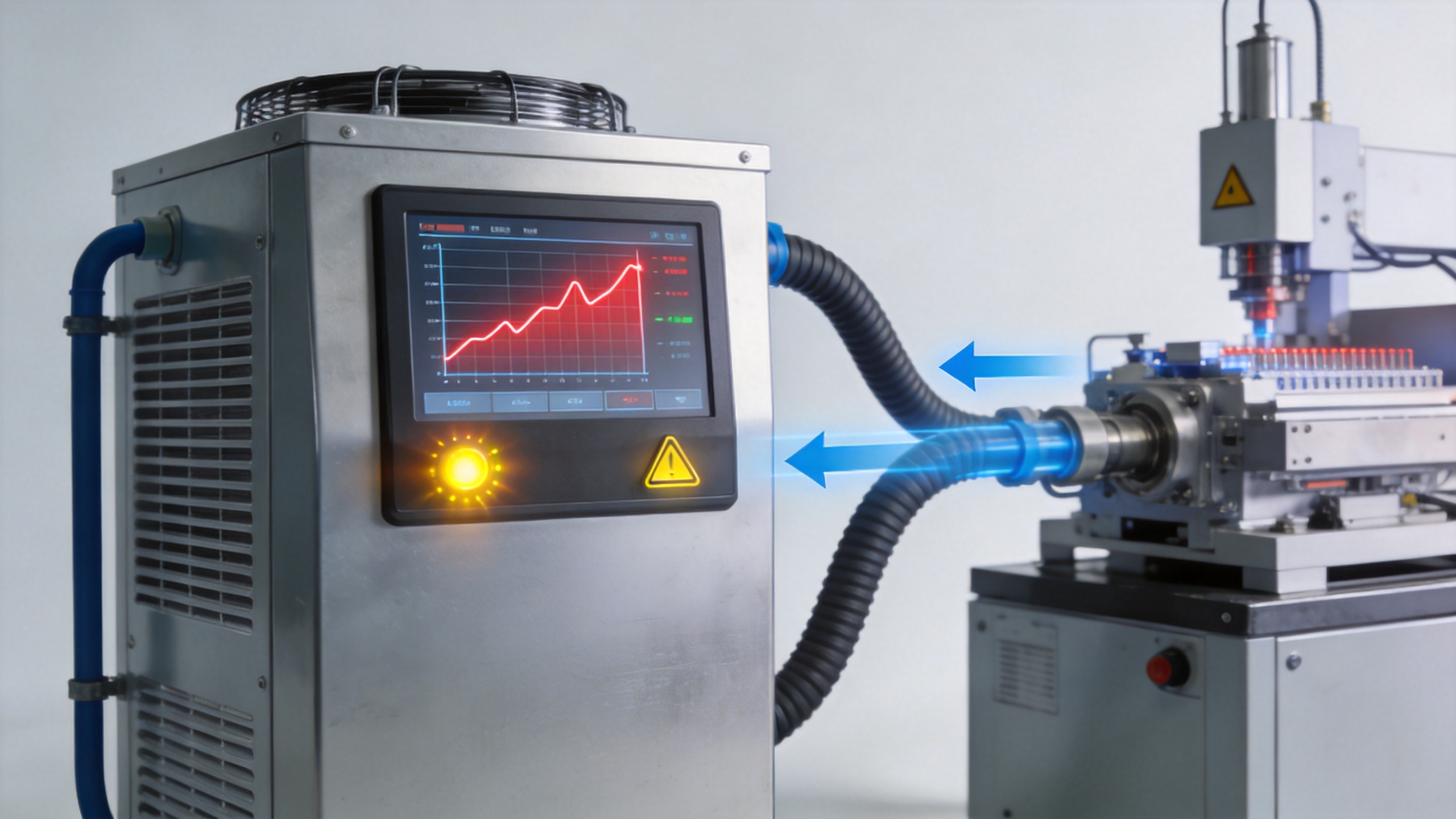
Temperature drift is one of the most visible semiconductor chiller failure signs. The process may no longer hold the programmed setpoint, or the displayed temperature may oscillate beyond its usual band. A semiconductor chiller can show this behavior when its heat-rejection path is restricted, the circulating flow is inadequate, the refrigeration circuit needs attention, or the process heat load has changed sharply.
Start by asking whether the temperature movement follows a process event. A repeating rise during a particular recipe, wafer test sequence, or chamber duty cycle may point toward load variation or flow conditions rather than an immediate internal failure. Conversely, a drift that persists while the process is idle deserves prompt investigation. Do not attempt to compensate by repeatedly changing the setpoint; that can hide the trend that helps locate the cause.
2. Repeated High-Temperature, Low-Temperature, or General Alarms
An alarm is a protection signal, not a complete diagnosis. When a semiconductor chiller repeatedly reports high temperature, low temperature, pressure, or communication alarms, document the code, timestamps, operating setpoint, and what happened immediately before the event. A process chiller may alarm because it cannot maintain the requested condition, but insufficient capacity, heat load, flow, heat rejection, sensors, and control logic should be distinguished before replacing parts.
If the same alarm returns after an operator reset, avoid treating resets as a repair. Repeated resets can interrupt a controlled troubleshooting sequence and may expose sensitive equipment to unstable thermal conditions. Follow the site lockout, safety, and OEM service procedures before opening panels or working on refrigeration components.
3. Low-Flow Warnings, Flow Fluctuation, or a No-Flow Trip
A recirculating chiller depends on stable fluid movement. Low-flow indications, intermittent flow alarms, unexpected pump noise, or a return line that behaves differently from normal all deserve attention. Possible contributors include a dirty strainer, partially closed valve, air in the loop, a pump issue, a restriction in piping, or a fluid condition that has changed. The observation alone does not identify which one applies.
Where site procedures permit, a sensible first check is to compare valve positions and inspect the items already defined in the maintenance plan, such as strainers or filters. Then compare flow indication with previous records. A semiconductor chiller that intermittently loses flow during process transitions may require a closer review of the complete chiller system, including the process-side control sequence.
4. Rising Pressure, Condensation, Leaks, or Fluid Quality Changes
Visible moisture, residue around fittings, a falling reservoir level, or a change in fluid appearance should not be ignored. For a semiconductor chiller, even a small leak or contamination concern can affect thermal performance and may create a compatibility issue for the process loop. Record the location, appearance, reservoir level, and whether the condition is new. Use the approved fluid specification and maintenance procedure; do not add make-up fluid or treatment chemicals based on appearance alone.
Pressure trends also deserve context. A single pressure reading is less useful than the relationship between supply pressure, return condition, flow, load, and operating temperature. If readings change quickly or approach protection limits, isolate the equipment only as required by the approved operating procedure and escalate to qualified personnel.
5. Unusual Noise, Vibration, or Frequent Cycling
New rattling, grinding, cavitation-like sound, strong vibration, or frequent starts and stops can be early warning signs. In a semiconductor chiller, these observations may involve the pump, fan, compressor, mounting, piping support, or a control command. They also may become more apparent when a process chiller transitions between loads. The useful record is specific: note where the sound is heard, when it starts, whether it changes with load, and whether an alarm occurs at the same time.
Do not assume that a unit is healthy merely because the display still shows the target temperature. A recirculating chiller can temporarily achieve a setpoint while mechanical or flow-related symptoms are developing.
6. Inconsistent Sensors, Control Faults, or Lost Communication
When the displayed temperature conflicts with a trusted process reading, or the chiller reports sensor, interlock, or communications faults, the next step is verification—not guesswork. Inspect logged values, connector status where authorized, controller messages, and the timing of any software or recipe changes. Sensor drift, wiring faults, electrical noise, configuration changes, and process interface problems can all create confusing symptoms in a semiconductor chiller.
A control fault can look like a cooling fault because the chiller system may receive the wrong command or may not receive a permissive signal. Preserve alarm history and trend data before clearing faults whenever the operating procedure allows it. This is especially important when the symptom appears only during a defined tool sequence.
How to Prioritize the Response
Urgent action is appropriate when there is an active safety concern, an uncontrolled temperature excursion, a confirmed leak, electrical damage, repeated protective trips, or evidence that process equipment could be harmed. For less urgent changes, use a structured record and compare it with normal operation. One abnormal value does not by itself establish a failure, but a repeated pattern should be treated as a planned maintenance or service priority.
- Record setpoint, supply and return temperatures, flow, pressure, alarms, and process state.
- Check for obvious external changes: blocked airflow, facility-water changes, valve position, leaks, and recent maintenance.
- Review trend history before changing settings or replacing components.
- Escalate refrigeration, electrical, or sealed-system work to qualified service personnel.
Turn Symptoms Into a Better Service Request
The most effective service request for a semiconductor chiller includes the model and serial details, fluid type, operating setpoint, alarm history, trend screenshots, process timing, and a description of any visible or audible change. It should also say whether the issue affects a single tool, several tools, or the entire loop. That information helps separate equipment symptoms from conditions elsewhere in the chiller system.
In short, temperature instability, recurring alarms, low-flow events, fluid changes, unusual mechanical behavior, and control faults are common signals that warrant investigation. A semiconductor chiller should be evaluated against its actual temperature range, heat load, fluid, interfaces, and maintenance history. With those conditions documented, a process chiller service discussion can move from a vague “not cooling” report to a safer, more targeted diagnosis.
 Hot News