
What Industrial Chiller Units Offer for Scalable Plants
When a plant grows, cooling capacity is rarely the only question. New tools, longer shifts, added process stations, and tighter temperature windows can change the load profile long before the original cooling loop reaches a visible limit. For that reason, industrial chiller units should be evaluated as part of a scalable thermal-management system rather than as isolated refrigeration equipment.
From an equipment-integration perspective, the useful starting point is to define the process heat load, required supply temperature, fluid, distribution layout, and control connections. Those details show what an industrial chiller needs to do now and what it may need to accommodate later. This approach is especially relevant in semiconductor equipment, chemical and pharmaceutical processes, new-energy testing, and aerospace-related applications, where temperature change can influence repeatability, throughput, or equipment protection.
Scalability begins with a defined cooling duty
A scalable plant does not necessarily need the largest unit on day one. It needs a configuration that can be extended without forcing a complete redesign of the process loop. The duty should therefore describe more than a nominal cooling number. It should include expected heat rejection, target supply and return temperatures, anticipated load variation, ambient conditions, the circulation medium, and the equipment connected to the loop.
It is also important to distinguish a chiller outlet setpoint from the temperature received by the process. Pipe length, insulation, flow conditions, and the heat introduced by connected equipment can affect delivered temperature. If the process is sensitive to variation, the hydraulic layout and sensor locations deserve the same attention as the refrigeration section.
An industrial chiller units discussion becomes more useful when these items are documented as a growth envelope: current load, likely next-stage load, possible operating shifts, and the point at which another process line may be added. With that envelope, a project team can compare staged capacity, reserve connections, or a modular arrangement on an informed basis.
What modular capacity can offer
Modularity is often associated with adding another unit, but the practical value depends on how the system is arranged. Multiple industrial chiller units can allow capacity to be staged as demand develops, provided that headers, pumps, electrical supply, controls, and plant-space allowances are planned for the expansion. The result is not an automatic efficiency or uptime claim; it is a design option that can be assessed against the site’s operating profile.
For example, a plant with strongly variable load may want to compare how different capacity steps operate during partial-load periods. Public efficiency guidance for electric chillers distinguishes full-load from part-load operation, which is a useful reminder to review the expected duty profile rather than relying on one nameplate condition. Actual performance still depends on the selected configuration and site conditions.
- Staged cooling capacity: capacity can be matched to a documented expansion plan instead of assumed future demand.
- Service planning: separate modules may support a maintenance plan, but the bypass arrangement and process tolerance should be verified.
- Layout flexibility: pipe headers, isolation valves, and reserved floor space can reduce disruption when a future module is evaluated.
- Control coordination: a sequence strategy can be defined for demand changes, alarms, and handoff between installed units.
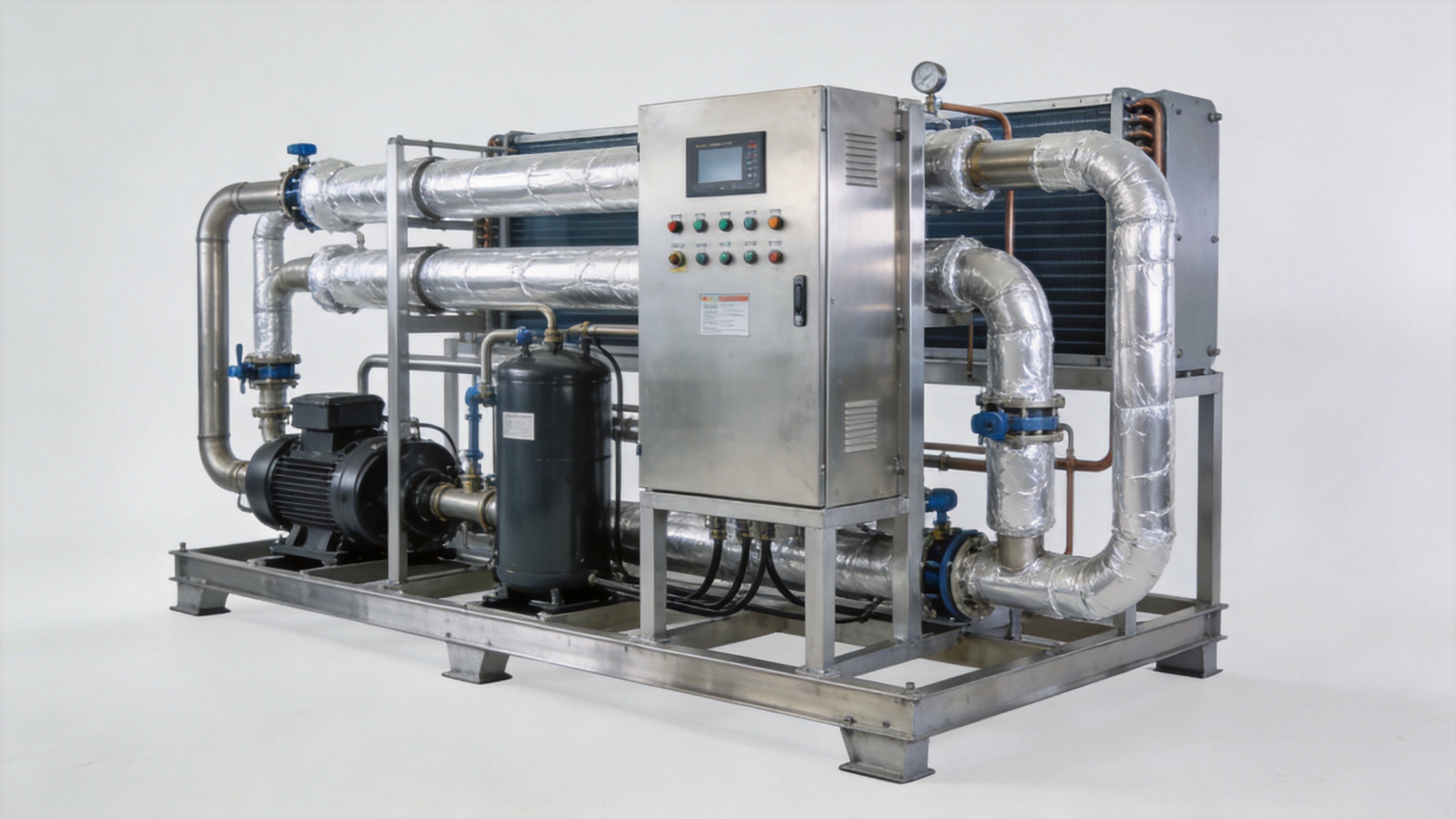
These possibilities are only meaningful when the rest of the plant supports them. A module added to an undersized header or control architecture does not, by itself, create a scalable system.
Temperature range and fluid choice shape the configuration
Many process loops use water, while lower-temperature or outdoor-exposed applications may call for a water-glycol mixture. Glycol can provide freeze protection, but concentration changes fluid properties and should be considered alongside the required temperature range, pump sizing, materials compatibility, and maintenance practice. It should not be selected merely because an industrial chiller is expected to run at a lower setpoint.
For a scalable plant, clarify whether future equipment will share the same fluid and temperature range. A common loop may simplify distribution in some projects, while separate loops may be worth assessing when new processes have materially different temperature stability, cleanliness, or operating schedules. The appropriate boundary is an engineering decision based on confirmed process conditions.
Controls turn capacity into a usable plant resource
As a facility adds stations, the control question becomes more specific: which temperature matters, where should it be measured, and what action should occur when load changes? Industrial chiller units can be specified with controls that communicate operating state, temperature values, alarms, pump status, or other permitted signals to a site-level system. Before assuming integration is straightforward, confirm the protocol, I/O list, alarm philosophy, and responsibility for sequence control.
In practice, a good requirements review separates three layers:
- Chiller control: refrigeration operation, safety logic, and local setpoint handling.
- Loop control: flow, pressure, buffer volume, pump duty, valves, and distribution conditions.
- Plant coordination: process permissions, alarms, load scheduling, and records used for troubleshooting.
This separation helps address a common scale-up problem: treating a new chiller as a direct replacement while leaving its upstream and downstream interfaces undefined.
Reliability planning is different from making promises
A larger plant usually has less tolerance for unplanned interruption, but no equipment choice removes the need for operating procedures and verification. A more grounded review asks what happens if a pump, sensor, compressor circuit, or power supply condition changes; whether the process can be kept within its defined operating response; and what maintenance access is required. The answers depend on the equipment design and application, so they should be confirmed in project documentation rather than inferred from a generic product category.
Useful planning items include isolation points, clear service access, spare-part strategy, fluid-quality checks, alarm routing, and a defined response for temperature deviation. In a production expansion, these details can be reviewed together with commissioning tests so that the plant team understands both normal operation and the boundaries that require attention.
A practical checklist for comparing industrial chiller units
Before selecting or expanding an industrial chiller units installation, collect the information below. It gives suppliers and integrators a clearer basis for preparing a configuration discussion.
- Current and anticipated process heat load, including how quickly it changes.
- Required supply temperature, allowable variation, return temperature, and any low-temperature conditions.
- Fluid type, glycol requirement, cleanliness expectations, and compatible materials.
- Required flow and pressure at the process, plus pipe runs, elevation, and distribution losses.
- Indoor or outdoor location, ambient range, utilities, noise constraints, and floor-space allowance.
- Future process stations, growth timing, preferred capacity increment, and reserved header connections.
- Control connection, monitoring needs, alarm handling, and commissioning acceptance criteria.
- Maintenance access and the process plan for planned service or abnormal conditions.
Choosing a path for plant expansion
The value offered by industrial chiller units in a scalable plant is not a one-size-fits-all performance promise. It is the ability to structure cooling around known process requirements and future decision points. A single centralized unit, staged units, or separated loops may each be reasonable depending on the load profile, temperature range, site utilities, and integration constraints.
For plants supporting precision temperature-control work, the next step is to turn the checklist into a project brief: define the current duty, state the expansion assumptions, identify the interfaces, and determine what must be demonstrated during commissioning. That creates a practical basis for discussing an industrial chiller configuration with a thermal-control equipment team and for keeping future growth from becoming an afterthought.
 Hot News