
How to Choose an Industrial Chiller for Your Application
Choosing an industrial chiller is easier when the conversation starts with the process, not the catalog. A chiller has to remove heat at the required temperature while circulating a compatible fluid through a real pipe run, under changing loads and site conditions. From an equipment-integration perspective, the unit is only one part of the thermal loop: connections, operating rhythm, and system coordination matter as much as a nominal capacity.
This guide explains how to choose an industrial chiller by turning application data into a clear selection brief. The same approach is useful for semiconductor equipment, chemical or pharmaceutical processes, new-energy test systems, and other applications where temperature stability and repeatability affect the next operation.
Start with the process heat load, not a nameplate size
The first question in how to choose an industrial chiller is: how much heat must leave the process, and when? Gather the continuous load, expected peaks, warm-up or cool-down events, and whether the load changes with production state. A heat-load estimate should connect process duty, fluid flow, and the permitted temperature rise across the load. Capacity alone cannot show whether the loop will hold a stable temperature during a transient.
For a typical project, separate three conditions:
- Normal operating duty: heat released during steady production.
- Peak duty: the short or recurring maximum that may occur during a cycle, test, or changeover.
- Future duty: expansion or a planned process change that should be stated explicitly rather than quietly assumed.
Ask the process owner how the load was derived and what measurement uncertainty remains. Adding an arbitrary margin can hide an incomplete model; selecting too close to an uncertain calculation can leave little room for real-world variation. The useful outcome is a documented duty range a supplier can review against the required temperature and fluid conditions.
Define the temperature window and stability requirement
Next, define the supply temperature, permitted return temperature, allowable process variation, and ambient temperature range. When evaluating how to choose an industrial chiller, a lower setpoint is not automatically a better choice. The useful setpoint is the one that matches the process specification and the available heat-transfer area without creating unnecessary condensation, freezing, or control complexity.
Also distinguish a broad process band from a precision control requirement. A curing or general machinery loop may tolerate a wider band than a semiconductor thermal-control loop or a sensitive test rig. State how and where temperature is measured: at the chiller outlet, at a manifold, or at the load inlet. These locations can behave differently when piping volume and load cycling are significant.
Choose the coolant around materials, temperature, and service conditions
The coolant belongs in the selection brief. Clean water, treated water, water-glycol mixtures, and other process fluids do not have the same heat capacity, viscosity, corrosion behavior, or maintenance needs. If freeze protection is necessary, a glycol blend may be considered, but its concentration changes thermal transport and pumping conditions. That effect should be assessed together with capacity and pump selection rather than after the chiller is sized.
Confirm the fluid with the process team before finalizing wetted materials, seals, filtration, and service procedures. Fluid quality, inhibitor compatibility, and contamination control can influence long-term heat-exchanger performance. This is particularly important where a loop serves sensitive equipment or where process media and make-up water conditions are controlled closely.
Size flow rate and pressure for the complete loop
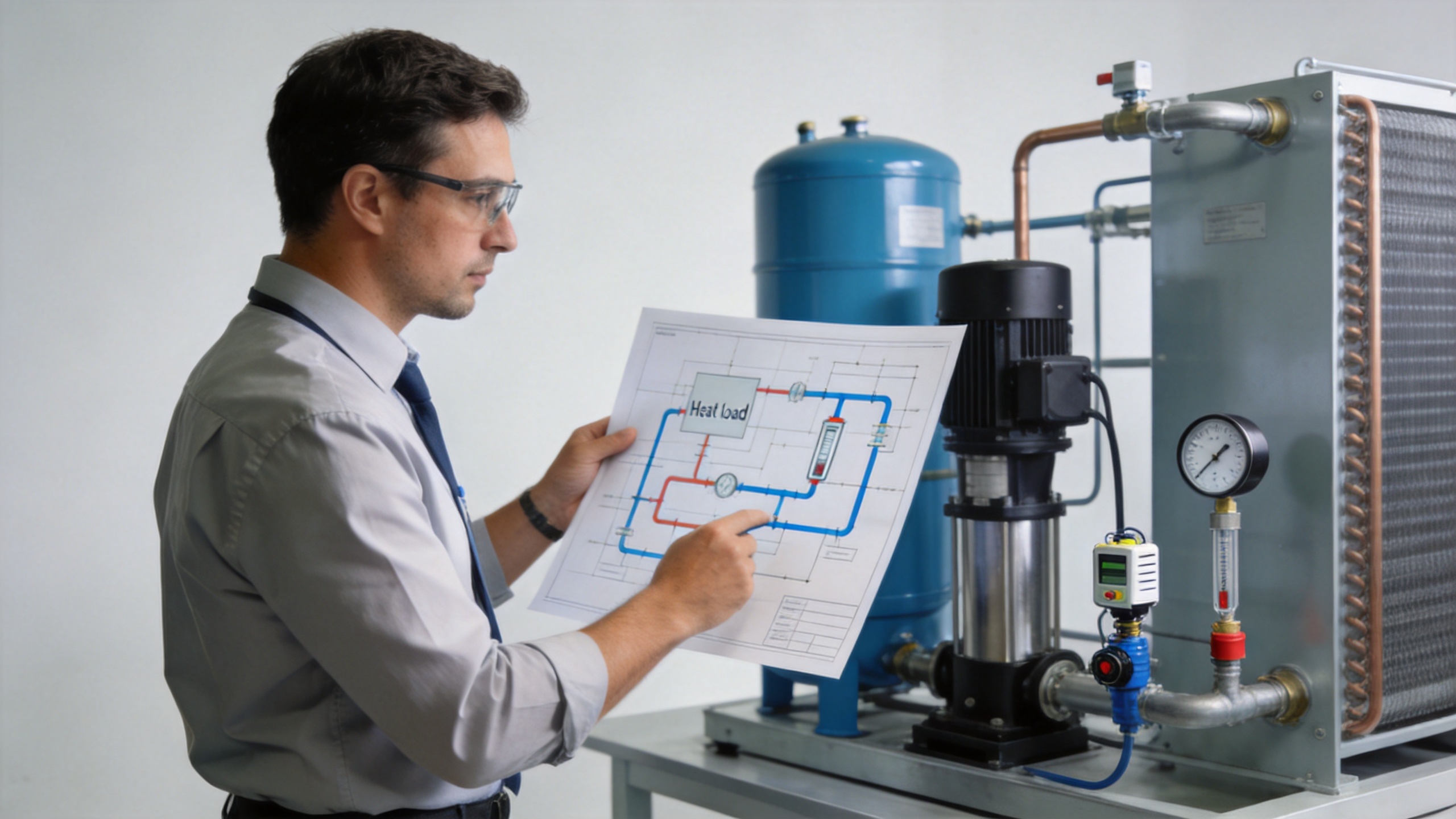
A reliable answer to how to choose an industrial chiller includes hydraulic data, not only refrigeration duty. Record the required flow rate, inlet and outlet connection sizes, expected pressure drop through the load, pipe length, elevation changes, valves, filters, manifolds, and any parallel branches. The circulating pump must overcome the full loop resistance at the needed flow, with enough control range for the actual operating pattern.
For a retrofit, do not rely on a sketch alone. Confirm pipe sizes, existing instruments, electrical interfaces, and control signals at the installation point. A replacement unit that fits the cooling capacity but cannot coordinate with the existing piping or control arrangement may require avoidable rework. A practical review moves from performance claims to operating boundaries: temperature range, fluid, load profile, flow, pressure, and interfaces should all be visible in the review.
Compare air-cooled and water-cooled arrangements by site constraints
Cooling method is an application decision. An air-cooled industrial chiller may simplify installation where a reliable plant-water circuit is unavailable, but it needs adequate airflow, clearance, and consideration of seasonal ambient conditions. A water-cooled arrangement may suit a site with an established cooling-water system, yet it introduces its own water-quality, treatment, heat-rejection, and maintenance questions.
Use the actual installation environment in the comparison: indoor or outdoor placement, dust, corrosive atmosphere, room ventilation, water availability, drain provisions, noise constraints, and access for service. The right industrial chiller configuration is the one whose heat-rejection method and maintenance plan fit those constraints—not simply the arrangement that appears smaller on a layout.
Specify controls, alarms, and integration before ordering
Controls should reflect what the process must know and what the plant can act on. Define the desired setpoint range, local display needs, remote start/stop, communication protocol, temperature and flow monitoring, alarm contacts, and data-logging expectations. For equipment integration, clarify interlocks for low flow, high temperature, leak detection, or other relevant protective conditions with the machine builder and site team.
A useful request for quotation also states electrical supply, installation location, commissioning responsibilities, and maintenance access. Procurement, engineering, and operators often ask different questions; combining them into one requirements list reduces the chance that a critical item remains only in an email thread.
Evaluate lifecycle fit without making unsupported cost claims
Purchase price is one consideration, but it should be reviewed alongside service access, routine fluid checks, filter or water-treatment needs, spare-parts planning, and the operational impact of downtime. Avoid treating a quoted efficiency figure as a complete lifecycle comparison unless the operating conditions behind it match the application. Part-load behavior, ambient conditions, maintenance practice, and the cooling method can all change the outcome.
When comparing quotations, request the operating envelope, control description, pump curve or hydraulic data, fluid compatibility statement, heat-rejection assumptions, and recommended maintenance tasks. Those records support a like-for-like comparison and give the commissioning team a clearer basis for validation.
A supplier-ready industrial chiller selection checklist
Before asking for a proposal, assemble this concise package:
- Process description and equipment to be cooled.
- Normal, peak, and expected future heat loads.
- Supply temperature, return temperature, and acceptable variation.
- Coolant type, concentration or treatment requirements, and wetted-material concerns.
- Required flow rate, pressure drop, pipe sizes, and loop layout.
- Ambient conditions and preferred air-cooled or water-cooled heat rejection.
- Power supply, control connection, alarms, and communications needs.
- Installation footprint, service clearance, commissioning, and maintenance expectations.
If several inputs are still unknown, identify them as verification items rather than filling the gaps with a confident guess. That keeps the decision transparent and gives the thermal-management team a sound basis for refining the proposal.
Conclusion
The most dependable way to decide how to choose an industrial chiller is to translate the application into a complete operating envelope. Start with heat load, then connect temperature, fluid, flow, pressure, ambient conditions, controls, and service requirements. With those conditions documented, an industrial chiller can be evaluated as part of the full process loop, helping engineering and purchasing make a decision that is appropriate for the application and ready to verify during commissioning.
 Hot News