
Why a Custom Heating Jacket Pays Off for Specialty Lines
A custom heating jacket can be a sensible investment when a specialty line needs repeatable heat at a vessel, drum, pipe section, valve, or other awkward process point. The value does not come from adding a made-to-order cover for its own sake. It comes from matching the heating surface, insulation, controls, and access features to a defined operating condition. For an industrial buyer, that distinction matters: a standard wrap may be sufficient for a simple duty, while a custom heating jacket becomes more relevant when geometry, temperature range, material behavior, or maintenance access makes the duty less ordinary.
From a procurement perspective, the useful question is not “is customization worth its added specification effort?” It is “which project conditions make a custom heating jacket a better fit than a generic option?” Start with the process rather than the jacket. Confirm the target temperature, product viscosity or phase behavior, expected heat loss, available power, control method, and the need to remove or inspect the cover. Those facts turn a broad request into a specification that can be reviewed.
Where customization can change the outcome
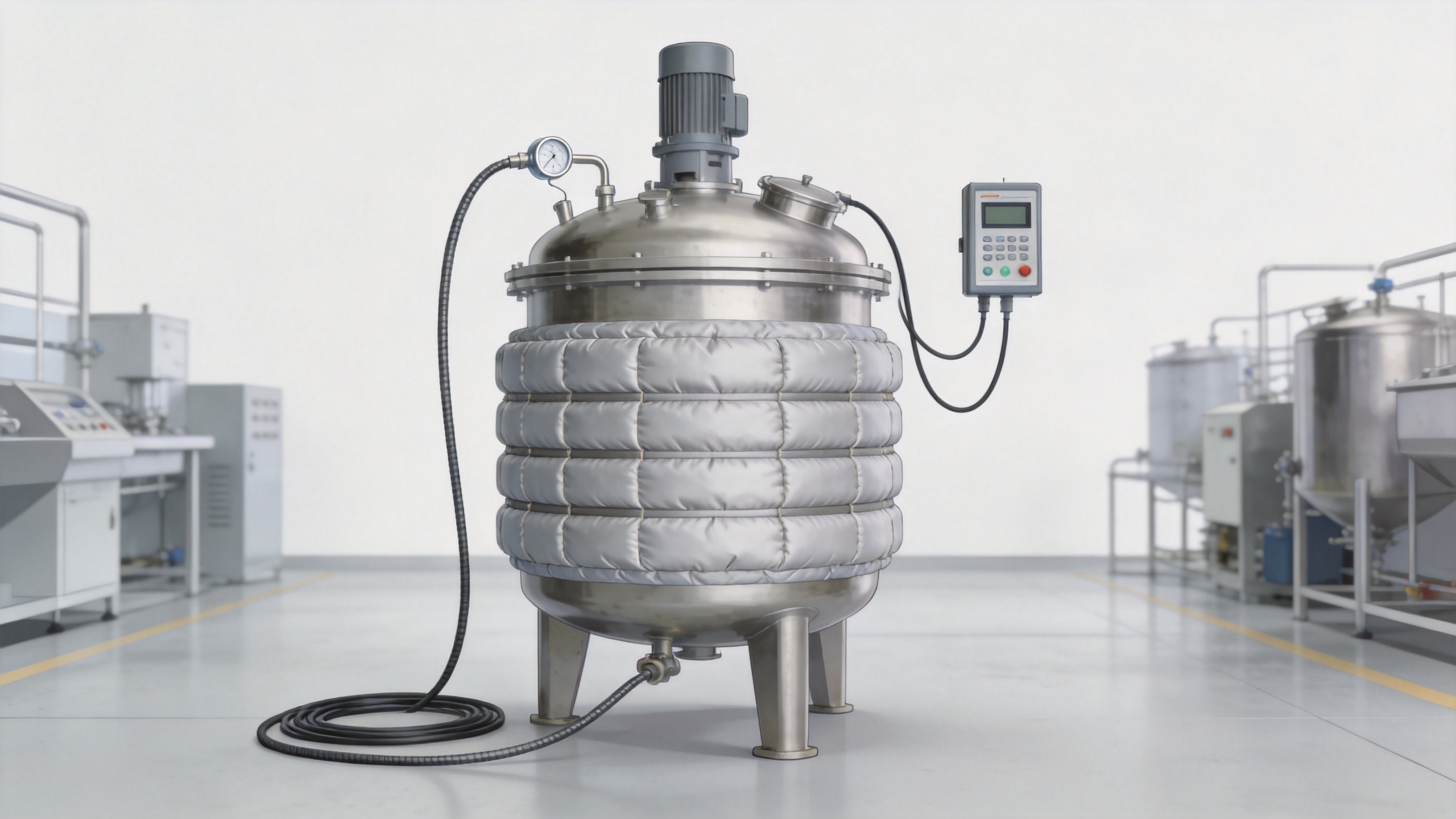
Specialty lines often involve equipment that is difficult to cover evenly. A conical hopper, a vessel with fittings, a pipe assembly with bends, or a small batch tank with frequent access points can all create gaps between a standard product and the actual heat-loss path. A custom heating jacket can be shaped around those constraints so heating zones and insulation remain relevant to the surface being managed. This is not a promise of a particular temperature result; the result still depends on process load, ambient conditions, and control settings.
Fit also affects day-to-day work. If operators must open a flange, read an instrument, clean a port, or change a connection, an oversized or poorly placed cover can introduce friction into maintenance. A custom heating jacket may use planned openings, closures, and segmented sections to make that access more practical. Before approving a design, ask who removes it, how often that happens, and whether reinstallation can be checked consistently.
Insulation is another reason to specify the jacket around the duty. Directional research for this article notes that custom heating-jacket designs commonly use insulation to reduce heat loss. In practice, the relevant question is not whether insulation exists, but whether its coverage and thickness suit the operating environment. A custom heating jacket should be discussed alongside exposed surface area, airflow, nearby equipment, and the expected duration of the heating cycle.
Compare the value drivers, not just the purchase price
A useful comparison separates initial cost from the work that follows installation. A custom heating jacket can require more information and engineering time before an order is released. That effort may pay off when it reduces ad hoc modifications, repeated fitting work, or unclear control responsibilities during commissioning. It may not pay off when the duty is simple, dimensions are common, and a standard item fits the process without compromises.
| Decision factor | What to clarify | Why it matters |
|---|---|---|
| Equipment geometry | Dimensions, nozzles, handles, supports, and obstructions | Determines whether a standard wrap can cover the intended surface. |
| Thermal duty | Target range, start condition, heat-up time, and expected losses | Helps size the heating approach around the actual process condition. |
| Material and environment | Contact surfaces, washdown exposure, ambient conditions, and insulation needs | Guides material and protection choices. |
| Operation and service | Access points, removal frequency, controls, sensors, and alarms | Shows whether the design can support routine work. |
This comparison is especially useful when a specialty line runs small batches, changes product frequently, or handles material whose flow behavior changes with temperature. A custom heating jacket is not a substitute for understanding the product. It is one part of a temperature-management arrangement that also includes power supply, sensing location, controller settings, operating procedure, and verification.
Specify the thermal duty before choosing construction details
Buying discussions can become too focused on wattage or a single temperature number. Those figures are relevant, but they do not describe the entire job. A custom heating jacket should be specified against a heat-loss and process-use picture: what is being heated, how much material is present, whether the material is moving, how quickly the condition must change, and which areas are allowed to remain unheated.
Questions for the process team
- What temperature range is required during startup, normal operation, and hold periods?
- What is the material condition at the beginning of the cycle, and how does it respond to heat?
- Which fittings, instruments, drains, or supports must remain accessible?
- Where can a sensor provide a meaningful reading, rather than merely reporting a convenient surface?
- What happens if the controller detects a temperature outside the intended operating range?
These questions help reveal whether a custom heating jacket needs one heating zone or several, a removable design or a fixed installation, and simple local control or a connection to a broader system. It is usually more productive to state these conditions early than to compare jacket styles before the duty is clear.
Control and verification are part of the return
The jacket itself is only one element of the system. A custom heating jacket can support a more orderly control plan when sensor locations, setpoints, cable routing, and protective functions are considered during design. Directional search results also identify temperature sensing and overtemperature protection as common questions for flexible heating products. The exact protective configuration should be confirmed for the project rather than assumed from a general description.
Commissioning should test the installed setup under representative conditions. Record the starting condition, setpoint, sensor position, time to reach the intended range, and any temperature differences across accessible locations. If heat load changes across a batch cycle, include that pattern in the evaluation. This converts a claim about a custom heating jacket into a documented check of how the assembled system behaves in its own line.
When a standard heating jacket may be enough
Customization is not automatically the right answer. A conventional heating jacket may be appropriate where vessel dimensions are common, coverage is uncomplicated, access is rarely needed, and the thermal duty is stable. The key is to avoid forcing a standard item into a geometry or operating routine it was not designed to accommodate. In those cases, the apparent savings can be offset by fit-up work, uncovered areas, or difficult service.
Conversely, a custom heating jacket deserves a closer look when the line has nonstandard geometry, limited space, frequent access requirements, separate heating stages, or a process whose material response makes even coverage important. Rather than relying on a broad return-on-investment claim, compare the expected specification effort with the operating complications the tailored design is intended to address.
A practical approval checklist
- Document the equipment drawing or measured geometry, including all obstructions.
- Define the required operating range and the thermal duty for each process stage.
- Confirm material, environmental, electrical, and cleaning constraints.
- Agree on access, closure, sensor, control, and protective-function requirements.
- Review the proposed custom heating jacket layout against the real installation.
- Plan a commissioning check with records that can be reviewed after startup.
For specialty lines, the payoff from a custom heating jacket is usually found in this disciplined fit between equipment, process, and operating routine. A supplier discussion is more productive when it begins with verified conditions—target range, heat load, material, connection details, and service needs—rather than a generic request for more heat. That approach gives the buyer a clearer basis for deciding whether customization is justified.
 Hot News