
How Chiller Machine Manufacturers Balance Cost and Performance
When a process line needs stable cooling, the lowest quotation is rarely the whole answer. Experienced chiller machine manufacturers have to reconcile the initial equipment budget with temperature stability, energy use, control integration, service access, and the actual duty cycle. For a buyer, the useful question is not “Which unit has the lowest initial price?” but “Which configuration meets the process requirement with costs that remain understandable after installation?”
That distinction matters in semiconductor, chemical, new-energy, and other temperature-sensitive work. An industrial chiller is part of a larger thermal-control system, so its result depends on load behavior, fluid, piping, controls, installation conditions, and maintenance practices. The following framework shows how chiller machine manufacturers and project teams can make those trade-offs visible before a purchase order is issued.
Start with the operating condition, not the catalog price
Responsible chiller machine manufacturers begin by clarifying the temperature range, required stability, heat-load profile, ambient conditions, fluid, flow and pressure needs, electrical supply, footprint, and control connection. A price comparison made before those conditions are defined can compare unlike systems. For example, a unit sized only for a nominal peak load may look economical at first while cycling inefficiently under the much more common partial-load condition.
This is why an industrial chiller inquiry should include a duty table rather than a single capacity number. It should show how often the process runs, whether load changes by batch or shift, what happens during start-up, and what temperature deviation is acceptable. Chiller machine manufacturers can then explain which parts of the proposal address confirmed requirements and which still need validation.
Where cost and performance usually meet
1. Capacity margin and temperature stability
Chiller machine manufacturers must balance enough cooling capacity for upset conditions against the cost and control consequences of oversizing. A larger compressor, heat exchanger, or pump can add margin, but excessive margin may increase purchase cost and make low-load control less suitable. The right margin depends on measured or estimated load variation, required recovery time, and the process risk of temperature drift.
For an industrial chiller supporting a sensitive process, ask for the assumptions behind the capacity calculation: entering and leaving fluid temperatures, ambient condition, flow, heat load, and allowable stability band. This moves the discussion from a headline capacity to a configuration that can be reviewed.
2. Efficiency where the system actually operates
Efficiency should not be reduced to one full-load number. Public U.S. Department of Energy purchasing guidance evaluates electric chillers with both full-load and integrated part-load efficiency requirements, because the useful comparison changes with intended operation. Chiller machine manufacturers should therefore relate efficiency data to the expected load profile and configuration rather than presenting a single value as a universal answer.
The budget impact can be substantial over time, although each site needs its own energy-rate and operating-hour calculation. In one public DOE example for a 300-ton water-cooled centrifugal chiller, the stated 23-year lifetime energy cost ranged from $452,160 for the high-efficiency case to $615,117 for the lower-efficiency case under that example’s assumptions. It is an illustration, not a forecast for an individual industrial chiller project, but it explains why chiller machine manufacturers should discuss lifecycle cost early.
3. Air-cooled versus water-cooled system boundaries
Chiller machine manufacturers often need to compare configuration choices rather than simply quote a machine. An air-cooled option may simplify site infrastructure in some situations. A water-cooled arrangement can introduce different efficiency and heat-rejection considerations, along with tower, water-treatment, and maintenance responsibilities. Neither category is automatically appropriate; the site, duty cycle, utilities, and service capability decide the trade-off.
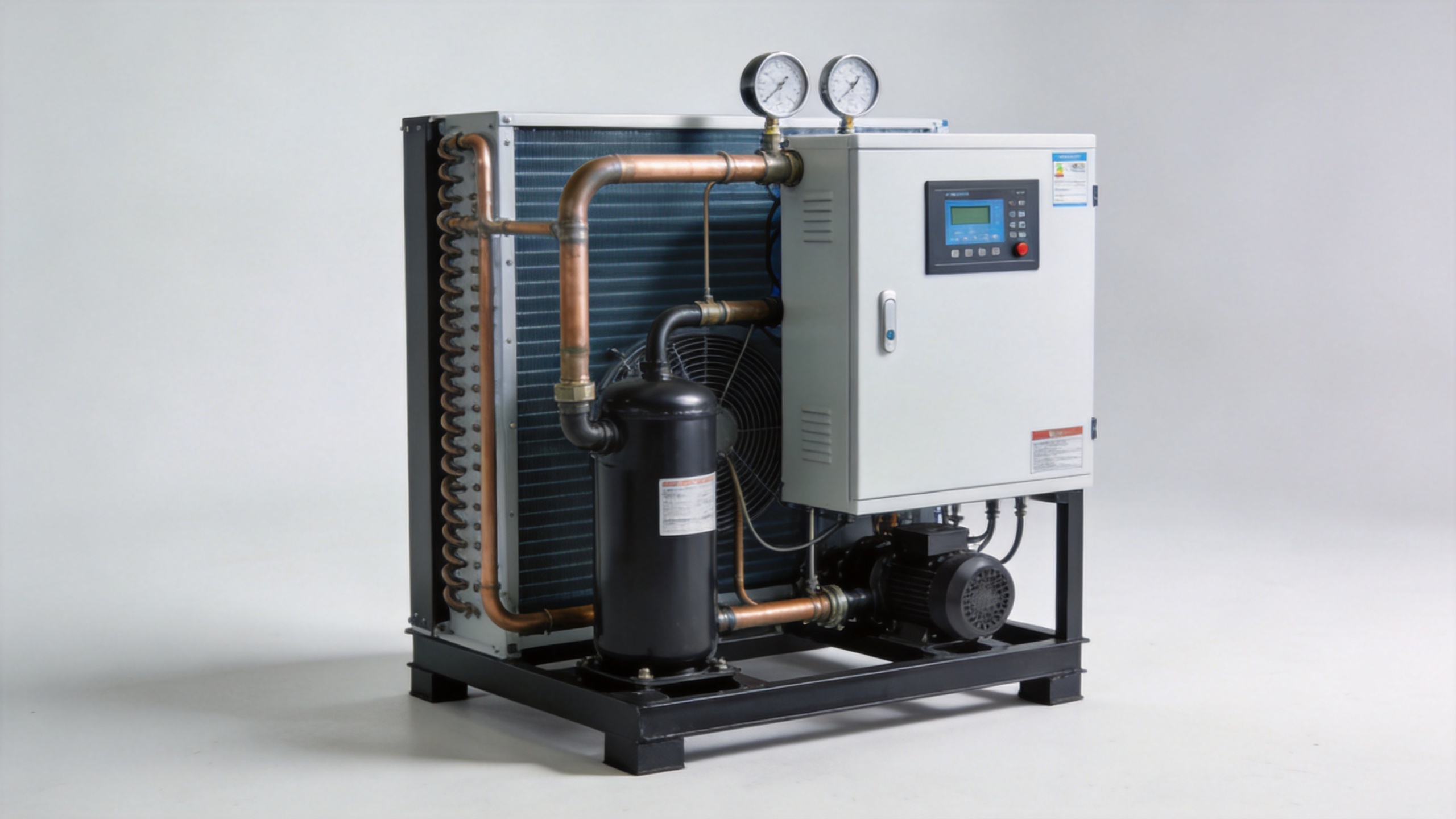
For an industrial chiller, buyers should list the equipment and operating work outside the cabinet as well: pumps, tanks, filtration, piping insulation, heat rejection, controls, treatment, commissioning, and access for maintenance. Chiller machine manufacturers who make these connections explicit help avoid an apparently low equipment price becoming an unclear installed cost.
Use configuration to control lifecycle exposure
The most practical proposals from chiller machine manufacturers separate base scope, options, and exclusions. That makes it easier to compare a standard unit with a customized arrangement without assuming that every feature produces the same process value. Variable-speed components, control communications, monitoring points, redundancy, filtration, and insulation may be justified when they address a documented operating condition; they are not automatically necessary for every industrial chiller installation.
Maintenance is another performance input, not an afterthought. Chiller machine manufacturers can improve the procurement conversation by identifying routine access points, recommended inspection records, fluid-management needs, and signals that require investigation. A design that is difficult to service may carry operational consequences even if its initial price is lower. Conversely, specifying every possible option without a process reason can use budget that would be better reserved for commissioning or spares.
A four-part comparison method for buyers
- Define the duty: Give chiller machine manufacturers the temperature range, fluid, load profile, ambient conditions, utilities, and control requirements.
- Compare like-for-like scope: Separate the industrial chiller price from pumps, tank, piping connections, controls, heat rejection, installation, and commissioning.
- Test the operating case: Review capacity and efficiency at the stated condition, including part-load operation where it is relevant.
- Price the lifecycle questions: Ask what maintenance access, consumables, service response, data visibility, and upgrade path are included or excluded.
This method gives chiller machine manufacturers a defined basis for engineering and gives procurement teams a clearer record of why one proposal costs more or less. It also reduces the risk of treating a catalog parameter as a site result.
Questions that make a quotation more useful
- What operating conditions were used to size the industrial chiller?
- Which items are included in the quoted scope, and which site connections remain with the project team?
- How do the stated capacity and efficiency values change at the expected load and ambient conditions?
- What controls, alarms, and communication points are available for integration?
- Which maintenance tasks need access, records, consumables, or water and fluid management?
- What information should be verified during commissioning before the process depends on the unit?
Balance is an engineering process
Chiller machine manufacturers balance cost and performance by making design assumptions explicit, matching equipment to the real duty, and showing where lifecycle cost can change the comparison. A capable industrial chiller proposal does not promise a result without conditions. Instead, it links the target temperature, heat load, media, controls, and maintenance plan to an explainable configuration.
For buyers, that creates a better decision: choose the system whose scope and operating evidence fit the application, then validate the remaining conditions during detailed engineering and commissioning. This approach keeps cost discipline without treating performance as an optional extra.
 Hot News