
Why an EV Battery Test Cooling System Boosts Test Accuracy
In battery validation, temperature is not background noise. It changes internal resistance, charge acceptance, voltage behavior, heat generation, and the pace of electrochemical reactions. That is why an EV battery test cooling system is a measurement-control tool, not simply auxiliary lab equipment. When the test article experiences a known, stable thermal condition, engineers can compare runs with more confidence and investigate differences that actually belong to the cell, module, pack, or test procedure.
From a thermal-management application engineer’s perspective, the important question is not whether a setpoint appears on a controller. It is whether the battery, coolant loop, fixtures, sensors, and measurement sequence have reached a defined and repeatable state. An industrial chiller can support that work when its temperature range, dynamic capacity, fluid compatibility, flow behavior, and control-signal compatibility fit the test plan.
Temperature can alter the result you think you are measuring
A battery test often records capacity, energy, DC resistance, charging response, discharge behavior, or cycle-life trends. Each result can be influenced by temperature. If one run begins after the battery has stabilized and another begins while the fixture or coolant loop is still drifting, the numerical difference may reflect the thermal condition rather than a genuine difference between samples.
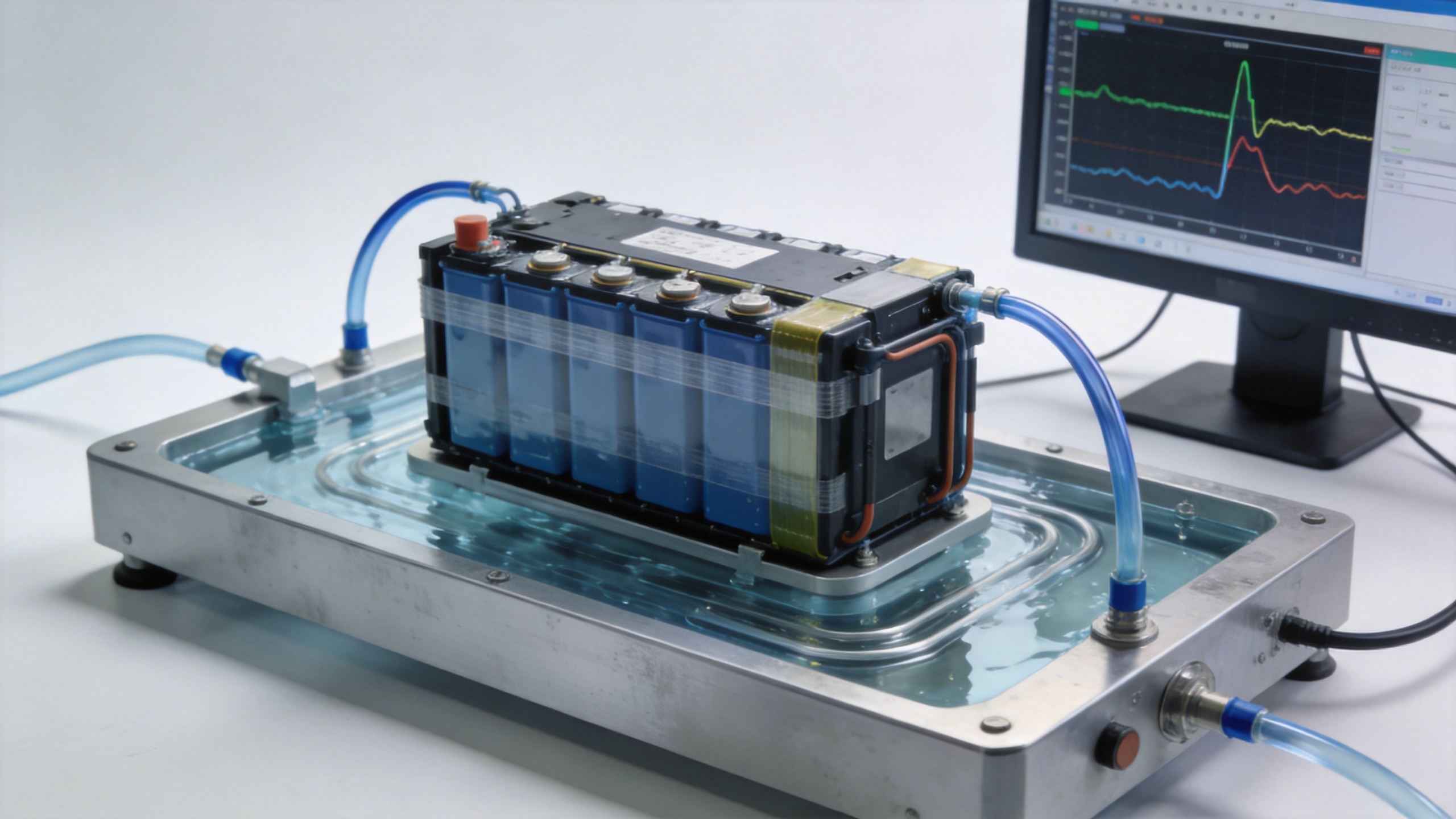
This is especially relevant during high-current charging and discharging. Heat can develop inside the test article, while the temperature seen by a chamber sensor, a cold plate, or a coolant supply sensor may not equal the temperature at the cell surface or inside a representative location in the pack. A capable EV battery test cooling system helps the laboratory manage that gap by supplying a controlled thermal boundary and by making temperature behavior observable throughout the sequence.
Defined temperature conditions are already part of reproducible battery testing. IEC 62660-1 is associated with standardized lithium-ion cell performance testing under stated temperature and current conditions. The exact condition depends on the method and objective, but the broader lesson is useful: temperature belongs in the test definition, not in the assumptions around it.
How controlled cooling improves test accuracy
1. It improves repeatability between samples and test days
Repeatability depends on starting from comparable conditions. An EV battery test cooling system supports repeatable testing by bringing the circulating fluid and fixture toward the defined temperature before a run begins, then limiting excursions while the battery is under load. This gives a team a more reliable basis for comparing batches, design revisions, or repeat runs performed on separate days.
The setpoint alone is not the acceptance criterion. A practical procedure should define an allowable temperature band, required dwell time, sensor locations, and a rule for deciding that the test article has stabilized. This distinction matters because a stable supply temperature does not automatically prove that a large module or pack has equilibrated.
2. It separates thermal effects from electrical behavior
When temperature moves during a run, electrical data can move with it. By controlling and logging the thermal boundary, an EV battery test cooling system gives analysts more context for interpreting voltage traces, resistance calculations, and efficiency results. If an anomaly appears, the team can ask whether it aligns with current, state of charge, coolant temperature, surface temperature, flow, or ambient conditions instead of treating every deviation as a cell issue.
This does not mean cooling removes every uncertainty. Sensor accuracy, sensor attachment, fixture contact, channel calibration, and test-software timing still matter. It does mean the thermal portion of the uncertainty is more visible and easier to manage.
3. It creates a controlled response to dynamic heat load
Battery heat load is rarely static. Pulse profiles, fast charging, high-rate discharge, and transitions between rest and active periods can change the demand on the loop. For this reason, an industrial chiller should be assessed against the expected load profile, not only an average cooling number. Engineers should also consider whether the work requires cooling only or both heating and cooling, since many validation schedules move through more than one thermal condition.
For context, thermal-cycling summaries of SAE J2464 describe cycling from −40 °C to 70 °C with a specified transition time. That example is not a universal setpoint for every EV program, but it illustrates why dynamic capability, ramp behavior, and fixture design deserve attention in test-system planning.
What to specify for an EV battery test cooling system
Choosing an EV battery test cooling system begins with the test method rather than a model number. Collect these project inputs before comparing equipment:
- Temperature window and tolerance: Define the target range, allowable deviation, dwell requirement, and sensor position used for release to test.
- Heat-load profile: Estimate steady and peak loads across charge, discharge, rest, and cycling stages.
- Thermal coupling: Document cold-plate area, hose routing, fittings, fluid volume, pressure drop, insulation, and fixture contact.
- Circulating medium: Confirm the required fluid, temperature range, material compatibility, cleanliness needs, and maintenance approach.
- Flow and control-system integration: Clarify required flow range, command signals, interlocks, alarms, data logging, and emergency behavior.
- Measurement plan: Decide which temperatures, flow values, pressures, and electrical channels are logged and synchronized.
This checklist reflects a simple principle: nominal capacity is not the full answer. An EV battery test cooling system may perform differently after it is connected to a real fixture, a long hose run, a selected coolant, and a fluctuating battery load. Reviewing the system as a whole produces a more useful technical discussion than comparing one nameplate value.
Why flow control and sensor placement matter too
Cooling accuracy is not only a temperature-control issue. Insufficient or unstable flow can create a larger temperature difference between coolant supply and return, or between parallel fixture paths. Poor sensor placement can hide a hot region, while excessive sensor lag can make a responsive control loop appear slow. A well-designed EV battery test cooling system therefore needs a measurement plan that connects the fluid loop to the actual test article.
A sensible starting layout records coolant supply and return temperature, flow, pressure where relevant, ambient temperature, and selected battery temperatures. The team should then define how those values are reviewed after a run. For example, a result may be flagged for engineering review if the thermal stabilization criterion was not reached, if flow departed from the planned band, or if a sensor trace indicates uneven fixture coupling.
Use cooling data to strengthen—not obscure—test decisions
The aim is not to claim that every test has one universally correct temperature. The aim is to document the temperature condition well enough that results can be repeated, compared, and explained. When thermal data accompanies electrical data, an unexpected result has more diagnostic value. When it does not, a lab may spend time investigating a battery difference that was actually caused by a changing test boundary.
For teams planning a new rig or updating a validation procedure, treat the EV battery test cooling system as part of the test method. Define the thermal condition, confirm stabilization, size the loop for realistic load changes, verify integration with the fixture and test controls, and retain the relevant logs with the electrical record. That approach helps turn temperature control from an assumed utility into a traceable contributor to credible battery-test data.
 Hot News