
Why a Semiconductor Chiller Is Key for Battery Test Temperature Control
Battery testing is not simply a matter of applying a charge and reading a result. Cell behavior, cooling-plate response, and the equipment around a fixture can all change as temperature changes. That is why a semiconductor chiller can be a useful part of a controlled battery-test loop. It gives the test team a way to circulate conditioned fluid through a plate, chamber interface, or other thermal path while the electrical test program runs.
From a thermal-management application engineer’s point of view, the useful question is not whether every battery lab needs the same semiconductor chiller. It is whether the planned temperature range, heat load, fluid, flow, pressure, and test sequence have been defined well enough to select and validate a system. A stable setpoint alone is not the whole requirement.
Battery tests need repeatable thermal conditions
Temperature influences battery behavior and durability, so laboratories commonly control thermal conditions while measuring capacity, power, cycling behavior, or system response. The retrieved battery-test material describes characterization points such as −20°C, 0°C, 25°C, and 45°C under IEC 62660-2-related testing; the applicable edition and exact procedure should be confirmed for the project. The point is not that every program uses those values. The point is that a test plan may need repeatable transitions and dwell periods across more than one condition.
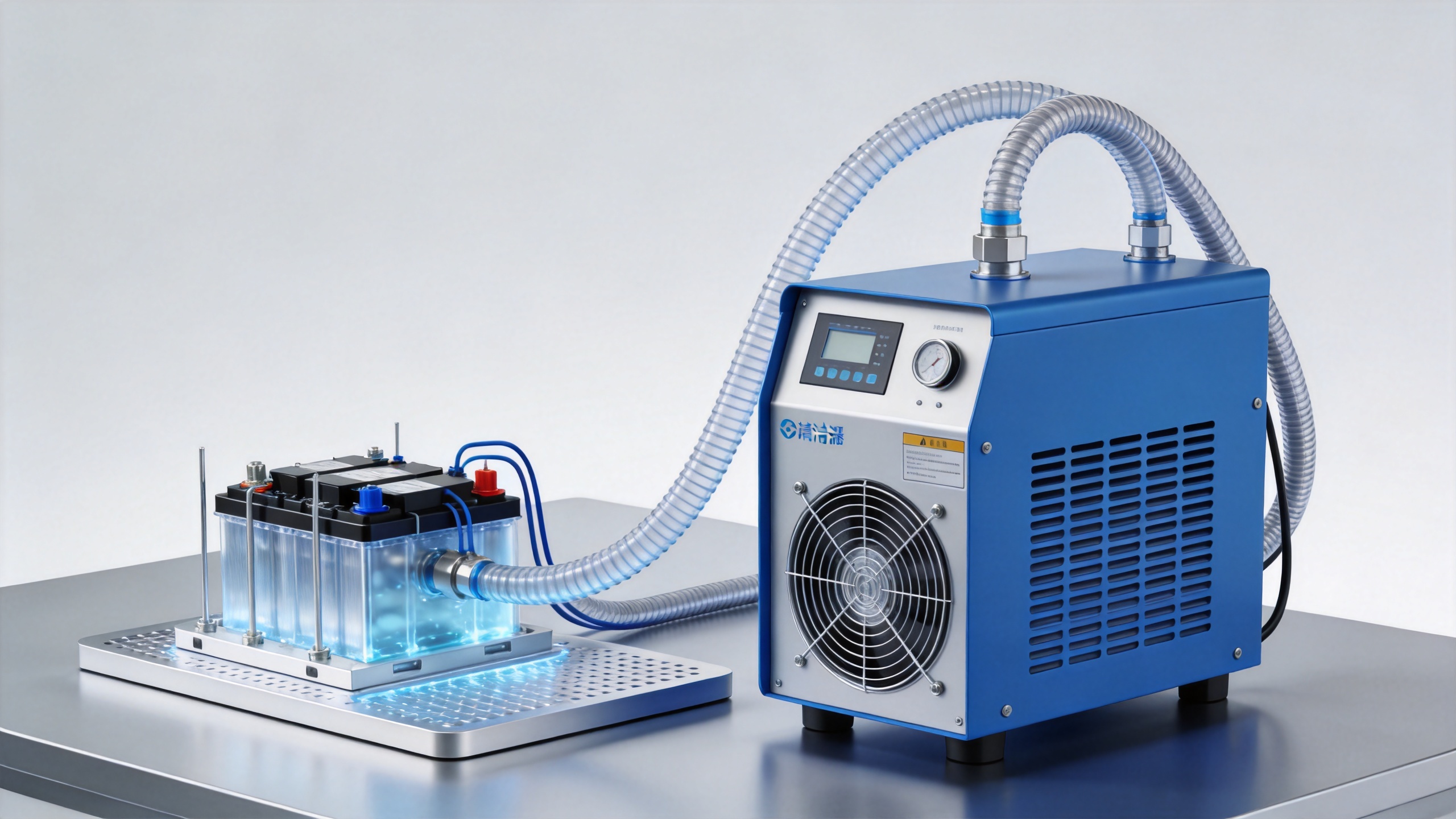
A semiconductor chiller supports that need by conditioning a circulating heat-transfer fluid outside the battery specimen. The fluid can enter a cooling plate or fixture at a defined temperature, flow rate, and pressure. This helps the test team distinguish a battery or battery-management-system response from a change in the thermal boundary condition. If the inlet condition drifts, the data may be harder to interpret.
Why use a semiconductor chiller rather than a generic cooling source?
The term semiconductor chiller usually signals an application where temperature stability, repeatability, and integration matter. Semiconductor tools and battery test rigs are different applications, but they share a practical need: the thermal source must work with a programmed process rather than just remove heat at an unspecified condition. A conventional industrial chiller may be appropriate in some facilities, especially for broader plant cooling. For a test loop, however, the selection discussion often needs to go further.
- Setpoint behavior: Examine how the system behaves at steady state and during programmed changes, not only its nominal temperature range.
- Thermal-load variation: Charging, discharging, environmental changes, and fixture losses can alter the load. A stated target temperature does not define those changes by itself.
- Fluid-loop conditions: Fluid compatibility, flow, pressure drop, hose length, and connection design affect the condition that reaches the battery interface.
- Controls and data exchange: A semiconductor chiller should be considered alongside the test controller, alarms, interlocks, and the way a program requests or records thermal states.
In other words, a process chiller is not evaluated only by its refrigeration capacity. The question is whether the complete loop can establish and document the test condition that the procedure calls for.
The link between temperature control and data quality
When a cell or pack is being tested near a thermal limit, small changes in the surrounding thermal path can affect the observation. That does not mean the semiconductor chiller determines every result, nor does it guarantee a particular level of measurement accuracy. It means that controllable inlet conditions and a recorded thermal response make the test boundary clearer.
Consider a cooling-plate test. A recirculating chiller can deliver conditioned fluid to the plate while the team monitors inlet and return temperatures, flow, pressure, and battery temperatures. If the return condition changes sharply during a current pulse, that observation may point to a changing heat load, a control interaction, or a restriction in the loop. It still needs engineering interpretation, but it is more useful than an uncontrolled thermal environment.
This is also why a semiconductor chiller should be matched to the whole system. The same unit may behave differently with a short, insulated loop and a long fixture line exposed to room heat. Installation space, ventilation, ambient heat sources, and maintenance access are part of the operating condition, not afterthoughts.
Key selection questions for a battery-test loop
Before comparing a semiconductor chiller, prepare an application sheet that answers the following questions. It is better to clarify these conditions than to choose a model based on a single headline figure.
- What temperature range and transition profile does the test procedure require? Include dwell periods, ramp expectations, and low- or high-temperature boundary conditions.
- What is the expected thermal load? Note nominal and changing loads, plus heat coming from cables, fixtures, chambers, or neighboring equipment.
- Which heat-transfer fluid and materials are planned? Confirm compatibility with the battery plate, tubing, seals, and maintenance practice.
- What flow and pressure conditions reach the device under test? Account for line length, pressure drop, manifolds, and any parallel branches.
- How will the chiller communicate with the test system? Define start/stop behavior, setpoint control, alarms, interlocks, and what data must be logged.
- How will performance be verified? Agree on sensor locations, stabilization criteria, load profiles, and acceptance evidence before commissioning.
These questions apply whether the equipment is described as a semiconductor chiller, a recirculating chiller, or a process chiller. Names can help frame an application, but they do not replace a thermal-load calculation or an integration review.
Do not separate the chiller from the test workflow
One common mistake is to specify the temperature-control unit after the battery fixture and test schedule are already fixed. Another is to compare equipment only by a nominal range or cooling number. A semiconductor chiller is part of a system that includes piping, fluid, sensors, control logic, electrical test steps, and the battery thermal interface. Looking at those elements together reduces the chance that a system appears suitable on paper but leaves important conditions unverified.
A practical validation plan can start with no-load circulation, then controlled load steps, then representative test sequences. Record the environmental condition, fluid supply and return values, flow, pressure, fixture temperatures, and relevant alarms. This is not a promise that every issue will be eliminated; it is a structured way to identify where a test condition needs further confirmation.
Conclusion
A semiconductor chiller can be key to battery test temperature control because it helps turn a broad thermal requirement into a managed, repeatable fluid-loop condition. The strongest selection decision comes from matching the unit to the temperature program, dynamic heat load, fluid circuit, controls, and validation method. If those inputs are still uncertain, start by documenting them. That creates a better basis for evaluating an industrial chiller or process chiller and for building a battery test workflow that produces interpretable results.
 Hot News