What a Heating Jacket Manufacturer Should Certify
Choosing a heating jacket manufacturer for an industrial line is not the same as sourcing heated apparel. An industrial heating jacket is an electrically heated, insulated assembly that fits a vessel, valve, pipe, drum, or process component. It may influence personnel safety, electrical conformity, maintenance access, and process repeatability. That is why a buyer should ask a heating jacket manufacturer for evidence that matches the supplied configuration and the destination market—not simply a collection of logos.
From an industrial procurement perspective, the useful question is: which claims can this heating jacket manufacturer document for this design, this application, and this shipment? The checklist below separates company-level management evidence from product-level proof and project-level records.
Start by defining what the heating jacket must do
Before comparing certificates, give the manufacturer a clear application brief. Record the object dimensions, target temperature range, ambient conditions, process medium, heater supply, hazardous-area considerations where relevant, insulation constraints, controls, cable routing, and expected maintenance access. A certificate cannot fill a missing engineering input.
This first step also prevents an intent mismatch. Search results for “manufacturer” can include consumer garments, while an industrial heating jacket may require different materials, electrical construction, documentation, and installation controls. If the product will be used on a process line, state that in the request for quotation.
1. Verify quality-system certification and its scope
An ISO 9001 certificate can be a useful starting point when reviewing a manufacturer. It indicates that an independent certification process has assessed the supplier’s quality management system against the standard’s requirements. It does not, by itself, certify a particular heating jacket, temperature rating, or installation.
Ask the manufacturer for the current certificate, issuing body, expiry date, and scope statement. The scope matters: it should relate to the design, manufacture, assembly, or supply activities actually involved. Then ask how the supplier controls drawings, work instructions, incoming materials, inspection points, calibration, nonconforming output, and corrective actions. ISO 9001 guidance also emphasizes controlled documented information and retained evidence; a useful supplier should be able to show how records are created and retrieved.
2. Match electrical conformity evidence to the market
A manufacturer should not present CE, UL, CSA, or another mark as a universal substitute for all other requirements. Their relevance depends on the destination, product category, voltage, controller arrangement, installation method, and applicable regulations or customer specifications. Ask which conformity route applies to the delivered assembly and why.
- Request the applicable declaration, test summary, marking details, and the exact model or configuration covered.
- Check whether the evidence covers the jacket alone, the controller, the cable assembly, or the integrated system.
- Confirm rated voltage, power, protective-earth arrangement, ingress expectations, over-temperature protection, and installation limitations.
- Where third-party testing is claimed, request the report reference, laboratory identity, revision, and any conditions attached to the result.
These questions help a buyer assess a manufacturer without assuming that one label proves suitability in every country or every process environment.
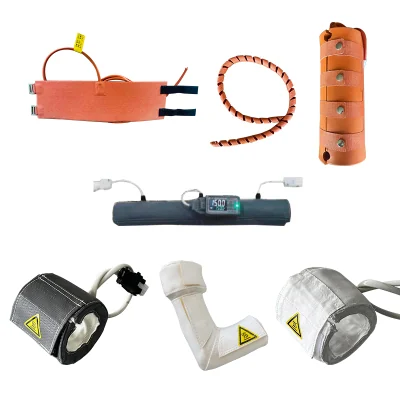 Product-level electrical and inspection evidence should match the supplied configuration.
3. Ask for traceable design and material records
For a custom or semi-custom heating jacket, the most useful evidence often connects the order to a controlled technical file. Ask the manufacturer for a drawing or dimensional confirmation, bill of materials where appropriate, heater-circuit description, insulation and outer-cover material identification, connector details, and revision status.
Material names alone are not enough. The manufacturer should clarify what the material statement applies to and whether it is backed by supplier documentation, a data sheet, or a test record. If chemical exposure, washdown, vacuum service, or clean-process restrictions matter, define those conditions before treating a general material declaration as adequate evidence.
4. Request product-specific inspection and test evidence
A capable manufacturer can explain which routine checks are performed on each unit and which validation tests apply to a design family. The appropriate test plan varies by application, so request acceptance criteria rather than relying on vague claims.
A practical file may include serial or batch identification, visual inspection results, continuity or insulation-resistance checks where appropriate, functional temperature-control observations, dimensional confirmation, and release authorization. If uniformity, sensor placement, thermal response, or a particular temperature limit is important, ask the manufacturer whether a representative test method is available and what its boundary conditions were.
Do not confuse a demonstration test with proof of your installed outcome. Heat transfer changes with vessel geometry, insulation contact, ambient losses, process load, and control tuning. More accurate procurement language is to ask the manufacturer for the test setup, measured points, tolerances, and limitations.
5. Check traceability, change control, and service records
Traceability makes later troubleshooting and replacement more manageable. Ask the manufacturer how a serial number or batch code links to the drawing revision, heater materials, controller version, inspection record, and shipment. Also ask how engineering changes are reviewed and how customers are notified when a change could affect fit, electrical connection arrangements, or operating documentation.
For repeat orders, request a procedure for preserving the approved configuration. A manufacturer that can identify the last accepted revision helps buyers compare like with like instead of relying on an old quotation or an informal email description.
6. Evaluate application-specific certifications separately
Some projects require additional evidence because of the environment, industry, or customer specification. A manufacturer may need to address hazardous locations, material restrictions, sanitation, pressure-system connection arrangements, or site-specific electrical rules. These are not automatic requirements for every heating jacket, and they should not be assumed from the supplier’s general brochure.
Use a requirements matrix: list each applicable standard or customer requirement, the responsible party, the required document, the configuration covered, and the acceptance date. This makes it easier to see whether the manufacturer has provided evidence for the complete delivered system or only for a component.
A document request list for supplier review
When comparing quotations, send the same request to each manufacturer:
- Current quality-management certificate and scope, if held.
- Product drawing, revision, dimensions, and connection arrangement confirmation.
- Electrical ratings, wiring information, controller compatibility, and installation instructions.
- Market- and application-relevant conformity declarations or test evidence.
- Material and component documentation appropriate to the stated process conditions.
- Inspection, functional-test, and release records for the supplied unit or batch.
- Serial or batch traceability and a documented change-notification route.
- Clear exclusions, assumptions, and items that need project-level verification.
Make the certification review a joint engineering step
The right manufacturer is not identified by the longest certificate list. A stronger sign is a supplier that can connect each document to an actual jacket configuration, explain its limits, and identify what remains to be confirmed. That evidence-led approach supports clearer purchasing decisions for industrial heating jacket applications.
For complex thermal-management projects, share the application brief early and ask the manufacturer to respond against the same document matrix. It keeps procurement, engineering, and site teams focused on verified inputs rather than broad marketing claims.
 Hot News