
How a Custom Industrial Heating Jacket Aligns with Your Process
A custom industrial heating jacket is not simply insulation with a power lead. It is a fitted thermal-control layer designed around a particular vessel, drum, pump, pipe section, filter, or process module. From an application-engineering perspective, the useful question is not “Which jacket has the highest rating?” It is “What operating condition must this jacket support, and what evidence will show that the configuration fits?”
That distinction matters when material viscosity, flow behavior, condensation exposure, temperature-sensitive handling, or restart time affects the process. A well-defined custom industrial heating jacket starts with the operating window, then brings geometry, heat loss, control strategy, access, and electrical connections into the same design brief. The result is a configuration that can be reviewed against the real installation rather than against a generic product description.
Start with the process condition, not the jacket format
Before choosing materials, closures, zones, or controller options, describe what the equipment must do. Is the aim to hold a fluid above a handling temperature, recover temperature after downtime, reduce surface cooling during transfer, or warm a component before a batch begins? Each objective changes the way a custom industrial heating jacket should be specified.
Define the normal target temperature, acceptable operating band, starting temperature, desired warm-up period, and expected ambient conditions. Then identify the medium inside the equipment, the approximate mass, whether mixing or flow continues during heating, and whether the load changes between batches. If heat demand varies substantially, a target temperature by itself is not enough. Heat loss, vessel wall material, exposed surface area, and process behavior all affect the thermal response.
An industrial heating jacket can be part of the answer, but the design basis should also state what is unknown. For example, a team may need to verify insulation condition, measured surface temperature, allowable electrical supply, or clean-down exposure before fixing the final configuration. Keeping those open items visible makes the selection discussion more useful.
Translate equipment geometry into a fitted heating plan
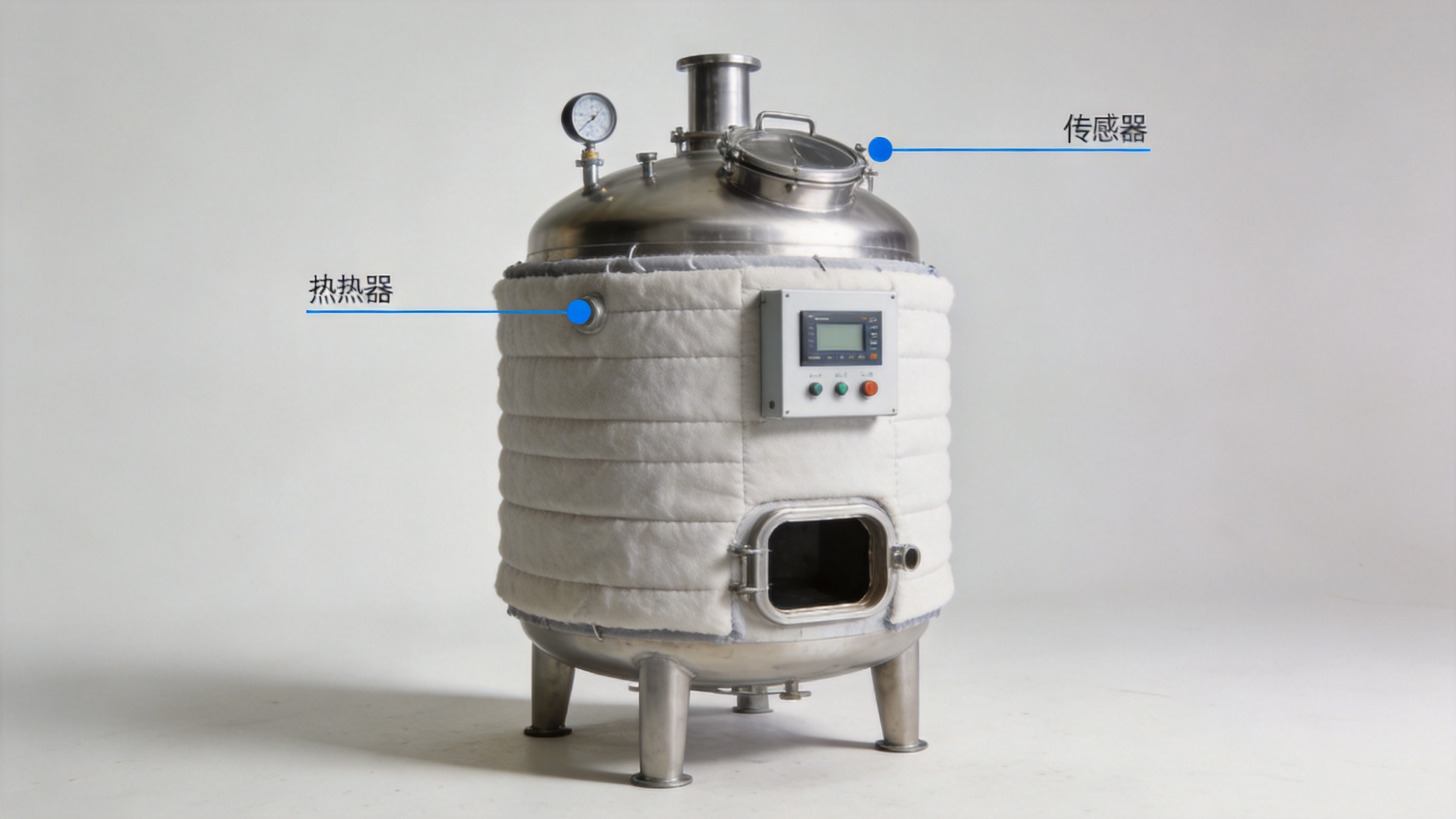
Geometry is where a generic wrap often stops being adequate. A custom industrial heating jacket may need to follow a conical bottom, flanges, support legs, nozzles, valves, sight ports, clamps, or an irregular pump housing. These details influence coverage, contact, removable sections, and the route for leads or sensors.
Provide current drawings when available, plus photographs from more than one angle and measured dimensions from the installed equipment. Mark any area that must remain accessible for inspection, sampling, lifting, cleaning, calibration, or maintenance. It is also important to identify obstacles such as brackets, nearby pipework, protruding edges, and moving parts. A jacket that fits a clean drawing but interferes with a routine task can create an avoidable operating burden.
Questions that clarify fit early
- Which surfaces need active heating, and which only need insulation?
- Where must operators open, disconnect, or inspect the equipment?
- Are there nozzles, drains, instruments, or supports that divide the jacket into sections?
- Will the custom industrial heating jacket be removed regularly, or remain in place for long runs?
- What clearances exist for closures, cables, and controller mounting?
This is also the point to decide whether one heating zone is sensible. Long equipment, uneven exposure, or different process regions may call for separate measurement and control points. That is not automatically necessary; it is a condition to review against the thermal duty and access constraints.
Match heat input and insulation to the actual thermal duty
A custom industrial heating jacket should be evaluated as part of a thermal system. The equipment shell, product, ambient air, insulation, and process flow all exchange heat. A higher heater wattage does not, by itself, establish that the process will warm uniformly or stay within the desired band. Conversely, improving coverage or insulation may change the duty enough that a different control approach is appropriate.
For a practical review, separate two conditions: heat-up and hold. Heat-up asks how much energy is needed to move the equipment and contents from the starting state toward the target. Hold asks how much energy is needed to offset ongoing losses once the target is reached. If the product is mixed, transferred, or replenished while heating, describe that behavior separately. The same custom industrial heating jacket can experience very different demands across those stages.
When exact process data is unavailable, label the assumption rather than turning it into a claim. A supplier or engineering team can then refine the brief using measured dimensions, material properties, ambient observations, and trial data. This approach gives procurement, operations, and engineering a common record of what has been confirmed and what still needs validation.
Specify sensing and control as an operating connection
Heating elements deliver energy, but sensing and control determine how that energy responds to the process. A custom industrial heating jacket specification should identify what temperature is being measured: jacket surface, vessel wall, product, or another approved point. The location matters because these measurements may not move at the same rate.
Discuss the controller connection early. Note the available supply, control enclosure location, cable routing, alarm expectations, local or remote operation, and any plant interlocks that affect operation. If the process requires records or a defined response to abnormal readings, include that requirement in the project brief instead of assuming a standard arrangement will cover it.
The goal is not to promise a fixed outcome from a single component. It is to make the custom industrial heating jacket compatible with the way the site runs, observes, and maintains the process.
Plan for installation, access, and verification
A configuration review should include how the jacket arrives, how it is fitted, and how the team will verify operation after installation. Removable sections may be useful when access is frequent, while a more continuous layout may suit stable equipment with limited intervention. The right choice depends on the site routine and the equipment envelope.
Before release, use a short acceptance checklist:
- Confirm equipment dimensions, penetrations, and access zones against the latest site information.
- Confirm the target temperature range, initial condition, ambient exposure, and expected duty cycle.
- Confirm electrical supply, controller location, sensing point, cable route, and operating responsibilities.
- Confirm any material-compatibility, cleaning, safety, or documentation requirements with the responsible site team.
- Agree on the observations used to verify fit and thermal behavior during commissioning.
A process-aligned brief supports better decisions
The value of a custom industrial heating jacket comes from alignment: the heating layout follows the equipment, the duty reflects the process, and the controls fit the operating routine. Treating those choices as one specification helps teams move beyond a single headline parameter and toward a configuration that can be reviewed, installed, and validated with fewer unanswered questions.
For applications involving sensitive equipment or changing operating conditions, share the process facts and constraints first. A clear brief gives engineers a basis for discussing a suitable custom industrial heating jacket configuration, the evidence needed before release, and the boundaries that should be verified on site.
 Hot News