
What a Laser Temperature Control Chiller Needs for Beam Stability
When a laser process begins to show beam drift, changing spot behavior, or uneven results over a long run, cooling is often treated as a secondary utility. In practice, the laser temperature control chiller is part of the stability chain. It must do more than remove heat. It must hold the coolant conditions delivered to the laser close to the operating conditions assumed during alignment, power setup, and process validation.
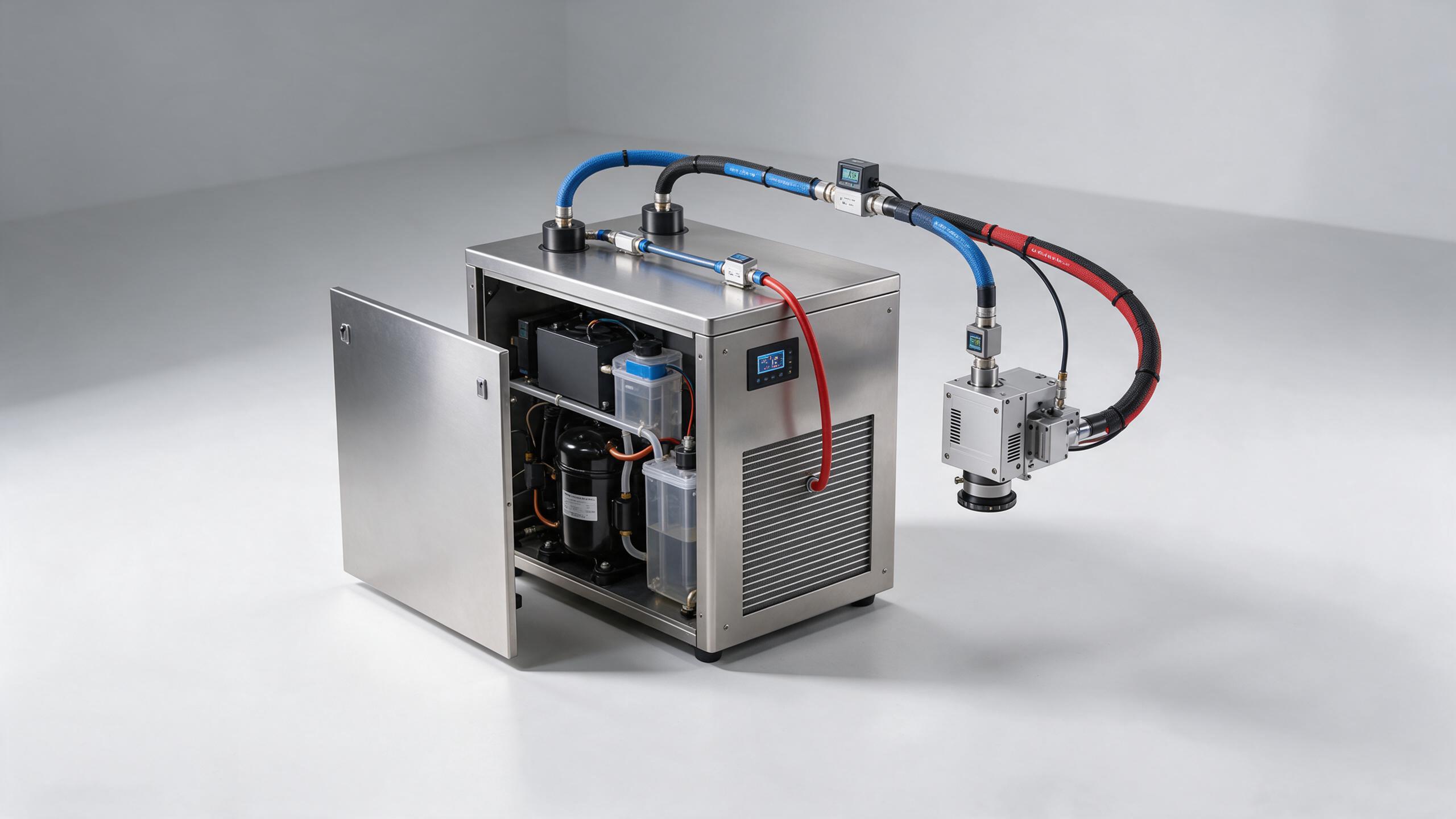
From a thermal-management viewpoint, the useful question is not simply, “Is the unit cold enough?” It is whether the laser temperature control chiller keeps temperature, flow, pressure drop, and control response sufficiently consistent at the actual laser connection point. That distinction matters because a stable setpoint at the chiller display does not automatically prove stable conditions through the laser, hoses, fittings, and heat exchanger.
Why Thermal Control Can Affect Beam Stability
Heat absorbed in a gain medium, laser head, mount, or optical component can create temperature gradients. Those gradients can change dimensions and, in optical materials, refractive index. The resulting thermal lensing or mechanical movement may alter focus behavior or beam direction. The sensitivity depends on the laser design, optical path, power level, duty cycle, ambient conditions, and process tolerance, so there is no single coolant-stability number that suits every system.
A laser temperature control chiller supports beam stability by reducing one source of changing thermal conditions. It cannot correct every optical or mechanical cause of drift, but it can make the thermal contribution easier to control and diagnose. If the beam changes as the machine warms up, the cooling loop deserves the same disciplined review as alignment, mounting, and electrical control.
Start With a Stability Budget, Not a Catalog Number
A practical selection begins with the laser manufacturer’s cooling requirements and the process team’s acceptance criteria. Define the permitted change at the laser inlet, the expected heat load, and the duration of the critical operating cycle. Then evaluate whether the laser temperature control chiller can maintain those conditions while the heat load rises, falls, or cycles.
- Temperature target and tolerance: Record the required supply temperature and the permitted deviation at the laser inlet rather than only at the chiller outlet.
- Heat load profile: Identify average load, peak load, warm-up behavior, and duty-cycle changes. A unit selected only for an average may respond poorly to a repeating peak.
- Coolant flow and pressure drop: Confirm the flow required by the laser and the resistance added by hoses, filters, quick couplings, manifolds, and the internal cooling path.
- Ambient environment: Account for room-temperature swings, condenser airflow, contamination, and whether the equipment is installed in an enclosed cabinet.
- Control and monitoring: Decide which temperature, flow, pressure, alarm, and interlock signals must be visible to the machine controller or maintenance team.
This approach makes the laser temperature control chiller a matched part of the system instead of a standalone utility selected only by nominal cooling capacity.
Temperature Stability Is Different From Setpoint Accuracy
Setpoint accuracy asks whether the displayed or measured value is close to the requested value. Stability asks how much that value moves over time. Both matter, but they create different commissioning tasks. A laser temperature control chiller may reach its setpoint after startup while still cycling around it in a way that is meaningful for a sensitive laser application.
Measure at locations that reveal the whole loop: chiller supply, laser inlet, laser return, and—where appropriate—the surrounding air near the laser. Log values during a representative process rather than relying on a single idle reading. Comparing supply and return temperatures helps show whether the thermal load and flow behavior are changing. A large or changing difference is not automatically a fault; it is a signal to compare against the designed load, flow, and laser maker’s limits.
Control Response Must Match the Heat Load
A laser’s thermal load is often dynamic. Startup, pulsed operation, changes in output power, and pauses in production can all change what the loop must absorb. For that reason, a laser temperature control chiller needs enough capacity margin and a control strategy that can follow realistic load changes without long recovery periods or aggressive oscillation.
Ask for performance evidence under conditions that resemble the application: intended fluid, supply temperature, ambient temperature, flow resistance, and changing load. If those inputs are not known, treat any precision statement as incomplete. The useful engineering conversation is conditional: what happens at this heat load, in this temperature range, with this loop volume and this hose layout?
Hydraulic Details Can Undermine a Good Controller
An industrial water chiller used in a laser loop must deliver repeatable coolant circulation, not merely refrigeration. Long hoses, undersized lines, restrictive fittings, trapped air, clogged filters, or an incompatible coolant can change flow and heat transfer. A laser temperature control chiller may appear stable internally while the laser receives a delayed or uneven thermal response.
During commissioning, verify flow at the relevant point, purge air according to the laser and chiller procedures, inspect filter condition, and confirm the fluid specification. Do not change fluid chemistry or concentration casually; corrosion protection, electrical conductivity, biological control, and compatibility can affect both the laser loop and service intervals. Record the normal pressure drop and return temperature so future deviations have a baseline.
Sensor Placement and Control Architecture Matter
A laser temperature control chiller controls what its sensor can see. If the sensor is located at the unit outlet, it may not capture heat pickup or delay in a long external loop. When beam stability is especially sensitive, use the available system signals to understand inlet temperature at the laser, return temperature, flow state, and alarm history. A remote sensor or supervisory controller may be appropriate when the laser supplier permits it, but the control architecture should be reviewed as a whole to avoid conflicting loops.
Trend data is often more useful than a snapshot. Correlate beam-quality observations, process defects, laser alarms, room temperature, supply temperature, return temperature, and flow events. This helps distinguish a cooling-loop issue from problems such as contaminated optics, a loose mount, or an electrical power variation.
A Commissioning Checklist for the Laser Cooling Loop
- Confirm the laser maker’s temperature, flow, fluid, pressure, and interlock requirements.
- Size the laser temperature control chiller for measured or documented load behavior, including realistic peaks and ambient conditions.
- Verify supply temperature at the laser inlet and compare it with the chiller display during startup and production.
- Check return temperature, flow indication, pressure drop, fittings, hose routing, and filter condition.
- Run the representative duty cycle long enough to observe warm-up and repeatability.
- Save baseline trends and alarm settings with the machine’s maintenance documentation.
How to Investigate Beam Drift Without Guessing
When a beam shifts, begin with a time-correlated record. Does the change occur after a fixed warm-up period? Does it follow a power step, an ambient-temperature change, a filter service interval, or a flow alarm? Measure before adjusting setpoints. Then inspect the cooling loop alongside optics and mechanics. This avoids assigning every drift symptom to the laser temperature control chiller when several coupled causes may be present.
For teams specifying a new system, provide the chiller supplier with the temperature range, heat-load profile, required flow, allowable pressure drop, coolant, ambient condition, loop layout, and required communications. That information supports a more useful review than laser power alone. It also creates a clear path for acceptance testing after installation.
Choose for Repeatable Conditions at the Laser
The right laser temperature control chiller is defined by how it supports repeatable conditions at the laser, not by a headline specification in isolation. Match its thermal capacity, control behavior, hydraulic performance, sensing, alarms, and maintenance access to the actual application. With a documented stability budget and a measured commissioning baseline, the cooling loop becomes a controllable part of beam-stability work rather than an assumption in the background.
 Hot News