
How an EV Battery Testing Chiller Handles High Discharge Heat
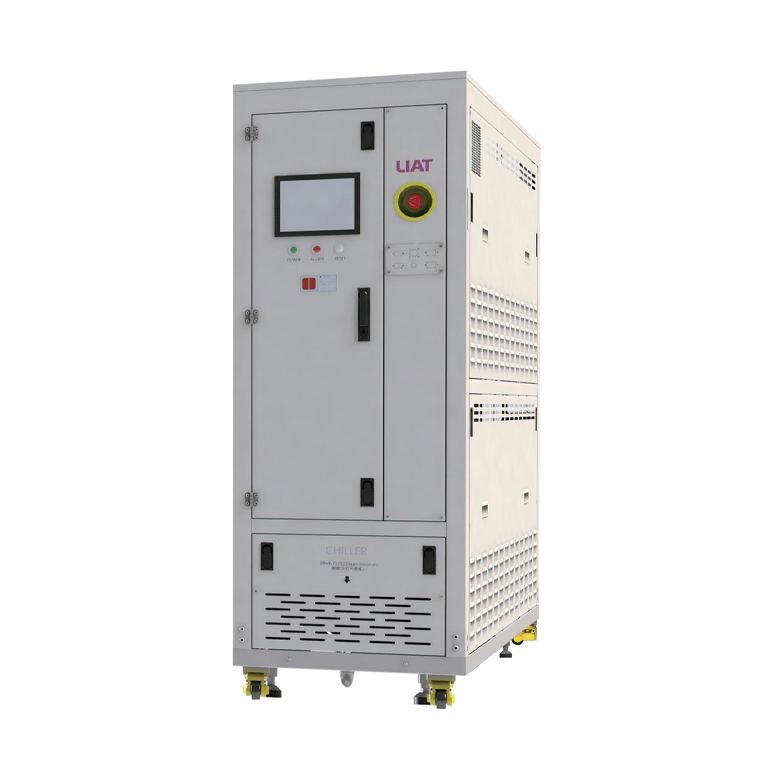
During a high-current discharge test, a battery pack is not simply delivering electrical energy; it is also releasing heat that must be removed under a controlled, repeatable condition. An EV battery testing chiller provides that coolant-side control. It circulates conditioned fluid through the unit under test, absorbs heat from the battery thermal-management loop, and rejects that heat through its own refrigeration and heat-exchange system. The aim is not to claim a single temperature outcome for every pack. It is to reproduce the commanded coolant condition while the heat load rises and falls with the discharge profile.
An EV battery testing chiller is relevant here because from a thermal-management engineer’s perspective, the important question is not just “What temperature should the chiller hold?” A useful test setup starts with the expected heat generation, discharge current, coolant circuit volume, target temperature range, required flow, allowable pressure drop, and the response expected during transients. Those conditions determine whether an industrial chiller is being evaluated as part of a credible battery test bench rather than as an isolated cooling appliance.
Why High-Discharge Testing Creates a Moving Heat Load
An EV battery testing chiller is relevant here because electrical losses inside cells, interconnects, busbars, and associated hardware become heat during discharge. At a modest, steady current, the coolant loop may see a comparatively stable load. Under a demanding drive-cycle simulation or high-rate discharge sequence, current can change quickly. The heat that reaches the coolant loop can therefore change in both magnitude and timing.
For this reason, the EV battery testing chiller is usually treated as a controlled heat sink and fluid-conditioning unit. It needs to remove heat at the rate demanded by the test, but it also needs stable sensing, a control response suited to the profile, and connections that do not distort the behavior being measured.
How the Coolant Loop Is Controlled During the Test
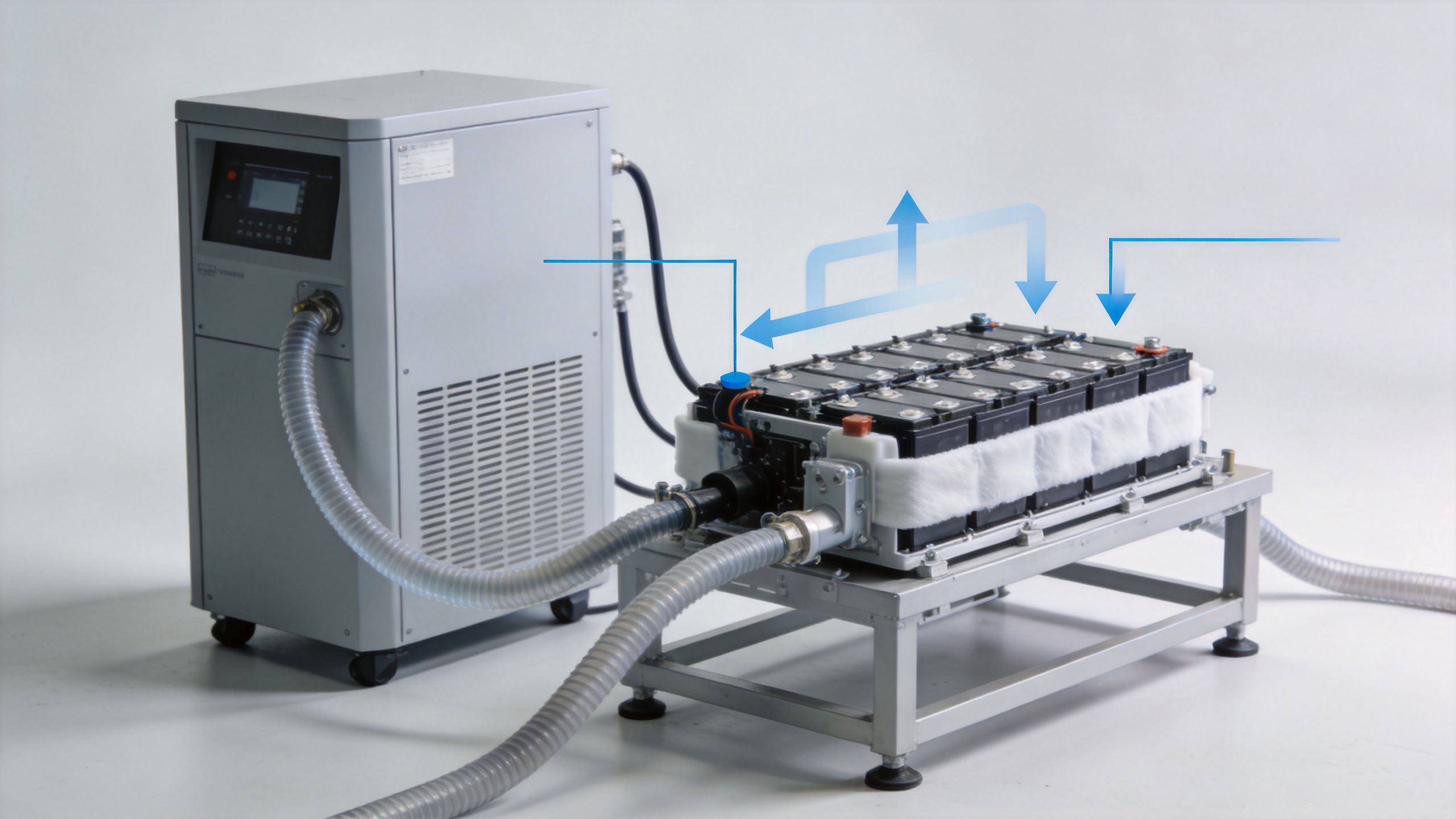
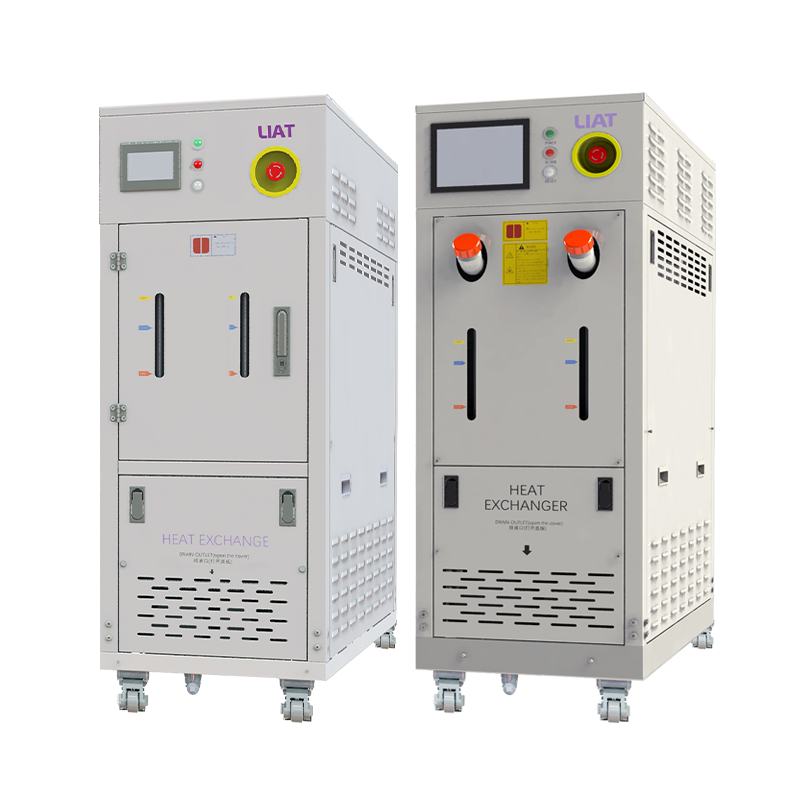
An EV battery testing chiller is relevant here because in a typical indirect loop, conditioned coolant leaves the chiller, passes through hoses, manifolds, and the battery’s cooling passages, then returns warmer. The chiller measures one or more loop temperatures and uses its heat exchanger and refrigeration circuit to pull energy from the returning fluid. The cooled fluid is then sent back to the battery circuit at the required setpoint or programmed profile.
This is different from an environmental chamber. A chamber principally controls the air surrounding the cell, module, or pack. Coolant-side equipment controls the fluid flowing through the battery thermal-management circuit. Both may be needed in one test, yet they answer different questions. Chamber control can create an ambient condition, while an EV battery testing chiller can apply and measure coolant temperature, flow, and circuit behavior closer to the pack’s normal thermal connection.
How the System Responds When Discharge Heat Climbs
1. It Detects a Fluid-Boundary Change
An EV battery testing chiller is relevant here because as the battery returns warmer coolant, sensors reveal a shift in return temperature, supply temperature, or both. The useful measurement location depends on the test objective. If the requirement is a controlled inlet temperature at the battery, supply sensing and line losses deserve particular attention. If the objective includes energy balance, the test plan may also need return temperature and flow data.
2. It Adjusts Heat Removal
An EV battery testing chiller is relevant here because the control system changes refrigeration output, compressor staging or modulation where available, and sometimes pump behavior or a bypass arrangement. The practical target is a controlled response with limited overshoot, oscillation, or lag for the stated test conditions. More accurately, that conclusion only applies after the coolant, control logic, and connections have been confirmed.
3. It Maintains Circuit Circulation
An EV battery testing chiller is relevant here because heat removal depends on both temperature difference and fluid movement. Insufficient flow can raise the coolant temperature rise across the battery and may create uneven cooling conditions. Excessive flow is not automatically useful either, because the battery loop may impose pressure-drop limits or the test may need to reflect a defined vehicle-side condition. The test team should specify a flow target, a pressure boundary, and the allowable variation around them.
4. It Rejects Absorbed Heat
Size an EV Battery Testing Chiller Around the Profile, Not Only Peak Current
An EV battery testing chiller is relevant here because high current is an important input, but it is not a direct cooling-capacity requirement by itself. The thermal duty should be estimated from expected heat generation and then checked against the full program: peak segments, duration, rest periods, starting temperature, ambient conditions, and likely heat soak in hoses and fixtures. Published EV test guidance similarly emphasizes discharge power, test current, and expected heat generation when selecting coolant-control equipment.
An EV battery testing chiller is relevant here because a sound review separates at least three questions:
- Peak heat removal: Can the EV battery testing chiller handle the highest expected thermal load for the specified interval?
- Transient response: Can it recover or track when the duty changes without obscuring the battery response?
- Steady repeatability: Can the loop return to the same supply condition across repeated cycles under comparable facility conditions?
An EV battery testing chiller is relevant here because these checks avoid a common mistake: specifying target temperature without documenting heat-load variation. In battery testing, a setpoint is only one part of the boundary condition.
Variables to Verify Before Commissioning
An EV battery testing chiller is relevant here because before running an aggressive discharge schedule, a test engineer can use the following checklist to turn a broad cooling request into testable requirements:
- The equipment must match the battery format and test level: cell, module, pack, or vehicle subsystem.
- For an EV battery testing chiller, document the discharge profile, maximum current, segment duration, and repeat count.
- Expected heat generation or a justified preliminary heat-load estimate.
- An EV battery testing chiller also requires the specified coolant type, concentration, compatibility requirements, and permitted contamination controls.
- Supply-temperature range, ramp requirement, stability band, and sensor location.
- Required flow, allowable pressure drop, hose dimensions, and connection type.
- Facility heat-rejection conditions and the instrumentation required for review.
- Interlocks, alarms, data logging, and the behavior required after a test interruption.
An EV battery testing chiller is relevant here because these are verification questions, not a universal specification. A cold-plate pack, an immersion test, and a chamber-only study may require different thermal boundaries. Stating those boundaries early makes it easier to distinguish a chiller limitation from a fixture, control, or facility-side issue.
Where an Industrial Chiller Fits in a Complete Test Bench
An EV battery testing chiller is relevant here because an industrial chiller is one part of the thermal system. It must work with the cycler, battery-management-system communication, safety controls, coolant conditioning hardware, instrumentation, and the physical test enclosure. A useful commissioning exercise is to run a controlled dummy load or a lower-energy profile first, then compare supply temperature, return temperature, flow, pressure, and electrical demand against the intended test sequence.
That staged approach can expose unexpected line heat gain, trapped air, unstable flow, or a control loop that needs tuning before a costly high-discharge test begins. It also creates a clearer record of what the EV battery testing chiller was asked to do. If later results differ, the team has a defined set of boundary conditions to review rather than relying on a nominal equipment label.
Key Takeaway
High-discharge battery testing turns cooling into a dynamic control problem. An EV battery testing chiller handles the heat by circulating conditioned coolant, absorbing energy from the battery loop, adjusting heat removal as the return condition changes, and rejecting that energy through its own thermal system. The quality of the result depends on the whole test boundary: heat profile, coolant, flow, pressure drop, sensor placement, controls, and facility heat rejection. When those conditions are documented and verified, the test bench can evaluate battery thermal behavior with a more defensible and repeatable coolant-side condition.
 Hot News